

Oq Mosque in Khiva: A Visitor Guide

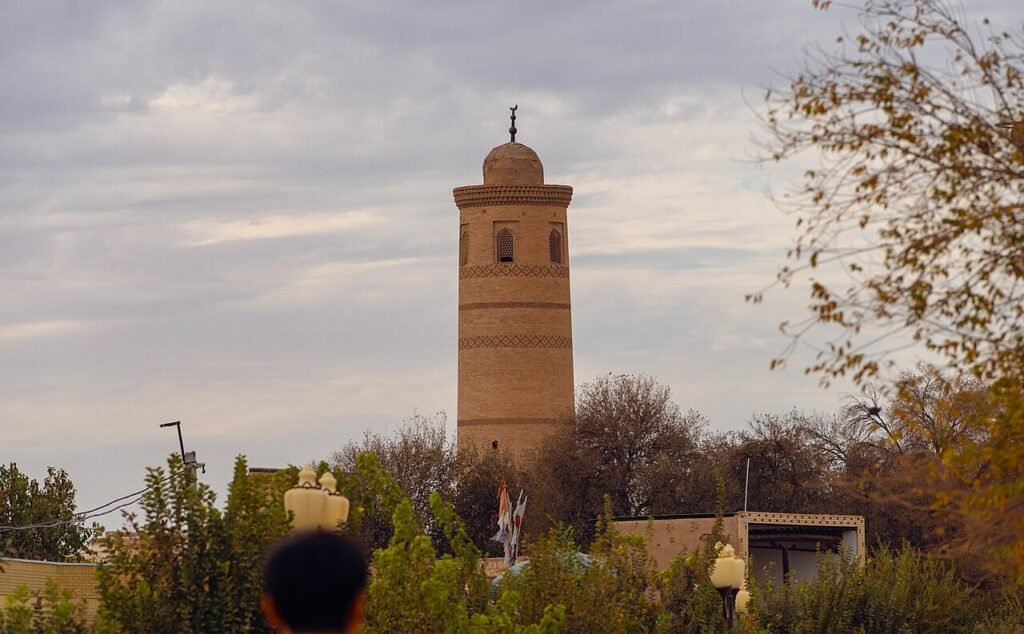
Ak Mosque (480997).jpg; by upyernoz from Haverford, USA (Ak Mosque), via Wikimedia Commons; CC BY 2.0.
Oq Mosque is one of Khiva’s smaller but more characterful monuments. Located in the eastern part of Itchan Kala, close to the Palvan Darvoza area and Tash Khauli Palace, it offers a useful contrast to Khiva’s monumental madrasas, soaring minarets and richly tiled gateways. The mosque’s name means “White Mosque”, a reference to its light-coloured appearance and restrained white plasterwork.
Why visit Oq Mosque?
Many visitors come to Khiva expecting every monument to announce itself through monumental portals and brilliant blue ceramics. Oq Mosque is different. It is a neighbourhood mosque, or guzār mosque, designed for regular daily prayer rather than for grand Friday congregations or royal display. Its scale is intimate, its decoration is selective, and its relationship with the surrounding streets is especially revealing.
The building also helps explain how historic Khiva worked as a lived-in city. Mosques, bathhouses, madrasas, palaces, markets and family houses stood close together inside the walled town. Oq Mosque formed part of the architectural setting around Tash Khauli and the eastern trading quarter, rather than standing as an isolated monument.
UNESCO lists Oq Mosque among the important monuments of Itchan Kala, the inner fortress of Khiva. The World Heritage site contains a dense mixture of monumental buildings and traditional domestic architecture, making a walk through the old city as important as any single stop.
History and changing dates
The history of Oq Mosque is best understood as a sequence of building phases. Heritage descriptions connect an early foundation with the period of Anush Khan, when the nearby Anush Khan bathhouse was established. Some heritage accounts date the mosque’s earlier structure to the seventeenth century, while the present building is generally associated with a major construction or rebuilding campaign in 1838–1842 during the Kungrat period.
This distinction matters. A date of 1675 can refer to an earlier mosque or foundation on the site, whereas the doors and surviving architectural form point to the nineteenth-century building visible today. Rather than treating the dates as an absolute contradiction, it is more accurate to describe Oq Mosque as a monument with an older base and a later completed structure.
The carved wooden doors provide particularly valuable evidence. They are associated with Khivan craftsmen, including masters identified in heritage descriptions as Qalandar and Nur Muhammad. Their work reflects a local tradition in which craftsmanship could be concentrated on a few architectural elements rather than spread across an entire façade.
Architecture and artistic details
Oq Mosque consists of a compact domed prayer room surrounded on three sides by a shaded aivan, or covered porch. This arrangement responds well to Khiva’s hot, dry climate. The aivan creates a cooler transitional space between the street and the prayer hall, while the central room provides a more enclosed setting for worship.
The prayer chamber is almost square, measuring approximately 6.3 by 6.35 metres. Its white hemispherical dome rises above a square base, creating a stepped profile that can be noticed from nearby rooftops and streets. The interior is deliberately calm: white plaster, timber elements and filtered light take precedence over colourful tile mosaics.
Wooden columns support the aivan, but they are not overloaded with deep carving. Their restrained appearance is part of the building’s character. Look instead at the relationship between the columns, the porch roof and the central volume. The composition is balanced and practical, with the porch helping to define the mosque’s façade without turning it into a theatrical monument.
Doors, windows and plasterwork
The most intricate details are concentrated around the entrances. The wooden doors feature carved vegetal and islimi-style patterns, together with decorative borders and inscriptions or inscription-like designs. The windows use ganj latticework, allowing daylight and air to enter while softening the brightness of the Khivan sun.
The south wall contains the mihrab, the prayer niche oriented towards Mecca. Its position reflects the mosque’s carefully planned orientation and allows worshippers in both the enclosed room and the adjoining porch to face the same direction.
What to notice during your visit
- The white surfaces: Notice how the plastered walls and dome create a quiet visual identity distinct from Khiva’s blue-and-turquoise tilework.
- The three-sided aivan: Read the porch as both a climatic feature and a social threshold between the street and the prayer hall.
- The carved doors: Spend time with the details around the entrances, where the finest ornamental work is concentrated.
- The compact dome room: Look at how arches and structural transitions expand the square chamber beneath the dome.
- The urban setting: Step back and observe how closely the mosque relates to nearby houses, lanes and larger monuments.
Oq Mosque is particularly rewarding for visitors interested in conservation, traditional building methods and the everyday religious architecture of Central Asia. It shows that historic Islamic architecture is not only a story of monumental scale; it is also a story of proportion, shade, craft and neighbourhood life.
Planning your visit
Oq Mosque lies within the pedestrian-oriented historic centre of Khiva. Most visitors reach it on foot while exploring the eastern side of Itchan Kala. It works well as part of a route beginning near the Palvan Darvoza entrance and continuing towards Tash Khauli, the Allakuli Khan trading area and the city’s other eastern monuments.
Allow around 15–25 minutes for the mosque itself, or longer if you are interested in architectural photography and timber detail. Because the site is modest, it is best visited slowly: examine the doors, compare the shaded porch with the enclosed prayer room, and look for the way the building fits into the surrounding urban fabric.
Opening arrangements, ticketing, access to the interior and photography rules may change. Some historic religious buildings in Khiva are viewed from the exterior or may have limited access depending on conservation work, religious use or local management. Check conditions shortly before your visit and follow any instructions from caretakers.
Etiquette and practical advice
- Dress respectfully, with shoulders and knees covered.
- Keep voices low, especially if worshippers are present.
- Ask before photographing people, prayer activity or interior details.
- Do not touch carved doors, plasterwork, lattice windows or painted surfaces.
- Wear comfortable shoes for uneven historic paving and bring water in hot weather.
Accessibility is likely to be limited by historic thresholds, uneven surfaces and the compact layout. Visitors with mobility concerns may find the exterior and approach easier than the full interior. Ask locally about current conditions, as access can vary.
What to see nearby
Oq Mosque can be combined with several of Khiva’s most important eastern monuments. Tash Khauli Palace offers a striking contrast in scale, with courtyards, reception spaces and extensive tilework. Nearby, the Allakuli Khan Madrasa and trading quarter helps place the mosque within the commercial and institutional life of nineteenth-century Khiva.
For a very different religious atmosphere, continue towards the Juma Mosque, whose dim interior and forest of carved wooden columns represent another important strand of Khivan mosque architecture. The contrast between Juma Mosque’s hypostyle hall and Oq Mosque’s compact domed room is one of the most useful comparisons to make in Itchan Kala.
If you have time for a broader architectural circuit, include the city walls and watchtowers, then return through the lanes in the softer light of late afternoon. Khiva is most rewarding when its monuments are understood as parts of one connected historic town.
Frequently Asked Questions
Where is Oq Mosque in Khiva?
Oq Mosque is in the eastern part of Itchan Kala, near the Palvan Darvoza area and close to Tash Khauli Palace and the Allakuli Khan trading quarter.
What does “Oq Mosque” mean?
“Oq Mosque” means “White Mosque”. The name reflects the building’s light-coloured plastered surfaces and white dome.
When was Oq Mosque built?
The surviving building is generally dated to 1838–1842, while the site may preserve an earlier foundation associated with the seventeenth century. The safest description is a mosque with an older base and a nineteenth-century completed structure.
Can visitors enter Oq Mosque?
Access can depend on current conservation work, religious use and local management. Check on arrival, follow caretaker instructions and do not assume that interior access or photography will always be available.
Sources and further reading
- UNESCO World Heritage Centre: Itchan Kala
- Meros.uz: Oq Mosque in Khiva
- Meros.uz: Itchan Qal'a heritage overview
- whc.unesco.org
- meros.uz
- uzbekistan.travel
Featured image: Ak Mosque (480997).jpg; by upyernoz from Haverford, USA (Ak Mosque), via Wikimedia Commons; CC BY 2.0. The image may be automatically resized or cropped for display.



2 Comments
[…] Oq Mosque, a quieter architectural stop that helps show the range of religious buildings within the old city. […]
[…] Near Palvan Darvaza stands the modest but distinctive Oq Mosque, a neighbourhood mosque associated with the eastern gate. Its whitewashed appearance, domed prayer hall and surrounding aivan galleries make a useful contrast with the grander tiled monuments elsewhere in Itchan Kala. The mosque’s restrained decoration places emphasis on proportion, carved wood and the calm quality of its small courtyard. You can continue reading with our Oq Mosque in Khiva visitor guide. […]