

Tashkent TV Tower: Visitor Guide to the City’s Skyline Landmark
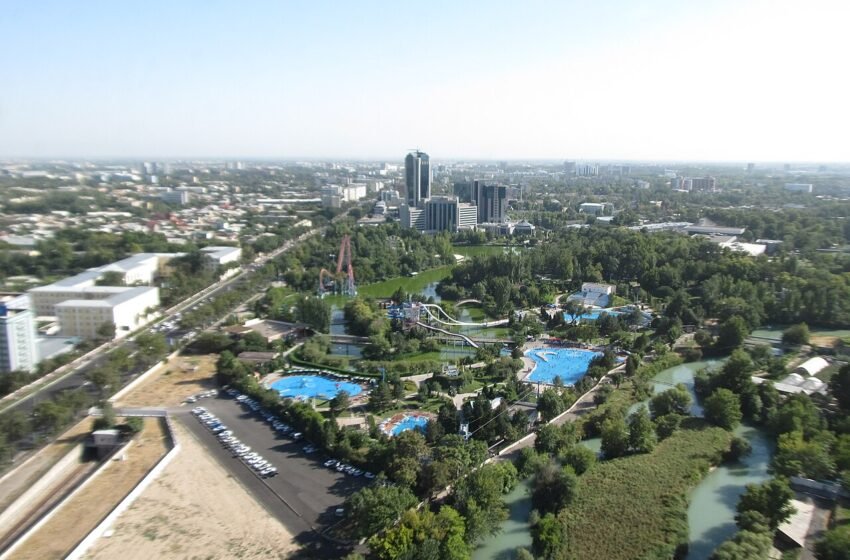
Photo: Vlad chernenko / Wikimedia Commons. CC BY-SA 3.0. Source: https://commons.wikimedia.org/wiki/File:%D0%A2%D0%B0%D1%88%D0%BA%D0%B5%D0%BD%D1%82%D1%81%D0%BA%D0%B0%D1%8F_%D1%82%D0%B5%D0%BB%D0%B5%D0%B1%D0%B0%D1%88%D0%BD%D1%8F_%D0%B2%D0%B8%D0%B4_%D0%B8%D0%B7_%D0%BE%D0%BA%D0%BD%D0%B0_%D1%80%D0%B5%D1%81%D1%82%D0%BE%D1%80%D0%B0%D0%BD%D0%B0.JPG License: https://creativecommons.org/licenses/by-sa/3.0
The Tashkent TV Tower is one of the Uzbek capital’s most recognisable landmarks: a slender, open steel structure rising 375 metres above the city. It is still a working broadcasting centre, but visitors can also ride up to a panoramic observation level and the revolving Koinot restaurant. The tower offers a useful introduction to Tashkent’s modern identity, where Soviet-era engineering, seismic design and contemporary city life meet.
Why visit Tashkent TV Tower?
Many of Tashkent’s historic attractions are low-rise monuments, courtyards and tree-lined avenues. The TV Tower gives you a different perspective. From around 100 metres above ground, the city opens into a broad urban panorama: dense neighbourhoods, green belts, major roads and the distant outlines of the Tashkent region.
The view is especially valuable early in a Tashkent itinerary because it helps you understand the capital’s scale. On a clear day, look for the contrast between the central city’s broad avenues and the lower, more spacious districts beyond it. The experience is less about identifying every building than about seeing how the capital has expanded around its older core.
The tower is also an architectural attraction in its own right. Its triangular supports and lattice frame create a striking silhouette from ground level, while the changing angles of the structure become more apparent as you approach the entrance. At night, illumination makes it one of the city’s most visible urban markers.
History and design
Construction began in 1978 and the tower was commissioned in January 1985. It was designed by architects Nikolai Terziev-Tsarukov and Yuri Semashko, together with engineers including Evgeny Morozov and Mikhail Musheev. The project responded to the need for a larger broadcasting centre capable of serving Tashkent and surrounding areas.
Official tourism and municipal accounts describe the tower as originally associated with a project intended for Baghdad before it was adapted for Tashkent. The detail is often repeated in local histories, although the wider design story is best understood as part of the ambitious late-Soviet development of communications infrastructure across Central Asia.
The tower’s most impressive achievement is not simply its height. Engineers designed it for a seismically active region, using three large supports, a central shaft and a flexible structural system. Official descriptions state that the structure was designed to withstand earthquake forces of up to nine points. The tower’s metal framework weighs more than 6,000 tonnes and stands on a deep foundation.
Its broadcasting role remains important. The antenna and technical sections occupy much of the tower’s height, while visitor facilities are concentrated at lower levels. This combination of infrastructure and public access is characteristic of major television towers around the world: a working communications facility that also becomes a symbol of the city it serves.
What to see inside
The lobby mosaic and tower models
Before taking the lift, pause in the entrance area. The lobby contains a large decorative mosaic panel and displays of famous television towers from around the world. These details are easy to overlook if you are focused only on reaching the observation deck, but they provide useful context for the tower’s place in international broadcasting architecture.
The observation level
The visitor route rises rapidly by high-speed lift to an observation area at approximately 100 metres. The viewing space is the main reason most travellers come, and it is best enjoyed slowly rather than treated as a quick photo stop. Move around the windows to compare different directions of the city, and allow extra time if you are visiting at sunset or after dark.
Koinot revolving restaurant
Above the observation area is Koinot, whose name means “space” or “cosmos”. The restaurant’s seating platform turns gradually around the tower, allowing diners to see a changing panorama without leaving their table. Official descriptions refer to two halls, traditionally presented in national and European styles, with capacity for roughly 120 guests in total.
Restaurant availability, menus, reservations and operating arrangements can change. If dining is important to your visit, confirm the current arrangements directly before travelling rather than assuming that a table or full revolving service is guaranteed.
Planning your visit
The tower stands at 109 Amir Temur Avenue in the Yunusabad District, near the Shahriston and Bodomzor metro stations. The city’s visitor information portal currently lists opening hours of 10:00–20:00, but hours, admission arrangements and access conditions may change for maintenance, official events or operational reasons. Check shortly before your visit.
- Allow time: Plan approximately one to two hours, longer if you intend to eat at Koinot or wait for better visibility.
- Choose the weather carefully: Haze can soften the panorama. Clear mornings and evenings often provide the most attractive light.
- Bring identification if requested: As the tower remains an operational communications facility, visitors may pass through controlled entry procedures.
- Photography: Municipal information indicates that photography and video restrictions have been relaxed, but follow staff instructions and any signs in operational areas.
- Accessibility: Visitors use lifts for the ascent, but the precise route, seating, toilets and assistance available for wheelchair users or visitors with reduced mobility should be confirmed in advance.
- Families: The lifts, height and city view are appealing to older children, though adults should supervise children carefully around windows, queues and restaurant seating.
For a broader introduction to the capital’s attractions, combine the tower with our Independence Square in Tashkent guide or the guide to Amir Temur Square and Museum. Travellers interested in the city’s transport and design can also explore Tashkent Metro, whose decorated stations offer a very different expression of the capital’s architectural culture.
Nearby ideas
The TV Tower is in northern-central Tashkent, an area suited to a half-day combining modern landmarks, parks and cultural sites. Depending on your route, you can continue towards the memorial and literary spaces around the city’s northern districts, or return towards central Tashkent for museums, theatres and squares.
For a contrasting experience, visit the Minor Mosque, where pale stone, open courtyards and contemporary Islamic design create a calmer visual rhythm. Alternatively, continue to a market district such as Chorsu Bazaar for food, ceramics, dried fruit and everyday city life. The tower is best understood not as an isolated attraction but as one point in a wider journey through Tashkent’s Soviet, Islamic and contemporary layers.
Frequently Asked Questions
How tall is Tashkent TV Tower?
The tower is 375 metres high. Visitors do not go to the summit; the public route reaches an observation area at approximately 100 metres, with the restaurant located slightly higher.
Can visitors go inside the tower?
Yes. The tower has a visitor route with guided or organised access, lifts, an observation area and the Koinot restaurant. Entry procedures and available services can vary, so verify current conditions before visiting.
Is the restaurant revolving?
Koinot is designed as a revolving restaurant, with seating that turns around the central tower shaft. Confirm opening, reservations and the current dining format in advance.
What is the best time to visit?
Late afternoon can combine daylight views with sunset and evening illumination, while a clear morning may offer sharper visibility. Weather and air clarity matter more than a fixed time of day.
Sources and further reading
- Tashkent City Administration: Tashkent TV Tower
- Uzbekistan Travel: Tashkent TV Tower
- Visit Tashkent: Tashkent TV Tower listing
- Government Directorate: Tashkent Television Tower
- visit.tashkent.uz
- visit.tashkent.uz
Featured photo: Ташкентская телебашня вид из окна ресторана.JPG by Vlad chernenko, Wikimedia Commons. CC BY-SA 3.0. Resized for display.



3 Comments
[…] Metro to see some of the capital’s celebrated underground architecture, or continue to the Tashkent TV Tower for a contrasting view of the modern […]
[…] you want to continue with Tashkent’s green and architectural contrasts, consider the Tashkent TV Tower for a view over the city, or use the Tashkent Metro to reach central districts and their […]
[…] day. The nearby Tashkent TV Tower provides a contrasting view of the city from above, while the Tashkent TV Tower visitor guide can help you plan the […]