
Itchan Kala in Khiva: Complete Guide to the Walled City

Photo: Bgag / Wikimedia Commons. CC0. Source: https://commons.wikimedia.org/wiki/File:Itchan_Kala_west_gate.jpg License: http://creativecommons.org/publicdomain/zero/1.0/deed.en
Itchan Kala is the fortified inner town of Khiva and one of Uzbekistan’s most concentrated architectural landscapes. UNESCO describes an enclosure of traditional houses, mosques, madrasas, mausoleums, palaces, caravanserais and markets protected by high earthen walls. Its value lies in the harmony of the complete townscape as much as in any single monument.
The inner city has a history spanning more than two millennia, although most prominent buildings visible today date between the seventeenth and early twentieth centuries. Understanding this layered chronology prevents a common mistake: imagining that every street and façade belongs to one unchanged medieval moment.
Walls, plan and gates
The enclosed area follows a roughly rectangular plan, elongated from south to north. UNESCO records dimensions of approximately 650 by 400 metres, with fortification walls rising as high as ten metres. Their rounded towers and sloping surfaces create Khiva’s powerful silhouette.
Ota Darvoza, Palvan Darvoza, Tash Darvoza and Bogcha Darvoza connect the inner city with surrounding Khiva. Enter through one gate and leave through another when possible. This simple route reveals how commercial, ceremonial and residential zones relate to the defensive perimeter.
An exceptional concentration of heritage
UNESCO identifies 51 historic monumental structures and about 250 dwellings within the property. Important buildings include the Juma and Oq mosques, the madrasas of Muhammad Amin Khan, Muhammad Rahim Khan and Allakuli Khan, Pahlavon Mahmoud Mausoleum, palaces, caravanserais and markets.
Traditional houses are equally important to the site’s authenticity. Courtyards, carved wooden columns, raised iwans and private living spaces show how domestic architecture responded to climate and social life. Be mindful that some lanes remain residential and are not merely routes between ticketed sights.
A logical walking route
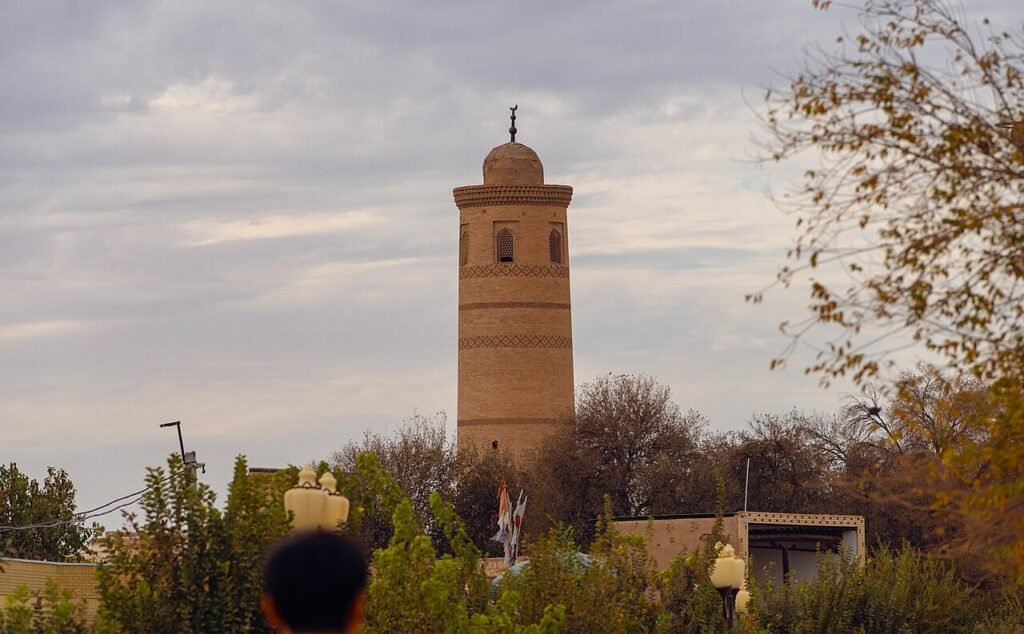
From Ota Darvoza, begin with Kalta Minor and the Muhammad Amin Khan Madrasa, then enter the Kunya-Ark. Continue along the main east-west street to the Muhammad Rahim Khan Madrasa and the Juma Mosque.
On a second circuit, explore Pahlavon Mahmoud Mausoleum, Islam Khoja, Tash Hauli Palace and the Allakuli Khan commercial ensemble near Palvan Darvoza. Then leave the central route and walk quieter side streets, where scale, doorways and domestic façades make the urban composition legible.
Viewpoints and timing
Elevated viewpoints may be available from the Kunya-Ark watchtower, Islam Khoja Minaret or sections near the walls, subject to current access. Each offers a different perspective: the watchtower frames Kalta Minor, while the taller minaret reveals the density of courtyards and domes.
Early morning is best for quiet streets and soft façades; late afternoon creates long shadows on the walls. Midday can be harsh and hot. Divide the visit into two sessions and use the central hours for shaded interiors, lunch or a museum. More planning advice is available in our Khiva travel guide.
Practical information
The core of Khiva is compact, but the concentration of monuments rewards an unhurried visit. An early start gives quieter streets and softer light; evening is ideal for seeing the walls and minarets change colour. Surfaces can be uneven and shade is limited in summer. A combined ticket may cover several museum-monuments, although inclusions can change, so verify the current arrangement at the official ticket office. Dress respectfully in mosques and mausoleums.
Before you go: Opening hours, ticket prices, restoration closures and photography rules can change. Confirm current conditions at the official ticket office, museum or your accommodation. Never climb on historic fabric, and ask permission before making close portraits of residents or vendors.
Frequently asked questions
When did Itchan Kala become a World Heritage Site?
It was inscribed on the UNESCO World Heritage List in 1990.
How large is the inner city?
UNESCO describes an area roughly 650 by 400 metres inside walls that reach about ten metres in height.
Do people still live inside Itchan Kala?
Yes. Traditional dwellings and residential life are part of the historic urban fabric.
Sources and editorial note
This independent guide was written in original language and fact-checked against the authoritative references below. It does not reproduce their text. Practical details should be rechecked close to the date of travel.
Featured photo: Itchan Kala west gate.jpg by Bgag, Wikimedia Commons. CC0. Resized for display.