

← All historic cities of Uzbekistan
Uzbekistan • City chronicles
The History of Tashkent
Tashkent is often a visitor’s first encounter with Uzbekistan, but its broad avenues conceal a much older city. Behind the capital’s stations, government buildings and apartment districts lies the history of an irrigated oasis, a trading settlement, an Islamic centre and a colonial administrative capital. Earthquakes and rebuilding changed its appearance without erasing every earlier layer.
The city is best understood by moving between those layers. Chorsu and the old neighbourhoods preserve one pattern of urban life; the streets east of the Anhor canal reveal another; the metro and reconstructed squares tell a twentieth-century story. Modern Tashkent grew from all three.
At a glance: Tashkent through time
- Antiquity: settlements develop in the Chirchiq oasis; Chach becomes an important regional name.
- Eighth century: Arab conquest brings the oasis into the expanding Islamic world.
- Medieval period: Shash and later Tashkent appear in the region’s political and commercial history.
- Early nineteenth century: the city comes under the Kokand Khanate.
- 1865: Russian forces conquer Tashkent.
- 1930: Tashkent becomes the capital of the Uzbek Soviet Socialist Republic.
- 1966: an earthquake triggers an extensive reconstruction programme.
- 1977: the first section of the Tashkent Metro opens.
- 1991: the city becomes the capital of independent Uzbekistan.
Chach, Shash, Binkath and the name Tashkent
The changing names associated with Tashkent describe a long history of languages, political authority and settlement. Chach referred to an oasis region and its principal urban centres; Shash was a form familiar in Arabic writing. Binkath appears in medieval accounts of the town that developed within that region. The later Turkic name Tashkent, commonly understood as stone city, gradually became dominant. These names do not mark the repeated disappearance of one population and its replacement by an entirely unrelated people.
The distinction between the city and the wider oasis is particularly important. Medieval authors sometimes used a name for both, while neighbouring settlements had names that look similar in modern transliteration. Binkath should not be confused with Banakath, a separate town near the confluence of the Angren and Syr Darya rivers. A small difference in spelling can conceal a substantial difference in location and historical function. Maps and geographical descriptions are therefore as useful as lists of dynasties.
Tashkent’s current administrative boundaries also encompass land that once belonged to separate settlements, agricultural areas and routes. An ancient archaeological site within the modern metropolis was not necessarily the exact centre of every later version of the city. Urban development can move, expand and reorganise itself while preserving connections with earlier occupation. The modern capital has absorbed several parts of this historical landscape.
For visitors, the names provide a way to read that process. A museum label mentioning Chach may refer to the early oasis rather than to a standing monument. A scholar called Shashi carries a geographical association that does not identify the exact building in which he studied. The word Tashkent in a later chronicle belongs to a different political and linguistic setting. Following those distinctions makes the city’s long chronology more precise without reducing it to a single disputed birthday.

The Chirchiq oasis and the meeting of town and steppe
Tashkent developed in a favourable position between irrigated agricultural land and routes reaching towards the steppe and the western Tian Shan. Water from the Chirchiq system supported cultivation, while surrounding landscapes provided access to different resources and forms of livelihood. The city’s history grew from this meeting of environments. It was neither purely an agricultural town nor simply a stopping place for distant caravans.
Settled farmers and mobile pastoral communities exchanged products that the other needed. Grain, textiles and manufactured goods could move in one direction, while animals, animal products and other resources moved in another. Political relationships were not always peaceful, but commerce and practical cooperation continued alongside conflict. The town’s position near the steppe helped make it valuable to successive rulers seeking influence over northern routes.
Water management underpinned the urban economy. Channels supplied fields, gardens and neighbourhoods, and their maintenance required collective work. The location of cultivated land influenced where people settled and how routes developed. A canal could serve as a practical source of water, a boundary and a reference point in the city’s geography. Later planning did not erase all of those relationships, even where modern roads and buildings transformed the surroundings.
The Anhor canal is especially useful when reading later Tashkent, but it should be understood within this longer history of a managed water landscape. Modern embankments and recreational uses are recent layers. Behind them lies the dependence of the oasis on the distribution and control of water. The city’s greenery is therefore not merely decoration around a capital. It belongs to an environmental history that connects ancient settlement, imperial planning and contemporary urban life.
Archaeology before the monumental city
The early history of Tashkent is often easier to understand through archaeological sites and museum objects than through standing architecture. Shashtepa and Ming Urik preserve evidence for stages of settlement that precede the best-known Islamic monuments. Other sites in the wider region, including Kanka, help reconstruct a more extensive urban and political landscape. They are not interchangeable examples of one ancient town.
Ming Urik is particularly striking because its surviving remains stand within a modern city. The contrast between archaeological material and contemporary buildings makes the depth of occupation visible. Excavation can reveal parts of earlier structures, surfaces and objects, but the surviving area is only a fraction of the historical settlement. It should not be mistaken for a complete plan of early Tashkent or for an untouched ruin that has simply remained exposed since antiquity.
Coins, pottery and architectural fragments answer different questions. A coin can indicate political authority, economic exchange or a script in use. Pottery can help establish the sequence of occupation and connections with other production centres. A fragment of decorated architecture may reveal artistic practices without identifying every aspect of the room from which it came. The evidence becomes stronger when these forms are studied together.
Archaeological interpretation also changes as new evidence is found. Official anniversaries and popular histories often simplify a complex sequence into a single age. That can be useful for commemoration but should not replace the distinctions between first occupation, urban development and later political prominence. Tashkent’s antiquity does not require every historical question to have a final numerical answer. The surviving evidence already establishes a much older city than the modern avenues initially suggest.
Chach in the early medieval world
In the early Middle Ages, Chach belonged to a Central Asian world of oasis principalities, regional rulers and connections with Turkic political powers. Local elites negotiated their position among larger forces rather than governing in isolation. Trade, diplomacy and marriage could link ruling groups, while military pressure altered the balance between them. The oasis’s location near routes into the steppe gave those relationships particular importance.
The region participated in the wider cultural environment often associated with Sogdian trade and urban life. Goods and ideas moved through networks that crossed political boundaries. Religious practice was varied before the consolidation of Islam, and material evidence can reveal different traditions without providing a complete picture of every community. A single object should not be used to assign one uniform identity to the entire population.
Local production mattered alongside exchange. A town needed food, tools, building materials and skilled labour. Its prosperity depended on the relationship between cultivated land and markets as well as on traffic from far away. The modern phrase Silk Road can help connect Chach with other regions, but it can also make everyday economic activity disappear behind a story of luxury caravans. The historical city functioned at several scales simultaneously.
The written sources for this period are uneven, and many descriptions were produced outside the oasis. Their names and categories reflect the interests of the authors. Archaeological evidence can complement them but does not always resolve every uncertainty. The most responsible account presents early Tashkent as part of a connected and changing region while avoiding an invented sequence of precise events where the surviving record is incomplete.

Arab conquest and the formation of Islamic institutions
Arab campaigns reached Chach in the early eighth century as part of the expansion into Transoxiana. The process involved military force, agreements and continuing resistance across the region. Capturing a town and establishing durable authority were different achievements. The political landscape did not become stable simply because a chronicler recorded a successful campaign.
Islamisation unfolded over generations. Public institutions, religious teaching and legal practices changed, while languages and local customs continued to develop. The presence of a mosque signalled a new place for collective worship and public authority, but it did not tell the whole story of household belief. A gradual account is more useful than imagining that every inhabitant adopted the same practices at the same moment.
As the city became part of the wider Islamic world, scholarly and commercial connections expanded in new directions. Students and teachers could travel between Central Asian towns and centres further west or south. Books, legal traditions and religious reputations moved along those routes. Local institutions drew prestige from participating in networks that extended far beyond the oasis.
The later importance of Islamic scholarship in Tashkent grew from this accumulated development. It should not be projected unchanged into the first years of Arab conquest. Nor should Islamisation be treated as the end of the region’s earlier history. The city’s agricultural economy, languages and relationships with the steppe continued to shape its development within the new political and religious framework.
The medieval town, its suburbs and commercial life
Medieval urban descriptions distinguish fortified centres, citadels and suburban areas in ways that help explain how towns functioned. Binkath, associated with Tashkent, developed as more than a compact enclosure around a ruler’s residence. Markets, workshops and residential areas extended the practical city beyond its most strongly defended spaces. The growth of suburbs reflected economic activity and population as much as formal planning.
The organisation of a town could change as commerce expanded. A road leading to a gate might attract shops and workshops; a religious institution could encourage settlement around it; access to water could determine where particular activities were practical. The resulting urban form was produced through repeated decisions by many people. It was not necessarily designed at one moment by a single ruler.
Tashkent’s northern connections remained important under successive dynasties. The city linked the settled centres of Transoxiana with routes towards other oasis towns and the steppe. That position could bring revenue and influence, but it also exposed the city to political competition. Rulers who controlled Tashkent gained a strategic asset beyond the value of its immediate agricultural land.
The surviving old neighbourhoods do not preserve a complete medieval plan. Later damage, reconstruction and expansion changed the city repeatedly. Nevertheless, the relationship between narrow residential lanes, larger commercial routes and religious institutions helps visitors imagine how older urban life was organised. The value lies in understanding a pattern of relationships, not in assuming that every wall along a lane has stood unchanged for a thousand years.
Kaffal Shashi and the Khast Imam tradition
Abu Bakr Kaffal Shashi, a scholar associated with the tenth century, occupies a central place in Tashkent’s religious memory. His geographical name connects him with Shash, while his scholarly reputation belongs to the wider Islamic world. Like many learned figures of the period, he should be understood through networks of study and teaching rather than through one local building alone.
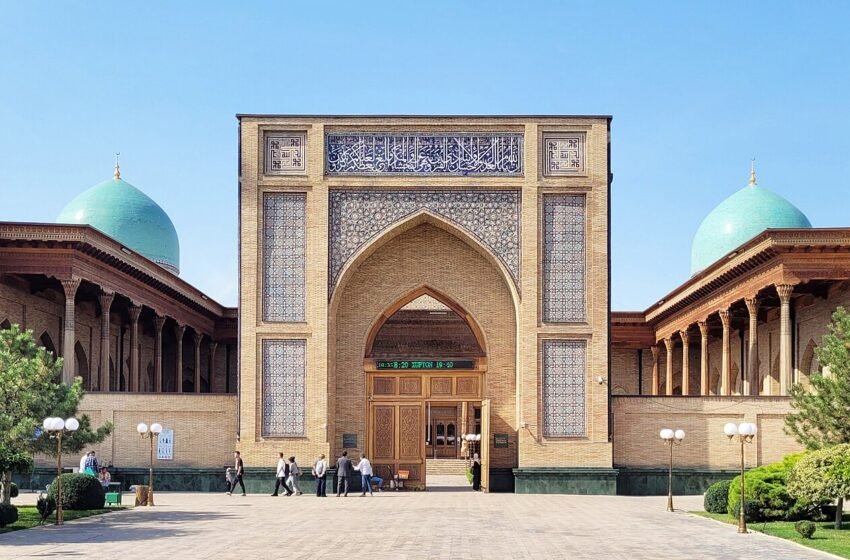
The Khast Imam ensemble developed around this memory through later generations of patronage. A shrine can preserve an early association while the architecture surrounding it belongs to several subsequent periods. The surviving mausoleum, madrasas, mosque buildings and modern additions should therefore be read separately by date and function. The age of the revered figure is not the construction date of the whole complex.
Such ensembles connect remembrance with institutions. Pilgrimage, teaching, worship and the preservation of manuscripts can occupy neighbouring spaces without being identical activities. Different visitors arrive for different reasons. Someone interested in a historic manuscript may share the precinct with a worshipper or a student. That coexistence is part of the place’s significance, not a complication to be ignored in a sightseeing itinerary.
The modern presentation of Khast Imam has also changed its urban setting. Open spaces and reconstructed elements affect how the ensemble is approached and photographed. A visitor can appreciate the current appearance while recognising that the precinct has not always looked exactly this way. Historical photographs, plans and careful local interpretation can help distinguish the inherited monuments from the most recent phase of redevelopment.
The Quran manuscript and the history of attribution
The famous Quran manuscript associated with the Muyi Muborak library is one of Tashkent’s best-known cultural treasures. It is traditionally linked with Caliph Uthman, an attribution that has played an important role in its religious and historical significance. The traditional identification and the scholarly dating of a manuscript are different kinds of claim. They should not be presented as automatically confirming one another.
Manuscript study considers script, materials, format and comparison with other examples. Early Quranic manuscripts can be difficult to date precisely, and their later histories may include gaps or contested accounts. A revered attribution can tell us much about the communities that preserved and honoured an object even where specialists do not accept a direct connection with the person named in the tradition.
The manuscript’s movement between places is another part of its history. Sacred and prestigious books could be taken, collected, transferred and returned under changing political regimes. Their location was connected with authority as well as scholarship. A manuscript now associated with Tashkent may have acquired that association through a long journey rather than through local production.
For visitors, the most productive approach is to appreciate both the object and the questions around it. Its scale, script and material survival are remarkable without requiring every popular claim to be accepted literally. Respect for its religious importance is compatible with careful historical explanation. The distinction allows the manuscript to be understood as a work of early Islamic book culture and as an object with a substantial later life in Central Asian memory.
Timurids, Yunus Khan and connections with the Fergana world
Tashkent’s history in the Timurid and later fifteenth-century world connects it with several competing centres of authority. Samarkand was the principal imperial capital under Timur, but cities such as Tashkent remained important for routes, resources and regional control. The story of the period cannot be reduced to the movement of one ruler’s court. Local institutions and populations continued to matter within a larger field of dynastic competition.
The mausoleum of Yunus Khan offers a surviving architectural connection with this late medieval political world. Yunus Khan belonged to the Chaghatayid sphere of Moghulistan and was the maternal grandfather of Babur. These relationships link Tashkent with the Fergana Valley and the wider history of the Timurid princes. The monument is therefore a useful place to connect a local site with people encountered in the histories of Andijan and Samarkand.
Family relationships had political consequences. Marriage connected ruling houses, created obligations and could strengthen a claim to support. Such connections did not guarantee peace. Princes and their relatives could cooperate in one campaign and compete in another. The history of Babur’s youth is full of shifting alliances, and Tashkent formed part of the regional geography in which those choices were made.
The surviving monument also raises familiar questions about preservation. Its present appearance reflects repair and the changing urban environment around it. It should be read in relation to neighbouring sacred sites and the older city, rather than as a detached object. The site helps explain a historical network of people and places that is much wider than its immediate surroundings.
The Shaybanid city: Kukeldash and Barak Khan
The sixteenth century brought Tashkent into the changing political order established by the Uzbek Shaybanids. Control of the city was valuable because of its northern position and commercial connections. It could serve as a regional seat of power within a larger dynastic state, while local rulers and elites pursued interests of their own. The relationship with Bukhara was therefore one of both integration and competition over time.
Kukeldash Madrasa, near Chorsu, is one of the most prominent architectural reminders of this period. Its position beside the commercial centre shows the close relationship between religious education and everyday urban life. Students, traders, worshippers and residents used overlapping routes. A madrasa was not placed outside society in a purely contemplative setting; it operated within a busy town and depended on resources drawn from that town and its wider region.
Barak Khan Madrasa, within the Khast Imam area, provides another important sixteenth-century connection. The two institutions occupy different urban settings and should not be treated as interchangeable examples of the same building. Their patrons, histories and later uses differ. Comparing them helps visitors see how educational architecture could participate in both a market-centred environment and a sacred precinct.
The surviving buildings have experienced damage, repair and changes of function. Their historical value does not depend on every brick being original. It depends partly on the continuity of the institution or site and partly on the evidence preserved in form, material and documentation. Responsible interpretation identifies those layers. A restored portal can communicate an earlier architectural composition while still requiring explanation of the later work that made its present appearance possible.
Four districts and the rule of Yunus Khoja
By the eighteenth century, Tashkent’s political life was shaped by powerful local interests and its position among competing regional states. The city is often described through four major divisions associated with different local leaderships. These districts were more than names on a plan. They represented social and political relationships within an urban population whose interests were not always unified.
Yunus Khoja emerged as a dominant figure in the late eighteenth century, bringing the divisions under a more consolidated authority. He should not be confused with Yunus Khan, the fifteenth-century figure commemorated by the mausoleum. The similarity of the names can obscure the considerable chronological distance between them. One belongs to the late medieval dynastic world; the other to Tashkent’s local political consolidation before its incorporation into Kokand.
The city’s ability to act independently depended on military resources, revenue and relationships with surrounding powers. Its position offered commercial advantages, but it also made Tashkent a target for rulers seeking control of the northern routes. Fortification and diplomacy were therefore closely connected with the practical requirements of maintaining local authority.
This period explains why the subsequent Kokand conquest was not merely a change of name at the top of a timeless administration. Tashkent had its own political experience and local elites. Incorporation into a larger khanate altered the balance between those interests and a court based in the Fergana Valley. The city’s later history continued to reflect its importance as a regional centre with an identity and economic life larger than a provincial outpost.
Tashkent under the Kokand Khanate
The Kokand Khanate brought Tashkent under its control at the beginning of the nineteenth century. Sources sometimes differ in the dating of particular stages of conquest and consolidation, which is why a simple early-nineteenth-century description is often more useful than treating one date as the complete explanation. The essential change was the extension of a Fergana-based ruling power over a major city beyond the valley.
For Kokand, the city supplied revenue, access to trade and a strategic position towards the steppe. Administration involved governors, military forces and relationships with local notables. Tashkent’s inhabitants encountered the khanate through taxes, obligations, appointments and the consequences of political conflict. The palace in Kokand and the streets of Tashkent belonged to different ends of the same structure of authority.
The khanate itself was not politically stable throughout the period. Succession struggles and competition among powerful groups affected its capacity to govern. Relations with Bukhara and the expanding Russian Empire added further pressure. Tashkent’s value made it an important prize in these struggles, while its population had reasons to seek security for trade and daily life that did not always align with the priorities of distant rulers.
This background is essential to understanding the Russian conquest of 1865. The event did not occur against a static political landscape. It followed a period of regional competition in which several powers and local groups pursued different interests. Recognising that complexity does not make the conquest less consequential. It explains why the transfer of power had different meanings for soldiers, officials, merchants, religious authorities and ordinary households.
The Russian conquest of 1865
Russian forces under Mikhail Chernyaev captured Tashkent in 1865 after fighting that brought the city under a new imperial authority. The conquest belonged to Russia’s wider expansion across Central Asia, but it also depended on the local military and political situation. The city’s defences, access to water, internal divisions and relations with Kokand all affected the campaign. A description of the event as a peaceful voluntary entry would conceal the use of military force and the loss of sovereignty.
Local responses were not uniform. Merchants interested in secure trade could assess the situation differently from military leaders or officials whose positions depended on the existing order. Religious authorities and neighbourhood leaders had their own concerns about security and the treatment of the population. Recognising these differences does not imply that all inhabitants freely chose the resulting political system. It shows how people attempted to respond to an event whose major decisions were often beyond their control.
The immediate aftermath required the establishment of a new administration. Military occupation and the development of a functioning colonial capital were different stages. Russia had to decide how to organise conquered territories and their populations. In 1867, Tashkent became the centre of the newly created governor-generalship of Turkestan, giving the city a role that extended far beyond its previous local importance.
This administrative status shaped Tashkent’s subsequent growth. Officials, soldiers, specialists and settlers arrived, and investment followed the needs of imperial government. The city became a base from which other parts of Central Asia were administered and studied. Its expanding institutions were inseparable from the unequal political order that produced them. Museums and surviving buildings from the period are therefore evidence of both urban development and colonial power.
Old city and new city: the colonial urban divide
The Russian imperial period produced a new administrative and residential district alongside the existing city. Broad streets, formal squares, civic buildings and European architectural references contrasted with the older pattern of lanes, courtyards, bazaars and religious institutions. This was not the founding of Tashkent. It was the addition of a colonial urban centre to a settlement whose history already extended across many centuries.
The division was social and political as well as visual. Access to institutions, services and authority was shaped by the colonial system. The new district housed important administrative functions and a growing settler population, while the old city retained many of its existing institutions and forms of daily life. Movement and exchange connected the two, but connection did not eliminate inequality. A simple description of two charming architectural styles misses the structure of power behind them.
The Anhor canal remains a useful reference point when thinking about this historical arrangement, although later growth has made the city much larger and more complex. Today’s roads and neighbourhood boundaries should not be projected unchanged onto the nineteenth century. The old-new distinction describes an important stage of development, not a permanent line that explains every part of contemporary Tashkent.
For visitors, comparing street widths, building orientation and the placement of public institutions can make the colonial history visible. A courtyard house organises privacy differently from a residence facing a planned avenue. A formal square communicates authority differently from a market crossing. These differences reflect social purposes as well as aesthetic preferences. Reading them together reveals how imperial planning sought to establish a recognisable administrative environment while operating beside an older urban society.
Railways, trade and the growth of a regional metropolis
Railway development connected Tashkent more closely with other parts of Central Asia and the Russian Empire. Lines reaching the city at the end of the nineteenth and beginning of the twentieth centuries altered the speed and scale of movement. Goods no longer depended entirely on older combinations of animal transport and regional roads. The railway changed where commercial activity concentrated and how people imagined distance.
Stations and associated facilities required land, workers and services. Warehouses, repair activities and new forms of employment developed around transport infrastructure. The city’s role as an administrative centre reinforced these changes, drawing in people with different occupations and backgrounds. Tashkent became a place through which officials, soldiers, merchants, students and migrants passed on journeys that connected the region to a larger imperial system.
The economic consequences were uneven. Improved transport could expand markets while also exposing producers to new competition and strengthening dependence on external demand. The growth of cotton-related commerce in Central Asia belonged to this wider transformation. A railway was therefore more than an achievement in engineering. It was part of a reorganisation of production, trade and authority whose benefits and costs were distributed differently across society.
The railway history also offers a useful counterpoint to the romantic image of the Silk Road. Tashkent’s importance did not end when caravan transport lost its former dominance. The city adapted to new networks and acquired new functions. Its modern stations, industrial areas and transport collections help tell a history of continuity through change: the meeting of routes remained important, while the technologies and political systems governing those routes were transformed.
The Romanov residence and imperial collecting
The residence associated with Nikolai Konstantinovich Romanov, built in 1891, is one of the most distinctive surviving buildings of imperial Tashkent. Its scale, decorative details and garden setting differ from the religious monuments of the old city. The building belongs to the history of a member of the Romanov family living far from the principal imperial capitals, and to the broader presence of Russian elite culture in Central Asia.
The residence should be interpreted within that context rather than treated as a picturesque building detached from politics. Elite collecting, patronage and the display of imported objects were ways of establishing identity and status. Collections could later contribute to public museums, acquiring a new meaning when removed from a private household. The history of an object in a museum may therefore include both artistic production and the circumstances under which it was collected.
Architectural labels applied to the building vary in popular descriptions. It is safer to examine its actual features and date than to make the name of a style do all the explanatory work. Brickwork, decorative treatment, openings and the relationship with the surrounding grounds reveal an approach very different from the inward-looking domestic architecture of the older mahallas. The contrast is part of Tashkent’s nineteenth-century transformation.
Its current function and access arrangements can change, so historical interpretation should be separated from practical promises about entry. A visitor can understand the residence’s place in the city’s development without assuming that every room is always open. The same principle applies to other administrative or diplomatic buildings: survival as a landmark does not automatically make a place an unrestricted museum.
A city of different faiths and communities
Tashkent’s population became increasingly varied through migration, imperial administration, trade and later Soviet policies. Muslim communities remained central to the city’s life, while Jewish, Orthodox Christian, Catholic and other communities developed institutions and places of worship. The resulting diversity was not produced by one event and did not mean that every group enjoyed the same position at every moment.
Religious buildings help make this history visible. Mosques and madrasas belong to different periods of Islamic urban life. Churches and other institutions reflect migration, patronage and the needs of communities established or enlarged under later regimes. Comparing them by date and function is more informative than presenting them as timeless symbols of coexistence. Their histories include closure, adaptation, restoration and changing legal conditions.
Language adds another layer. Uzbek, Russian, Tajik and other languages have occupied different roles in domestic life, administration, education and culture. A multilingual city does not necessarily divide into separate self-contained worlds. People can move between languages according to context, and institutions can change the language through which they operate. The history of schooling and publishing is especially important for understanding those shifts.
The city’s diversity also includes painful histories of forced movement and repression. Migration was not always voluntary, and the experience of refuge should not be confused with the experience of deportation. A careful account can recognise hospitality and cultural exchange while remaining clear about the coercive policies that brought some populations to Central Asia. Tashkent’s social history is richer when these different kinds of arrival are distinguished.
Jadid reform, newspapers and a new public conversation
At the beginning of the twentieth century, Tashkent became an important centre of reformist activity and publishing. Jadid educators promoted new methods of teaching and sought to broaden the subjects available to students. Their work was connected with developments elsewhere in the Russian Empire and the Islamic world, but it responded to local conditions as well. Reform was not simply imported from outside and applied unchanged.
Schools, newspapers, literature and theatre provided ways to discuss society’s future. Questions about education could become questions about language, authority, public responsibility and the relationship between religion and modern knowledge. The people participating in these debates did not all share one programme. Their positions changed as they encountered new ideas and as political opportunities opened or closed.
Tashkent’s position as a regional administrative and communications centre made it an important place for such exchanges. Printed material could reach readers beyond the city, while travel brought intellectuals into contact with other reformers. The development of a public conversation depended on practical resources: presses, paper, money, distribution and readers able to use the texts. Cultural change had a material infrastructure.
The later fate of many reformist intellectuals prevents a simple story of steady progress. Revolutionary change and Soviet repression transformed the conditions in which they worked. Some hopes for education and cultural renewal were realised in altered forms, while individuals and institutions suffered persecution. Their legacy should be understood through both achievement and loss. A monument or museum display commemorating a writer is often the endpoint of a much more difficult biography.
Revolution and the making of the Soviet capital
The revolutions of 1917 and the conflicts that followed ended the imperial order but did not immediately create a stable or equal political system. Tashkent was a major centre of revolutionary power in Central Asia, and struggles over representation and authority affected the wider region. The interests of local Muslim political movements, Russian-speaking workers, soldiers and other groups were not identical. The new order emerged through conflict as well as ideological claims.
The establishment of Soviet republics and the reorganisation of Central Asia changed the political map. Samarkand initially served as the capital of the Uzbek SSR before the government moved to Tashkent in 1930. The transfer reinforced Tashkent’s administrative role and helped direct further investment into institutions, industry and urban infrastructure. Its earlier position as the centre of Russian Turkestan had already created an extensive base for that development.
Soviet rule transformed property, education, religious institutions and public culture. Expanded schooling and new opportunities coexisted with coercion, political repression and restrictions on religious life. These were not separate histories affecting entirely separate cities. They shaped the same households and neighbourhoods in different ways. A family could benefit from access to education while also experiencing the loss of an institution or the persecution of a relative.
The physical city changed alongside these social transformations. New buildings and plans expressed the ambitions of a republican capital, while older areas were adapted or redeveloped. The modern appearance of Tashkent therefore began well before the 1966 earthquake. Understanding the earlier Soviet period prevents the disaster from becoming an overly convenient explanation for every wide street or twentieth-century building a visitor sees.
Wartime Tashkent: evacuation, work and refuge
During the Second World War, Tashkent received evacuees, industrial equipment and cultural institutions from parts of the Soviet Union threatened or occupied by German forces. The movement placed immense demands on housing, food and services. It also changed the city’s population and economy. Factories and specialists arriving under emergency conditions could remain important after the war, contributing to the growth of a larger industrial and educational centre.
The experience of refuge occupies a prominent place in the city’s memory. Families who had lost homes and relatives found shelter in Central Asia, and stories of local households caring for children have become especially significant. The Shamakhmudov family is widely commemorated for taking in children of different backgrounds. Such individual stories give human scale to a movement that is otherwise easily reduced to administrative statistics.
Hospitality should be understood alongside the practical difficulties of wartime life. Resources were limited, and local residents were themselves affected by military service, shortages and loss. Receiving large numbers of people required work by households, institutions and officials. Remembering that effort makes the history of refuge more substantial than a simple slogan about friendship. It was enacted through food, accommodation, care and daily decisions under pressure.
Cultural life also changed as writers, performers and other intellectuals arrived. Tashkent became a meeting place for people whose previous careers had unfolded elsewhere. The contacts formed during evacuation left traces in literature, theatre and personal memory. The wartime city was therefore both a place of emergency survival and a setting for exchanges that influenced its post-war identity.
The Alisher Navoi Theatre and a regional capital of culture
The Alisher Navoi Theatre is an important monument of Tashkent’s twentieth-century cultural history. Its development belongs to the creation of major performing institutions in Soviet Uzbekistan and to the architectural ambition of the republican capital. The building, completed in the post-war period, brought together a formal theatre programme and decorative references to the artistic traditions of different Uzbek cities and regions.
The theatre is particularly useful for understanding how a modern public building could incorporate regional craftsmanship. Carving, plasterwork and other decorative arts were placed within an institution whose function and organisation differed from a madrasa or palace. Tradition was not simply preserved in its previous setting; it was selected and adapted for a new cultural programme. The result belongs to both the history of Soviet architecture and the history of local artistic skills.
Its construction is also associated with the labour of Japanese prisoners of war. That fact should be acknowledged as part of the building’s history rather than absorbed into a purely celebratory story of international cooperation. The circumstances of wartime captivity differ from voluntary cultural exchange. A monument can represent artistic achievement while also preserving evidence of coercive labour and the aftermath of war.
As a functioning theatre, the building continues to support performance rather than serving only as an architectural exhibit. Audiences, musicians, stage workers and maintenance staff give it a present-day life. A visitor who attends a performance encounters a different aspect of its history from someone viewing the exterior. Both experiences can be valuable, provided the building is understood as an institution with a continuing function.
April 1966: disaster and the problem of reconstruction
The earthquake of 26 April 1966 caused extensive damage in Tashkent, particularly to vulnerable housing. Its impact cannot be understood only through a magnitude number. The depth and location of an earthquake, the condition of buildings and the density of occupation all affect the consequences. Large numbers of residents lost usable homes, and the city faced an urgent need for shelter and reconstruction.
The disaster became the starting point for a major Soviet rebuilding programme supported by workers and resources from across the union. New apartment districts, roads and public facilities transformed the scale of the capital. Reconstruction addressed immediate needs while also creating an opportunity for planners to implement ideas about modern urban life. Emergency recovery and long-term redevelopment became closely connected.
The result involved both gains and losses. New housing could provide services unavailable in older dwellings, while relocation altered neighbourhood relationships and familiar patterns of daily life. The disappearance of a lane or courtyard was not simply the removal of an obsolete structure; it could mean the loss of a social environment. Conversely, preserving a traditional appearance was not enough to solve problems of safety and infrastructure. The choices were practical as well as cultural.
The earthquake did not destroy every historic building, and reconstruction did not begin from a completely empty site. Imperial planning and earlier Soviet development had already shaped large parts of the city. Later redevelopment added further changes. A historically accurate account therefore treats 1966 as a major turning point within a longer transformation, rather than as the single event that explains all of modern Tashkent.
The Monument of Courage and public memory
The Monument of Courage commemorates the earthquake and the reconstruction that followed. Its composition connects a fractured block and the recorded moment of the disaster with a group representing a family. The surrounding reliefs refer to the collective work of rebuilding. The monument was created in the Soviet period, and its artistic language expresses ideas about resilience, protection and cooperation through recognisable human figures.
Commemoration selects particular meanings from an event. The monument emphasises courage and solidarity rather than attempting to document every damaged neighbourhood or every difficult decision made during reconstruction. That focus does not make it uninformative. It tells us how the disaster was publicly represented and what qualities the state and the artist sought to associate with the city’s recovery.
Visitors can compare this public narrative with the built environment around them. Housing districts, roads and surviving older structures provide other forms of evidence. Family memories may describe the same period through relocation, work and the rebuilding of everyday routines. The monument, the urban landscape and personal testimony answer different questions. Together they create a fuller history than any one of them alone.
The site also has a contemporary social life, including visits by residents and wedding parties. Such uses show how a memorial can become part of the ordinary geography of a city. Its meaning is not fixed entirely at the moment it was unveiled. Later generations encounter and reinterpret it, carrying the memory of the earthquake into a city that has continued to grow and change.
The metro: transport as architecture and civic display
The first section of the Tashkent Metro opened in 1977 after construction began earlier in the decade. It addressed the needs of a growing city while also becoming a major architectural project. Stations were conceived as public interiors with distinct decorative programmes. Marble, ceramics, lighting and structural form turned daily travel into an encounter with images of history, culture, science and civic ambition.
The stations are not all products of one design or period. Different lines and extensions reflect changing approaches, technologies and resources. Even within the older network, each station should be examined through its particular composition. A vaulted space, a row of columns and a mural organise the passenger’s experience differently. The practical requirements of circulation and safety exist alongside the visual programme.
Names and symbols have changed since independence. A current station name may not be the one under which the space first opened. Such changes make the metro a useful record of shifting public memory. Architecture can remain while the political meaning attached to it is altered. The network therefore offers a way to study continuity and reinterpretation within a functioning piece of infrastructure.
For visitors, the metro is most rewarding when treated as both transport and design. People using it for work or study are not extras in an underground museum. Observing the architecture without obstructing movement respects its primary function. The stations demonstrate that Tashkent’s heritage includes modern engineering and public art as well as older religious monuments.
Soviet modernism, mosaics and the everyday city
Tashkent’s late Soviet architecture includes hotels, cultural venues, administrative buildings, housing and major public interiors. Some structures are celebrated as individual landmarks, while others are encountered as part of an ordinary journey through the city. Together they form a substantial historical layer. The capital cannot be understood only through monuments that resemble those of Samarkand or Bukhara.
Mosaics and decorative panels placed art within everyday settings. They could celebrate labour, science, regional history or images of a modern society. Their visual language varied, and local artistic references were sometimes combined with a broader Soviet vocabulary. These works were produced for particular buildings and audiences. Removing a panel from its setting can alter its meaning even if the material object survives.
Housing districts also deserve historical attention. Apartment blocks, courtyards, schools and shops organised a different form of daily life from the older mahallas. Standardisation could accelerate construction, while local adaptations responded to climate and social practice. Residents subsequently changed and personalised these environments. The history of a district includes both the original plan and the ways people made it work over time.
Preservation debates around modern architecture differ from those surrounding an ancient mosque but are no less historical. A building may be familiar enough that its value is overlooked until it is altered or removed. Questions of use, maintenance and public attachment matter alongside stylistic appreciation. Tashkent’s modern layer is still close to living memory, which makes its interpretation both especially rich and sometimes contested.
Chorsu: a modern dome over an older commercial place
Chorsu is one of the best places to connect Tashkent’s long commercial history with its present-day life. The name evokes a crossroads, and the market area has remained important through substantial changes in buildings and urban form. The large dome familiar from photographs is a modern structure. It should not be described as a surviving medieval roof simply because the place around it has an older history.
The market’s continuity lies partly in activity. Food, spices, bread, produce and household goods draw residents as well as visitors. The range of products connects the city with agricultural regions and supply networks beyond it. A market is a working economic institution, requiring delivery, storage, cleaning, negotiation and repeated customer relationships. Its historical importance is visible in those routines as well as in its architecture.
The relationship with nearby Kukeldash Madrasa helps explain the older urban centre. Commerce, education, worship and housing developed close to one another. Their proximity is more informative than treating each sight as an isolated stop on a tour. A short walk can reveal changes in scale between the market, the main roads and the quieter residential lanes.
For photographers and visitors, ordinary courtesy improves the experience. Ask before making a close portrait and recognise that vendors are working. The market is not a staged reconstruction of the Silk Road. Its value lies in the continuation and adaptation of urban exchange within a changing capital. Understanding that adaptation gives Chorsu a place in both the city’s medieval history and its twentieth-century transformation.
Independence, renamed spaces and the contemporary capital
Since 1991, Tashkent has served as the capital of independent Uzbekistan. Independence changed the political meaning of public spaces, monuments and institutions. Names associated with the Soviet system were replaced or reinterpreted, while figures from earlier Uzbek and Central Asian history received renewed prominence. These changes made the city a central setting for the presentation of national identity.
Renaming is a form of historical selection. It identifies which people and events a society or government wishes to place before the public. The physical street or square may remain while its name and symbolic associations change. Visitors encountering older maps or photographs should therefore distinguish a change in naming from the construction of an entirely new place. The capital contains many examples of an inherited space receiving a new political interpretation.
New religious buildings, business districts, housing and infrastructure have added further layers. Restoration and redevelopment can improve facilities while also raising questions about the survival of older neighbourhoods and buildings. The needs of a growing metropolis do not always align easily with conservation. A city’s history includes how those competing needs are negotiated, not only the results that appear in architectural photographs.
Contemporary Tashkent is thus neither a preserved medieval city nor a wholly new capital without roots. Its ancient oasis, Islamic institutions, colonial district, Soviet infrastructure and independent national spaces remain interconnected. The historical visitor’s task is to recognise those relationships. The city becomes much more legible when each period is given its own place instead of being forced into one simplified image.
Reading the history on a visit
- Start around Chorsu and Kukeldash to understand the old city’s commercial and educational landscape.
- Visit Khast Imam, distinguishing historic buildings from later reconstruction and additions.
- Compare the imperial-era streets and Romanov Palace with the old neighbourhoods.
- Use the Monument of Courage and metro architecture to explore the twentieth century.
- Allow time for a history museum: early Tashkent is often more visible in archaeology than in standing monuments.
For individual sights, see our Tashkent travel guides.
Sources and further reading
- Uzbekistan Tourism: History of Tashkent
- Tashkent City Administration: Hello, Tashkent
- Encyclopaedia Iranica: Kokand Khanate
- Our detailed Tashkent monument guides
Dates describe historical events, not the age of every structure visible today. Restoration and rebuilding are part of Tashkent’s story.