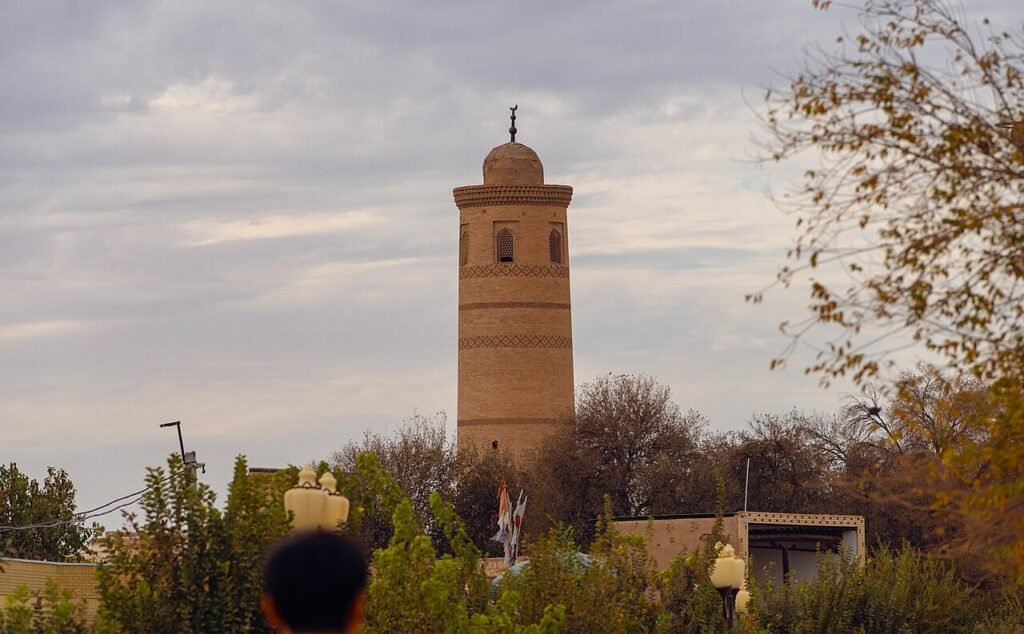

Tash Khauli Palace in Khiva: Courtyards, Tilework and Visitor Guide
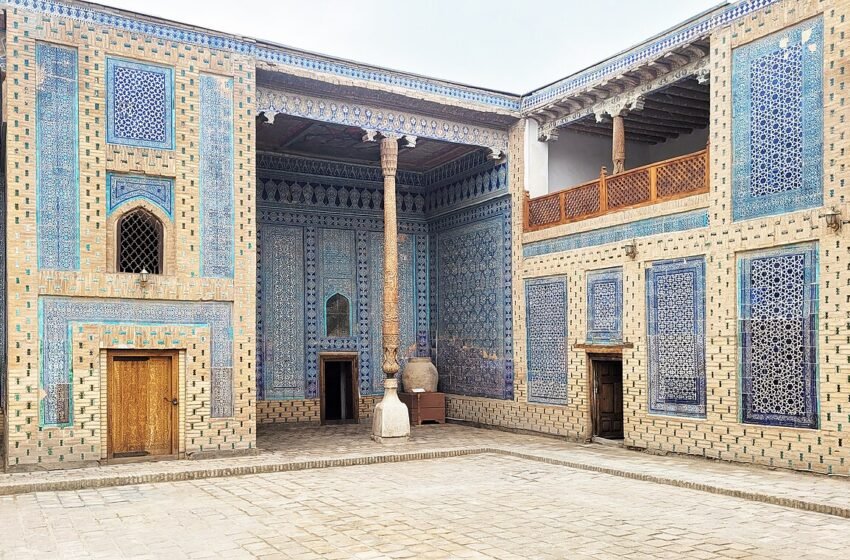
Photo: Bgag / Wikimedia Commons. CC0. Source: https://commons.wikimedia.org/wiki/File:Harem_of_Tach_Khaouli.jpg License: http://creativecommons.org/publicdomain/zero/1.0/deed.en
Tash Khauli, the “Stone Palace,” is Khiva’s most richly decorated royal residence. Hidden behind a relatively restrained street wall in eastern Itchan Kala, it unfolds through courtyards lined with blue-and-white majolica, carved wooden columns, deep iwans and intimate chambers once used by the khan’s household and administration.
Built for Alla Kuli Khan in the nineteenth century, the palace complements the older Kunya-Ark. Where the citadel represents a fortified seat accumulated over time, Tash Khauli presents a more concentrated palace programme shaped around ceremony, justice, entertainment and domestic life.
Building a new palace
Construction began in the 1830s during a period when Alla Kuli Khan also transformed the eastern commercial quarter. Work continued in stages as different courts were completed. The palace became a major statement of royal power within the already crowded inner city.
Traditional accounts emphasise the ruler’s demand for speed, but the surviving craftsmanship suggests sustained work by specialised teams. Tile makers, woodcarvers, painters and builders created a coordinated environment rather than applying ornament to a finished shell.
Three principal courtyard worlds
The palace is organised around distinct functional zones commonly identified with the harem, reception or entertainment court, and the court of justice. Narrow passages control movement between them. This separation allowed household life, official audiences and legal administration to operate within one complex.
The harem courtyard is especially memorable for its series of tall iwans, each associated with residential suites. Reception spaces use scale and decoration to stage authority, while smaller rooms reveal fireplaces, niches and surfaces connected with everyday use.
Khorezmian tilework and carved columns
Majolica panels cover walls with geometric, vegetal and calligraphic patterns in deep blue, turquoise and white. Designs repeat without becoming identical, rewarding close comparison from bay to bay. Carved wooden columns rise from stone bases, and their capitals mediate between slender shafts and decorated ceilings.
Morning light reaches some courts while leaving others in shade; later hours reverse the balance. Photograph wide compositions first, then details of tile joins, door carving and ceiling paint. Flash may be prohibited and can flatten the very texture that makes the interiors compelling.
How to visit Tash Khauli
Allow at least ninety minutes and follow the marked sequence, because the passages can be confusing. Ticket inclusion within the Itchan Kala system may change. Ask which courts are open and whether museum rooms require a separate ticket before beginning.
The palace lies near the Allakuli Khan commercial complex and Palvan Gate. Pair it with those eastern monuments, then use our Kunya-Ark guide to compare Khiva’s two royal centres. Pause between the courts so the dense ornament does not become visually repetitive, and carry water in hot weather. The Khiva travel guide suggests a logical two-day route.
Practical information
The core of Khiva is compact, but the concentration of monuments rewards an unhurried visit. An early start gives quieter streets and softer light; evening is ideal for seeing the walls and minarets change colour. Surfaces can be uneven and shade is limited in summer. A combined ticket may cover several museum-monuments, although inclusions can change, so verify the current arrangement at the official ticket office. Dress respectfully in mosques and mausoleums.
Before you go: Opening hours, ticket prices, restoration closures and photography rules can change. Confirm current conditions at the official ticket office, museum or your accommodation. Never climb on historic fabric, and ask permission before making close portraits of residents or vendors.
Frequently asked questions
What does Tash Khauli mean?
The name is usually translated as “Stone Palace,” distinguishing the residence within Khiva’s earthen-walled city.
Who built the palace?
Alla Kuli Khan commissioned it in the nineteenth century as a royal residence and administrative complex.
How long is needed?
Allow ninety minutes for the main courts and decorative details, longer if all museum rooms are open.
Sources and editorial note
This independent guide was written in original language and fact-checked against the authoritative references below. It does not reproduce their text. Practical details should be rechecked close to the date of travel.
Featured photo: Harem of Tach Khaouli.jpg by Bgag, Wikimedia Commons. CC0. Resized for display.