

← All historic cities of Uzbekistan
Uzbekistan • City chronicles
The History of Khiva
Khiva’s compact skyline can make its history look deceptively simple. Within Itchan Kala, walls, minarets, madrasas and palaces form an exceptionally coherent ensemble. Yet the city developed through changing river routes, regional rivalries, dynastic ambitions and repeated reconstruction. The buildings standing together today were not all created at the same moment.
Khiva also belongs to the much larger history of Khorezm. That distinction is essential: the antiquity of the region does not make every monument in Khiva ancient, and Khiva was not always Khorezm’s principal capital. This chronicle follows the city’s rise while keeping the wider oasis in view.

At a glance: Khiva through time
- Antiquity and the early Middle Ages: settlement develops within the Khorezm oasis; Khiva appears in medieval geographical writing.
- Sixteenth–seventeenth centuries: Khiva becomes increasingly important within the Uzbek-ruled state of Khorezm.
- Eighteenth century: warfare and instability interrupt urban life.
- Late eighteenth–nineteenth centuries: the Qungrat dynasty consolidates power and sponsors major construction.
- 1873: Russian conquest establishes a protectorate over the khanate.
- 1920–1924: the khanate ends and new political arrangements precede incorporation into Soviet Central Asia.
- 1990: Itchan Kala is inscribed on the World Heritage List.
- Since 1991: Khiva develops within independent Uzbekistan as a centre of heritage, craft and tourism.
Khiva, Khorezm and the names on a historical map
Khiva is a city; Khorezm is a much larger historical region. The distinction is essential to almost every period described in this chronicle. Khorezm developed around the lower Amu Darya, with settlements, cultivated land and political centres distributed across territory now divided between modern states. Its history cannot be confined to the walls of Itchan Kala, however impressive those walls may be. Khiva became one of its principal centres relatively late in a regional story that reaches far back into antiquity.
The names Khwarazm, Khwarezm and Chorasmia refer to versions of that regional name in different scholarly and linguistic traditions. They do not identify additional cities hidden somewhere near Khiva. Similarly, a ruler called a Khwarazmshah was not necessarily based in Khiva. Centres such as Kath and Gurganj held leading positions at different times. A traveller who keeps a simple distinction between region, state and city will find medieval and early modern history much easier to follow.
Urgench creates another potential confusion. Modern Urgench in Uzbekistan is not identical with the great medieval city whose remains are associated with Kunya-Urgench in present-day Turkmenistan. Changes in settlement, water supply and political geography have produced several layers of naming. These names preserve connections, but they should not be treated as proof that one unchanged city simply moved through history under different spellings. Each location has its own archaeological and urban development.
Khiva’s historical importance becomes clearer against this wider map. It was neither the original home of every Khorezmian achievement nor an isolated desert curiosity. It rose within a region of established scholarship, agriculture, trade and political competition. Its later khans drew on that inherited prestige when presenting themselves as legitimate rulers. The magnificent surviving inner town is one chapter of Khorezm’s history, and understanding the earlier chapters adds depth to a visit rather than diminishing Khiva’s appeal.
Wells, founding stories and the early town
Popular accounts of Khiva’s origin often centre on a well and a story associated with Shem, the son of Noah. Other versions explain the city’s name through the exclamation of travellers tasting its water. These narratives connect settlement with the experience of finding a reliable water source in an arid environment. They are meaningful expressions of local memory. They should be introduced as traditions, however, rather than used to establish a precise archaeological founding date.
The historical questions are more varied than a founding legend suggests. When did people first occupy the site? When did a defensible settlement emerge? When did it become a recognised town in written geographical accounts? When did it acquire the political functions of a capital? Those events need not occur in the same century. A settlement may exist for a long time before surviving texts mention it, and its earliest remains may lie below many later layers of construction.
Medieval geographical writing places Khiva within the network of Khorezmian settlements. Such references are useful because they show that the town formed part of an inhabited and connected region well before its best-known monuments were built. They do not mean that the streets visible today preserve the exact plan of that earlier settlement. Rebuilding, changes in defences and shifts in the location of important institutions all affect the physical continuity of a city.
For visitors, the practical lesson is to look for several kinds of age at once. The site may be ancient; a particular mosque may incorporate older material; its surviving structure may belong to a later rebuilding; and the visible decoration may include conservation work. None of these facts cancels the others. The history becomes richer when the layers are identified clearly instead of assigning the same age to everything enclosed by the city walls.
The Amu Darya and the engineering of an oasis
Khorezm’s agricultural landscape depended on the Amu Darya and on the systems that distributed its water. The river supplied opportunities for cultivation but did not provide a fixed, effortless environment. Channels changed, sediments accumulated and the relationship between watercourses and settlement required continual management. A town’s prosperity could be affected by a change in access to water even when its rulers and trading partners remained the same.
Irrigation joined technical work to political authority. Canals needed excavation, repair and regular cleaning. The allocation of labour and water involved institutions extending beyond an individual household. A ruler could advertise the restoration of cultivation, but the practical achievement depended on many people working in the landscape. Farmers, water officials, landholders and local communities had interests that might overlap or conflict. An oasis was a negotiated social environment as well as a cultivated one.
The title mirab, associated with the supervision of water, appears in Khorezmian history and even in the names of celebrated writers. This connection is a useful reminder that literary culture and administration were not separate worlds. Educated officials could participate in both. Their experience of government and resource management shaped the setting in which chronicles were written, even where the surviving text concentrates on rulers, campaigns and dynastic affairs.
The countryside also provided food, fodder and raw materials for urban life. The monumental city depended on fields and gardens beyond its walls. Building a palace required labour and materials that had to be supported by a wider economy. A caravan crossing the desert required provisions at both ends of its journey. Khiva’s urban history therefore cannot be explained only through trade passing from one distant empire to another. Its immediate agricultural hinterland was equally fundamental.
On a modern journey between Urgench and Khiva, cultivated land is part of this historical subject, even though the channels, crops and technologies have changed. The greenery is not a natural interruption in an otherwise empty desert. It is the result of sustained human intervention. Thinking about that work makes the contrast between the oasis and the surrounding arid lands more informative than a purely picturesque view.
Ancient fortresses and the world beyond Itchan Kala
The fortified archaeological sites of the wider Khorezm region reveal forms of settlement and authority much earlier than the surviving khanate city. Places such as Toprak Kala and Ayaz Kala belong to a landscape of substantial earth-built architecture. Their forms and functions vary, and they should not all be described as identical royal castles. Fortification, residence, administration and the protection of settlements could overlap in different ways.
These sites are especially useful for seeing how local building traditions responded to available materials. Earth construction could produce large walls and imposing spaces, but it also required maintenance and was vulnerable to erosion after abandonment. The shape of a ruin today is the result of both ancient design and centuries of weathering. Archaeological interpretation depends on excavated evidence, not simply on what a silhouette resembles from a distance.
The distinction between an excavated site and a restored urban monument matters. In Khiva, a visitor may encounter renewed tile surfaces, functioning courtyards and carefully maintained routes. At an archaeological site, the experience is often one of fragments, scale and landscape. Neither is a more authentic form of history in every respect. They preserve different kinds of evidence and require different forms of protection. A museum object can add detail that is no longer visible where it was discovered.
The famous fortress landscape also helps prevent a common historical shortcut. Khiva’s later rulers inherited a regional identity whose antiquity exceeded the age of their own capital. They could claim continuity with earlier Khorezm without occupying exactly the same places or reproducing the same institutions. A journey that combines the city with the wider region makes that relationship visible: the history moves through different centres rather than remaining inside one set of walls.

Medieval scholarship and Khiva’s place in Khorezm
Khorezm is associated with major figures in the history of mathematics, astronomy, geography and other fields of learning. Al-Khwarizmi’s name itself preserves a regional connection, while al-Biruni’s early life and scholarship belong to the intellectual world of Khorezm. Their importance is often celebrated during a visit to Khiva. Care is needed, however, when translating a regional association into a claim that a particular person was born, taught or worked in the present inner city.
Medieval intellectual centres developed through patrons, libraries, teachers and the movement of scholars. The Ma’munid court at Gurganj is an important example of that wider geography. Its history belongs to a different period and political setting from nineteenth-century Khiva. Remembering the distinction allows the later city to be understood as an inheritor and interpreter of regional scholarship, rather than as the physical location of every achievement now commemorated there.
Scholarship also depended on travel. Learned people moved in search of patronage, books, teaching or political security. Their writings circulated further still, through translation and copying. The result was an intellectual geography that crossed the boundaries of individual cities and states. A museum display can celebrate a regional figure while acknowledging that the work attributed to that person emerged through connections with many places.
This approach is especially helpful for families and visitors encountering Central Asian history for the first time. It replaces a collection of isolated names with a network of relationships. Khiva’s historical museums and commemorative spaces can be read as part of the modern effort to present that inheritance. The presentation itself has a history: different periods have emphasised different scholars, languages and forms of regional identity.
Mongol rule, changing centres and the rise of Khiva
The Mongol conquests transformed Khorezm in the thirteenth century. The destruction associated with the fall of Gurganj belongs to the wider regional catastrophe, not to an interchangeable story that can be attached to every town. Political divisions after the conquest placed different parts of Khorezm within different spheres of authority. The region’s later development was shaped by these divisions, subsequent conflicts and the changing fortunes of its settlements.
Khiva’s eventual rise should therefore be understood as a process rather than a single dramatic transfer of a capital. Water supply, regional security, the interests of ruling groups and the position of other towns all contributed. The decline or disruption of one centre could create opportunities for another, but such changes were not automatic. A new political centre still needed the institutions and economic support required to sustain a court and a substantial urban population.
Under the Uzbek dynasties that established themselves in Khorezm from the sixteenth century, Khiva became increasingly important. The Arabshahids traced their legitimacy through Chinggisid descent, an important principle in the political culture of the region. Their rule connected local authority to a wider steppe and Central Asian dynastic world. The later name Khanate of Khiva can make it appear that the city had always been the state’s uncontested centre, when the historical development was less straightforward.
By the seventeenth century Khiva was firmly established as a leading seat of rule. Its growth required more than a fortress. Religious institutions, markets, workshops and residential quarters formed the supporting city. The capital’s population included people with different occupations, origins and relationships to the court. Its development was a social and economic transformation as well as a shift in the place from which a khan issued commands.
Arab Muhammad Khan, Abulghazi and the writing of dynastic history
Arab Muhammad Khan’s reign in the early seventeenth century belongs to a period of conflict with neighbouring powers and struggles within the ruling family. Such disputes are a reminder that succession was not always a smooth transfer between one monarch and the next. Princes commanded supporters, territories and resources of their own. The outcome could affect the security of the capital and the ability of its inhabitants to conduct ordinary business.
Abulghazi Bahadur Khan is notable both as a ruler and as a historian. His writings on Turkic and Turkmen genealogy linked political communities to accounts of descent and the past. Genealogies mattered because they helped explain and justify authority. They were not simply family records assembled for private interest. In a world where a claim to rule could depend on ancestry, writing history was itself connected to government.
These texts are important sources, but they need to be read with the same care as other courtly histories. A ruler writing about origins and dynasties had reasons to select, organise and interpret the past in particular ways. Stories of descent could combine remembered events, oral traditions and political arguments. Their value is not reduced by recognising those purposes. On the contrary, the purposes help explain why the histories took the forms they did.
Khiva’s later chroniclers continued to connect literary work with the needs and interests of the court. This tradition gives the city a historical identity that extends beyond its buildings. Manuscripts, translations and the work of copying deserve attention alongside minarets and tiled courtyards. The survival of a text can preserve a political and intellectual world whose original rooms, readers and patrons are no longer accessible.
The eighteenth century: invasion and the rebuilding of authority
The eighteenth century brought severe instability to Khorezm. Rivalries among ruling groups, conflict with neighbouring states and struggles over resources affected the region’s towns and countryside. Khiva’s urban life did not proceed in a smooth sequence of architectural improvements. Periods of insecurity could interrupt cultivation, movement and patronage. The later coherence of Itchan Kala should not hide the difficult history that preceded much of its surviving construction.
Nadir Shah’s campaign of 1740 is one of the major episodes of the period. His capture of Khiva formed part of a wider extension of Iranian military power into Central Asia. The campaign involved changes in rule and the liberation and relocation of captives. Accounts differ on numbers, and the scale of the human movement should not be reduced to an apparently exact figure repeated without context. The event nevertheless illustrates how warfare connected the fate of the city to populations far beyond Khorezm.
The growth of Qungrat influence gradually changed the political structure. Powerful leaders could exercise authority while maintaining nominal rulers whose dynastic ancestry supplied legitimacy. The distinction between a formal title and effective power is important: the person called khan did not always control the decisive military and administrative resources. Over time, the Qungrats moved from such positions to ruling in their own name.
Consolidation involved the recovery of the wider economy as well as political control. Stable cultivation and functioning markets were essential to the revenue that supported government. Restoring authority was therefore expressed through practical measures as well as ceremonial claims. The nineteenth-century building programme grew out of this process. Khiva’s famous monuments are partly the visible outcome of efforts to stabilise a region that had experienced repeated disruption.
The Qungrat dynasty and a nineteenth-century capital
The Qungrat dynasty formally assumed the khanly title in the early nineteenth century. Its rulers built on the authority accumulated by earlier members of the ruling group and developed Khiva as a capital. Their legitimacy drew on military success, government, religious patronage and the presentation of historical continuity. A dynasty without the same ancestry as its predecessors could still seek recognition through other established forms of political authority.
Muhammad Rahim Khan I and Allah Quli Khan were particularly important in the consolidation and development of the state. The period brought administrative changes and major construction. Palaces, madrasas, commercial buildings and expanded defences altered the appearance of the city. The concentration of these projects within a relatively compact area helps explain the powerful visual unity that visitors encounter today.
That unity should not be mistaken for social equality. The capital was a place of rank, privilege and controlled access. Wealthy patrons could commission monumental buildings, while much of the labour that supported them remains anonymous in popular accounts. Taxation, agricultural production and unequal forms of work contributed to the economy. A full history needs to connect courtly splendour with the people and institutions that made it possible.
The city also participated in relationships with Turkmen, Kazakh and other communities whose livelihoods and political interests were not confined to the urban oasis. Pastoral and settled populations exchanged goods and sometimes fought over resources or authority. Describing all such relations as a permanent conflict between nomads and townspeople is too simple. Cooperation and competition could coexist, and alliances changed. Khiva’s rulers governed within this varied regional society, not above an empty desert.
Itchan Kala and Dishan Kala: two scales of urban life
Itchan Kala is the inner walled town, the most familiar part of Khiva to international visitors. Its enclosing walls create a strong sense of arrival and make the relationship between gates, streets and monuments immediately visible. Yet historical Khiva extended beyond this enclosure. Dishan Kala, the outer town, developed with its own neighbourhoods and defensive perimeter. The two areas belonged to a larger urban organism rather than to completely separate cities.
The inner town concentrated major institutions of rule, worship and learning. Its compactness meant that these institutions were close to one another, but everyday movement connected them to workshops, houses and markets. Gateways regulated access and created important points of commercial and social activity. A defensive wall also had fiscal and symbolic roles: crossing it could mark entry into a space governed and represented in particular ways.
The outer town’s expansion, especially associated with nineteenth-century development, reminds visitors that the city was growing and changing. Housing, gardens, routes and commercial activity did not stop at the best-preserved walls. Later urban transformation has left different kinds of evidence outside Itchan Kala. Some structures survive clearly; others are understood through the street pattern, remaining gateways or historical documentation.
For a first visit, the inner town provides a manageable introduction. For a fuller historical understanding, it is worth asking what lies beyond the familiar photograph of the western gate. Where did provisions come from? Where did people live who did not have a place near the principal monuments? How did traffic move between town and countryside? These questions turn the walls from a picturesque backdrop into part of the city’s working geography.
Kunya-Ark: the citadel as an institution
Kunya-Ark, the old citadel, occupies a distinct position within the already fortified inner town. This nested arrangement expresses a further separation between the ruler’s precinct and the surrounding urban population. A wall inside a wall was not redundant. It controlled access to the court, its administrative spaces and its resources. The citadel functioned as an institution with several activities rather than as a single palace devoted only to residence.
Audience areas made political hierarchy visible. The arrangement of entrances, courts and reception spaces affected the way people approached the ruler and encountered officials. Architecture helped organise ceremony: a visitor could be delayed, admitted or positioned according to status. The decorated iwan was part of this controlled presentation. Its visual effect belonged to a setting where access carried meaning.
Other functions were more practical. Government required records, revenue, communication, stores and spaces for officials to work. The surviving complex represents only part of the citadel’s historical development. Destruction, rebuilding and conservation have altered what remains. It is therefore better to understand a room through its documented function than to assume that every restored interior reproduces one exact moment in the khanate’s life.
Views from the citadel help explain its relationship to the wider city, where access is permitted. The dense arrangement of roofs, domes and minarets reveals how closely royal, religious and domestic spaces were situated. The khan’s precinct was separated, but it was not detached from the urban economy. Its power depended on the surrounding population and the larger region that supplied the capital.
Tash Khauli and the organisation of courtly space
Tash Khauli, the Stone Palace, is associated with Allah Quli Khan’s nineteenth-century patronage. Its name can create an expectation of a single massive block, but the visitor experiences a sequence of courts, passages and rooms. Different areas served different purposes, and movement through them was controlled. The palace’s architectural interest lies as much in this arrangement as in the richly decorated surfaces for which it is famous.
The distinction between reception, administration and domestic life shaped the complex. Spaces intended for formal encounters were organised differently from those connected with the ruler’s household. The term harem should be understood in this domestic and social context rather than through an exotic fantasy. It refers to a protected household sphere involving family, residence and hierarchy. The lives of the women and other members of that household cannot be reconstructed simply from decorative interiors.
Tilework and carved wood create different levels of emphasis within the courts. Frames, inscriptions and patterned surfaces direct attention towards particular entrances and seating areas. The repetition of ornamental motifs can unify a space, while differences in detail distinguish one part from another. Slow looking reveals the labour of design and execution more clearly than a quick search for the most colourful photograph.
The palace also invites questions about patronage. A ruler’s desire for magnificence depended on skilled builders, ceramic specialists, carpenters and other workers. Their knowledge was accumulated and transmitted through practice. Even when a patron’s name dominates the historical label, the achievement was collective. Tash Khauli makes that collective skill visible through the coordination of structure, decoration and the experience of moving through a complex interior environment.
Juma Mosque and the history held in wooden columns
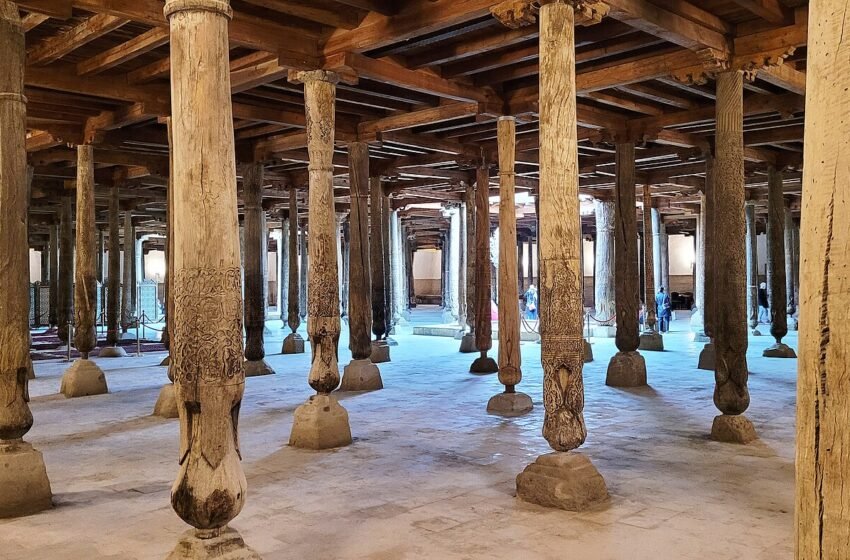
Juma Mosque offers one of the most distinctive spatial experiences in Khiva. Its covered hall is supported by numerous wooden columns, creating a field of repeated vertical forms. The effect differs markedly from the open courtyards and monumental entrance portals of nearby madrasas. Light, shadow and the variation between individual columns shape the visitor’s sense of the interior.
The current mosque incorporates material with different histories. Some columns preserve older carving traditions, while others belong to later work or replacement. Reuse can reflect respect for an earlier object, practical economy or the continuing value of skilled craftsmanship. It does not mean that every component was originally made for the same building. The mosque is valuable precisely because it allows continuity and change to be studied together.
Carved patterns should be examined as work carried out in a particular material. Wood has grain, strength and vulnerabilities different from brick or tile. A carver had to organise ornament around the form and structural role of a column. Differences between surfaces may reflect date, workshop practice or later intervention. Exact attribution requires specialist study; visual variety alone does not justify assigning every column to a named dynasty.
The building’s atmosphere is also connected with its function. A congregational mosque accommodates collective religious activity, and its layout affects movement, sightlines and the experience of gathering. Conservation must address both the material condition of the columns and the larger structure they support. Modern management of a building like this involves more than preserving an attractive photograph. It requires careful attention to the interaction between wood, masonry, moisture, use and visitor movement.
Pahlavan Mahmud: poetry, pilgrimage and dynastic memory
Pahlavan Mahmud is remembered through several overlapping identities, including poet, wrestler and revered spiritual figure. The traditions associated with him have made his mausoleum an important place of pilgrimage. Such a complex cannot be understood only as a work of decorative architecture. Its significance also lies in the acts of remembrance and devotion that continue to bring people to the site.
The surviving ensemble developed through later patronage. Khiva’s rulers associated themselves with the sacred place and used the complex for dynastic burial. This connection between royal memory and an established shrine had political as well as religious meaning. A ruler could seek legitimacy through proximity to a revered figure, while supporting the institution’s buildings and public standing. The tombs therefore belong to both spiritual and dynastic histories.
The blue tilework creates an exceptionally concentrated visual environment. Its effect depends on the relationship between patterned surfaces, inscriptions, architectural frames and the scale of the rooms. Visitors who look only for a single decorative detail may miss the way the ornament organises the whole space. The decoration does not float independently of function: it surrounds places of burial and remembrance.
Because pilgrimage remains part of the site’s life, a visit should allow for purposes other than sightseeing. People may be praying, remembering relatives or participating in a religious tradition that has personal significance. Quiet observation and respect for local guidance are part of understanding the monument. The continuing use of the complex is historical evidence in its own right, even though practices and management have changed over time.
Madrasas and the city’s educational geography
Khiva’s many madrasas demonstrate the importance of educational and religious patronage within the capital. Their portals and courtyards contributed to the city’s appearance, while the institutions provided spaces for teaching and accommodation. A large building could express a patron’s ambition, but the quality of education depended on teachers, students, books and financial support. Monumental scale and intellectual influence were related only imperfectly.
The courtyard plan organised several activities within a compact area. Cells could accommodate students, while other rooms served instruction and worship. The rhythms of study differed from those of a modern school timetable. Learning often involved close relationships with particular teachers and the study of established texts. The range of subjects and the reputation of an institution varied according to the people and resources available at a given time.
Madrasas also belonged to a property and funding system. Endowments could provide income for salaries, maintenance and other needs. The institution’s continuity depended on the management of those resources and on the wider political economy. A building without support could decline even while its facade remained impressive. Conversely, an institution might continue to function through repair and adaptation rather than through the complete preservation of its original form.
Many former madrasas now accommodate museums, exhibitions, shops or hospitality uses. These adaptations make a new chapter in their history. They can bring resources and activity, but they can also alter the relationship between rooms and their original purposes. A visitor can appreciate the present use while asking how the space once worked. The essential distinction is between the age of the architecture and the age of the activity currently taking place inside it.
Muhammad Amin Khan and the unfinished Kalta Minor
The ensemble associated with Muhammad Amin Khan shapes one of the most familiar approaches to Itchan Kala. The large madrasa and the broad tiled tower beside it create an architectural relationship that is immediately recognisable. The tower’s unfinished form makes it especially memorable. Visitors see a substantial base and a decorative programme whose proportions differ from the completed slender minarets elsewhere in the city.
Kalta Minor’s construction ended after the death of its patron in the mid-nineteenth century. Accounts of its intended final height and the ruler’s ambitions often become increasingly elaborate in retelling. The surviving structure establishes that a much larger project was begun, but it does not independently verify every story about a plan to see as far as another city. The distinction between physical evidence and later legend is particularly useful here.
An unfinished monument reveals the dependence of architecture on politics. A project required a patron, finance, labour and continuity of purpose. The death of a ruler or a change in priorities could interrupt that combination. The resulting building might acquire a meaning quite different from the one originally intended. Kalta Minor has become an emblem of Khiva because of its incompleteness, turning the interruption of a royal project into a defining feature of the modern city’s identity.
The adjacent madrasa helps explain the original context. Looking at the tower alone can make it appear to be an isolated architectural experiment. Seen together, the structures show how a patron sought to organise a prominent urban approach through monumental scale and decoration. The ensemble also demonstrates the value of a slow circuit: changes in viewing angle reveal how mass, height and coloured surfaces work in relation to the gate, street and surrounding buildings.
Commerce, workshops and the labour of the city
Khiva’s markets connected the capital with its agricultural hinterland and with longer-distance routes. Urban households needed grain, fruit, fuel, animals, tools and textiles. Travelling merchants required accommodation, storage and information about routes and prices. These practical needs supported a range of commercial buildings and occupations. The city’s economic life cannot be understood solely through exotic goods arriving from distant countries.
Caravanserais provided an environment in which goods and people could be accommodated under more controlled conditions than in an open street. Commercial buildings near gateways benefited from the concentration of traffic. Markets were also places where news travelled and relationships were established. A merchant’s knowledge of trustworthy partners could be as important as possession of a particular commodity. Exchange depended on social connections and judgement as well as on roads and buildings.
Craft workshops contributed both to everyday consumption and to elite patronage. Carpenters made doors and structural elements; carvers transformed wood into elaborate surfaces; potters and tile makers worked with clay, pigments and firing; textile workers supplied clothing and furnishings. The construction of a major monument required coordination between such specialists. Their skills were not interchangeable, and the surviving buildings preserve evidence of several kinds of expertise working together.
Today, demonstrations and shops can help visitors encounter living craft traditions. They should not automatically be described as unchanged survivals of the khanate. Tools, markets, materials and the organisation of work have changed. A contemporary craftsperson may draw on inherited knowledge while adapting products to new customers. That adaptation is part of the tradition’s history. Asking about process, material and training often produces a more informative conversation than asking only whether an object is ancient or authentic.
Slavery, captivity and the unequal economy
Khiva’s history includes a substantial slave trade and the use of enslaved labour. Captives arrived through warfare, raiding and commercial networks extending across the region. Their origins and circumstances varied. Some were taken from Iranian territories, while others came from different neighbouring populations. The experience of captivity was not a decorative footnote to the history of a magnificent court. It was a central part of an unequal social and economic order.
Enslaved people worked in agricultural, domestic and other settings. Their labour contributed to the wealth and functioning of the wider region. A history focused only on khans and monuments can leave those lives almost entirely invisible. The absence of individual names in a popular account does not make the contribution or suffering less important. It reflects the uneven survival of records and the priorities of the people who produced them.
The subject also requires care because foreign accounts of Khiva were shaped by diplomatic and imperial interests. Descriptions of slavery could be used to justify military intervention, even where the reporting of coercion was substantially grounded in reality. Recognising that political use does not excuse the institution. It means examining both the conditions described and the purpose for which an account was written. Historians must be able to acknowledge injustice without accepting every argument made by a conquering power.
The Russian conquest of 1873 brought a decisive formal break with slavery in the khanate. The consequences involved more than a change in law: former captives needed to establish new lives, and the economy had to adapt to altered labour relations. Numbers reported by different sources are not always directly comparable. A responsible visitor-facing history can explain the scale and importance of the institution without presenting uncertain figures as precise counts of individual lives.
Russia, failed expeditions and the conquest of 1873
Russian interest in Khiva developed over a long period and involved trade, diplomacy, strategic concerns and the fate of captives. Earlier expeditions failed to impose lasting control. The desert environment created serious logistical difficulties, particularly where an army depended on water, fodder and transport across long distances. Military ambition did not automatically translate into the ability to reach and hold an oasis capital.
The context changed as Russia expanded its position in Central Asia during the nineteenth century. Campaigns in other parts of the region altered the strategic balance and the resources available for a further expedition. The conquest of Khiva in 1873 was therefore part of a larger imperial process rather than an isolated adventure. It affected neighbouring populations and territories as well as the city itself.
The resulting settlement left the khan in place while placing the state under Russian predominance and reducing its freedom in external affairs. This protectorate arrangement differed from direct annexation. It also differed from complete independence, despite the survival of royal ceremony and local institutions. The distinction is important when reading the final decades of the khanate: the court continued to operate within a fundamentally changed political framework.
For Khiva’s inhabitants, the consequences included changes in trade, administration and relationships with the outside world. Imperial influence could create new connections while limiting political autonomy. It is too simple to describe the period only as either modernisation or stagnation. Different groups experienced its effects differently. A court patron might continue to build, a merchant might find new markets, and another household might face disruption. The history of the city after 1873 is shaped by these unequal and overlapping changes.
Feruz, Munis and Agahi: the court as a literary centre
Khiva’s nineteenth-century court supported a substantial literary and historical culture. Munis and Agahi are among its most important names. Their work connects poetry, translation, historiography and administration. The chronicle tradition associated with them provides essential evidence for the history of Khorezm, while also showing how the past was organised and presented within a courtly environment.
Munis began a historical project that Agahi continued. Such continuity illustrates the collective life of a text across generations. A chronicle was not always the product of one author working in isolation from beginning to end. Successive writers could extend a narrative, draw on earlier material and respond to new political circumstances. Manuscript copying and circulation added further stages to the work’s history.
Muhammad Rahim Khan II, known as a poet by the pen name Feruz, is associated with the patronage of literature and the arts. His position as both ruler and literary participant should be understood within the politics of the court. Patronage could encourage creativity while also establishing expectations about praise, loyalty and the presentation of authority. The existence of a cultivated court does not mean that writers operated outside political constraints.
Translation was another important activity. Rendering texts into the Central Asian Turkic literary language opened connections with wider Persian and Islamic traditions. It required choices about vocabulary, style and the needs of readers. The resulting works participated in a multilingual intellectual world. Khiva’s cultural history therefore belongs not only to the preservation of local forms but also to the active adaptation of material circulating beyond the region.
Islam Khoja and the city at the beginning of the twentieth century
The Islam Khoja complex is a striking reminder that Khiva’s skyline continued to change in the twentieth century. Its slender minaret contrasts with the broad unfinished Kalta Minor, even though both now appear together in the familiar visual identity of the old town. The later tower belongs to a period of new technologies, political uncertainty and discussions about reform. It should not be placed casually in an undifferentiated medieval past.
Islam Khoja, an influential minister, is associated with initiatives in education and public development as well as with architectural patronage. His position at court connected reforming ambitions with the realities of dynastic politics. The history of reform was not a simple opposition between an enlightened outsider and a completely unchanging city. Proposals for change operated through existing relationships of authority and could provoke resistance from those whose power or interests they threatened.
The madrasa and minaret demonstrate the continued importance of established architectural forms. A patron could support new institutions or technologies while also commissioning a building rooted in the city’s religious and decorative traditions. Modernity did not necessarily arrive as a complete rejection of local design. Khiva’s late buildings are informative because they show several kinds of change occurring at once.
The early twentieth century also brought new ways of recording and representing the region, including photography. Images could document court ceremony, people and architecture, but they were framed and selected by particular individuals. Historic photographs are valuable evidence for surfaces, clothing and urban arrangements that have since changed. They should still be read critically: an image captures what was placed in front of the camera and excludes what remained outside the frame.
The end of the khanate and the Khorezm republic
The upheavals following the Russian Revolution altered the political environment around Khiva. Local reform movements, armed forces and competing leaders struggled over authority. The final years of the khanate were marked by instability rather than a peaceful transition from one established system to another. The events involved actors whose priorities were not identical, even when they temporarily cooperated.
In 1920 the khanate came to an end, and the Khorezm People’s Soviet Republic was established. This new political formation preceded the national-territorial reorganisation of Soviet Central Asia. It should not be confused with the modern Republic of Uzbekistan or imagined as having the same borders. The reorganisation of 1924 distributed the former region within a new political geography that shaped the later Soviet republics and, ultimately, the independent states.
For the city, political change affected property, religious institutions, education and the organisation of public life. Buildings associated with the court lost their original ruling function. Former institutions were adapted, closed or given new roles. The transformation was not only architectural: it altered the relationships between inhabitants and the authorities who administered their lives. The same courtyard could survive while the social order it once represented disappeared.
The twentieth century should therefore be treated as part of Khiva’s history rather than as an empty interval between the last khan and contemporary tourism. It shaped which monuments were preserved, which uses were permitted and how the city was presented to visitors. The modern historical image of Khiva emerged through these decisions. It was not simply waiting, complete and untouched, for international tourism to discover it.
Conservation, museums and the meaning of a living old town
Itchan Kala’s inscription on the World Heritage List in 1990 recognised an ensemble, including the relationship between major monuments and the surrounding urban fabric. This is different from listing only a set of famous buildings. Streets, dwellings, small structures and the pattern of movement contribute to the character of the place. The walls enclose an environment whose significance depends on how its parts relate to one another.
Conservation involves choices about repair, materials and new uses. Renewed tilework may protect a facade and restore its visual coherence, while also changing what a visitor perceives as old. Reusing a former madrasa may bring income, but alterations can affect the original arrangement of rooms. Improving infrastructure can support residents while requiring careful work in a historically sensitive setting. These choices rarely have a solution that satisfies every interest without compromise.
Museums have played a major role in the presentation of Khiva. They can make objects, documents and interpretive material accessible, especially where a building’s original function has ended. At the same time, a museum display is a selection. It reflects the questions and priorities of the people who created it. Comparing a display with the architecture around it can reveal both the history being described and the later history of how it has been interpreted.
The city’s continued residential life is equally important. Houses, schools, shops and family routines should not be treated as interruptions in a visitor’s experience of heritage. They help explain why Khiva remains a city rather than only an outdoor collection. Tourism can support livelihoods, but the quality of urban life depends on more than visitor numbers. The needs of residents are part of the long-term protection of the place.
Reading Khiva through materials, light and human scale
After the main chronological story is understood, a second walk can focus on materials. Brick establishes walls, arches and domes; timber supports roofs and provides surfaces for carving; glazed ceramics introduce colour and patterned emphasis. Each material has its own history of production, maintenance and repair. Their combination gives Khiva its particular architectural character. The city is not simply a collection of interchangeable blue facades.
Light changes how those materials are perceived. A carved wooden surface may become easier to read in angled light, while a tiled facade can appear flatter under direct midday sun. Shaded courts and covered halls produce different acoustic and thermal experiences from an exposed square. These effects were part of how buildings functioned before electric lighting and modern climate control. They are historical information available through direct observation.
Human scale provides another useful comparison. A monumental portal addresses the street and announces an institution. A smaller doorway controls entry into a house or work space. A narrow passage can create privacy or manage movement, while a broad court permits gathering and ceremony. Paying attention to these differences helps explain the city’s social organisation without requiring every building to carry a long explanatory sign.
The most complete visit combines these ways of seeing. Dates establish sequence; texts identify patrons and institutions; materials reveal skills; and the experience of space suggests how people used it. Khiva’s appeal lies in the opportunity to bring those forms of evidence together within a compact setting. The result is a history that remains connected to the lives of builders, students, traders, worshippers and residents, as well as to the rulers whose names appear most often on the monuments.
Following the chronology during a visit
Use the western entrance as a starting point, then compare Kunya-Ark, the Muhammad Amin Khan ensemble and Juma Mosque. Continue to Pahlavan Mahmud, Tash Khauli and Islam Khoja. This route brings different forms of authority, worship and architectural patronage into one walk.
Allow time to revisit a street in different light. The ensemble becomes easier to read when the first rush of photographs is over. For routes and individual monuments, see our Khiva travel guide and Itchan Kala visitor guide.