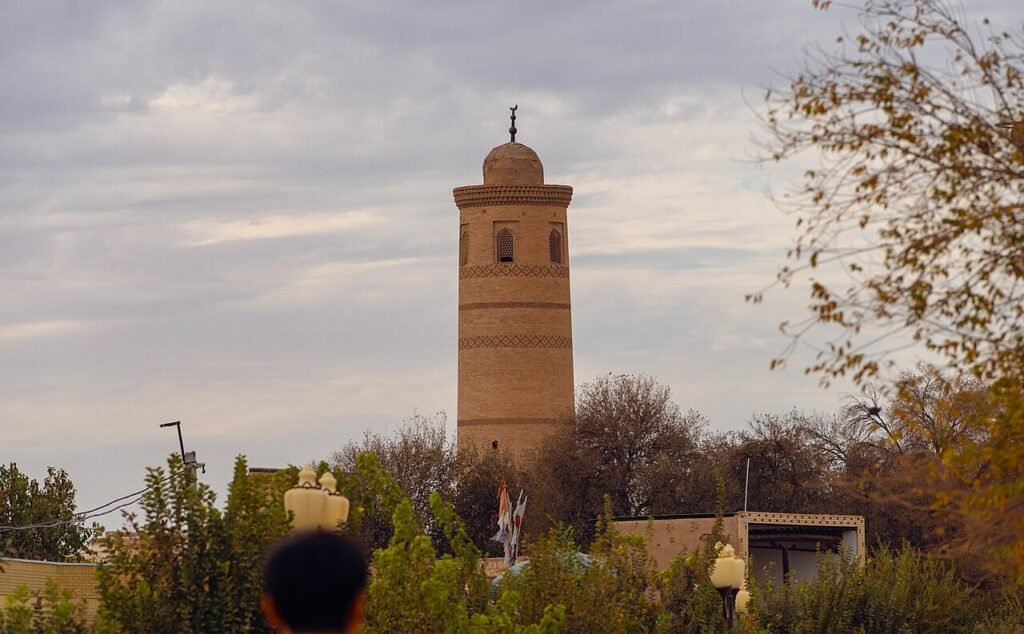

Dzharkurgan Minaret: A Visitor Guide
Dzharkurgan Minaret is an unusual medieval monument in Surkhandarya, southern Uzbekistan. Its deeply ribbed brick shaft rises near Minor village, about 5 kilometres from Jarkurgan and approximately 40 kilometres from Termez according to Uzbekistan’s tourism information. The surviving structure is a distinctive example of early 12th-century brick architecture and forms part of the wider cultural landscape associated with ancient Termiz.
This is a focused heritage stop rather than a large museum complex. The minaret stands as the principal surviving element of a medieval religious setting; the mosque once located beside it has not survived. Visitors should therefore come mainly to study the tower’s unusual form, inscriptions and masonry, while allowing time for local navigation and checking current arrangements before departure.
Why visit Dzharkurgan Minaret
Dzharkurgan Minaret is best known for a surface that looks corrugated, braided or woven. Instead of relying primarily on colourful glazed tile, its visual character comes from the arrangement of baked bricks and the repeated ribs of the shaft. The effect changes with the light: from a distance the tower appears monumental and compact, while from close by the shadows between the ribs become the dominant feature.
The monument is especially rewarding for travellers interested in Islamic architecture, medieval Central Asia and the history of the Surkhandarya region. UNESCO’s documentation for Ancient Termiz includes Djarqurgan Minaret among the area’s important archaeological and architectural remains. The listing places the monument within a region where Buddhist, pre-Islamic and Islamic sites reflect the long cultural history of the Amu Darya and northern Bactria.
Dzharkurgan is also valuable precisely because it is incomplete. The missing upper portion and the absent mosque make the surviving shaft an archaeological fragment rather than a fully preserved ensemble. That fragment still communicates the ambition of the original design through its scale, rhythmic brickwork and surviving epigraphic decoration.
History and architectural significance
Heritage records date the minaret to 1108–1109. A tourism description identifies 1109 as the construction date, while another account notes that the inscription has sometimes been interpreted as indicating completion approximately in 1110. For visitors, the most reliable summary is that Dzharkurgan Minaret belongs to the early 12th century.
The inscription is associated with the architect Ali ibn Muhammad of Serakhs and with the political authority of Sultan Sanjar, who is described in the sources as the patron or ruler connected with the construction. The monument is linked to the medieval settlement of Charmangan. Meros records that a congregational mosque once stood beside the minaret, but the mosque has not survived.
The present tower represents the lower preserved portion of a larger structure. Meros describes the former minaret as two-tiered and records a current height of approximately 21.6 metres. Other official tourism material says that the tower may originally have reached about 43 metres. Because the sources describe the original height differently, visitors should treat the larger figure as an estimate rather than as a securely established measurement.
The reason the upper section disappeared is not settled in the sources. The Uzbekistan Travel account connects the monument’s shifted axis with the possibility that it was unfinished or partly destroyed and also reports differing views about the disappearance of the mosque and upper structure. It is better to present these as historical possibilities than as a single confirmed explanation.
Architectural details
The base is described as octagonal. Above it, the shaft is formed by sixteen adjoining or closed semi-columns. Their fluted arrangement creates the monument’s characteristic corrugated appearance. The ribs broaden toward the lower part and draw closer together higher on the preserved shaft, producing a strong upward movement.
The brickwork is another defining feature. Official descriptions refer to a herringbone or interlocking pattern made from specially arranged baked bricks. This technique turns ordinary brick into the main decorative medium. The result is a surface with pronounced relief, alternating bands of light and shade, and a texture that can appear almost textile-like.
Descriptions also mention Qur’anic inscriptions and an inscription identifying the architect and construction period. Some of the religious text is reported to be unfinished. The surviving epigraphy helps establish the monument’s date and connects the tower with the religious architectural culture of medieval Khorasan and Transoxiana.
Look closely at the transition between the lower body, the arched brick details and the inscription zone. From several angles, the ribs appear to twist or converge differently. Photography can record the overall silhouette, but walking around the monument—where permitted—gives a better understanding of how the masonry was composed.
Access and visitor planning
The minaret is near Minor village in Jarkurgan District, Surkhandarya Region. Uzbekistan Travel places it about 5 kilometres from Jarkurgan and about 40 kilometres from Termez. Another official description identifies its location between Kumkurgan and Termez. Use a current local map and confirm the final approach before setting out, because transliterations may vary between Jarkurgan, Dzharkurgan and Jarqorgon.
The monument is best planned as a drive-to visit. If you are not travelling by private vehicle, arrange transport in advance and give the driver both the monument name and Minor village as reference points. Allow additional time for navigation, parking decisions and possible delays on the final approach.
Current opening hours, entrance fees, restroom provision, guide services and internal access are not consistently published in the sources reviewed. Visitors must confirm these details locally with a tourism office, heritage authority or trusted accommodation before departure. Do not assume that the spiral staircase mentioned in older tourism material is currently open; climbing may be restricted for conservation or safety reasons.
Road conditions and final access arrangements should also be checked locally, particularly after adverse weather. Carry drinking water, sun protection and practical footwear. There is no verified basis for claiming current on-site services or availability, so independent travellers should prepare for a short, largely self-guided heritage visit.
Cultural etiquette
Treat the monument as a protected historical site with religious associations. Do not climb, touch fragile brickwork, remove fragments or enter fenced areas. Follow local instructions and any signs present at the site, even when they differ from older online descriptions.
Dress respectfully, keep noise low and ask before photographing residents or other visitors. Avoid treating nearby homes or village spaces as part of the attraction. If photography, drone use or interior access is relevant to your visit, confirm the rules locally before proceeding.
Frequently asked questions
Where is Dzharkurgan Minaret?
It is near Minor village in Surkhandarya Region, outside Jarkurgan. Official tourism information places it approximately 5 kilometres from Jarkurgan and about 40 kilometres from Termez.
When was the minaret built?
Heritage records date it to 1108–1109, with some descriptions using 1109 and another possible reading suggesting completion approximately in 1110. It is generally treated as an early 12th-century monument.
What makes the minaret unusual?
Its octagonal base, sixteen adjoining fluted semi-columns and herringbone brickwork create a deeply corrugated appearance. The decoration is produced principally through shaped and arranged baked brick rather than a smooth, tile-dominated surface.
Can visitors climb the minaret?
Do not assume that climbing is permitted. Older published material mentions an internal spiral staircase, but current access and safety conditions must be confirmed locally before visiting.
Dzharkurgan Minaret is a compact but memorable monument whose importance lies in the combination of date, craftsmanship and survival. Its ribbed brick shaft preserves an exceptional architectural idea, while the missing mosque and upper sections remind visitors that the modern site is only part of a once larger medieval setting. Plan transportation carefully, confirm operational details locally and approach the monument with the respect due to a protected cultural landmark.
Sources
- Uzbekistan Travel — Surkhandarya: Cradle of Ancient Civilizations
- Uzbekistan Travel — Jarkurgan Minaret: A Corrugated Miracle
- UNESCO World Heritage Centre — Ancient Termiz tentative-list documentation
- Meros — Jarkurgan Minaret, Termez
Automatically prepared reference guide, checked by automated source and translation checks; not an on-site review.