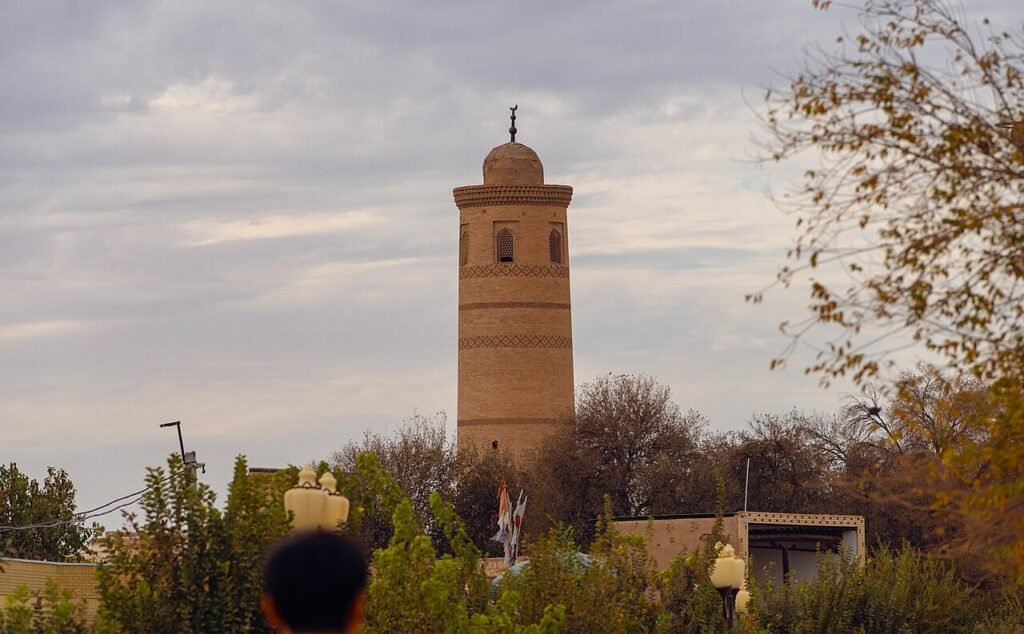
Ata Darvaza Khiva: Guide to the Western Gate

Ota Darvoza (West Gate), Khiva (481786) (2).jpg; by upyernoz from Haverford, USA (Ota Darvoza (West Gate), Khiva Uploaded by AlbertHerring), via Wikimedia Commons; CC BY 2.0.
Ata Darvaza—also written Ota Darvoza or Ata Khauz—is the principal western gateway into Itchan Kala, the walled inner city of Khiva. More than an entrance, it is a useful starting point for understanding how Khiva worked as a fortified oasis town: travellers arrived through a controlled passage, commercial activity gathered nearby, and the monumental skyline of the old city opened beyond the gate.
Why Ata Darvaza matters
Ata Darvaza stands on the western side of Itchan Kala, the historic inner town of Khiva. UNESCO describes Itchan Kala as a coherent urban ensemble enclosed by defensive walls, with streets, residences, mosques, madrasas, markets and caravan-related buildings preserved within the fortified area. The city was an important resting place for caravans travelling across the Khorezm oasis before the desert routes towards Persia.
That larger setting is essential. Visitors often arrive at Ata Darvaza looking for a single architectural monument, but the gate is best understood as part of a functioning historic city. It marked the transition between the outer urban area and the protected inner settlement, while the passage beyond led directly into a dense landscape of tiled façades, narrow lanes, domes, minarets and shaded courtyards.
It is also one of the most practical orientation points in Khiva. The western entrance is close to several of the city’s best-known landmarks, including Kalta Minor and the Muhammad Amin Khan Madrasa. From here, it is easy to begin a walking circuit through the central monuments of Itchan Kala.
History and the meaning of its name
The name is connected with the setting of the gate. Uzbekistan’s official tourism information associates Ata Darvaza with the Sher Muhammad Ata Mosque and a hauz, or traditional water basin, located in front of the entrance. In other words, “Ata” refers not only to the gate itself but also to the religious and civic surroundings that once gave the area its identity.
The present gate was built of fired brick between 1804 and 1806. According to the same account, the entrance area included a customs post and a currency-exchange office. This detail helps explain why gates in historic Central Asian cities were more than defensive structures: they were points of administration, inspection, trade and social contact.
The gate was reconstructed in 1975 to preserve the appearance of the museum-reserve and to follow its earlier form. The restoration was carried out under the direction of master Samandar Kalandarov. As with many restored monuments in Itchan Kala, the visitor experience today combines historic fabric with carefully managed conservation work. The surrounding urban composition, rather than the survival of every individual original element, is what gives the entrance much of its character.
What to notice at the gate
Look at the relationship between gate and wall
Begin by stepping back from the entrance instead of walking through immediately. Ata Darvaza makes sense when seen as part of the long earthen and brick defensive enclosure. Notice the contrast between the massive wall, the relatively narrow passage and the busy open space outside. The design communicates controlled movement: people and goods entered through a defined point rather than along an open street.
Observe the material and scale
The gate is built from fired brick, a material that appears throughout Khiva’s historic architecture. Official descriptions give the gate’s dimensions as approximately 10 metres in length and 4 metres in width. These measurements describe the structure and passage rather than a simple monumental façade, so the impression on site comes from the combination of the arch, wall thickness and adjoining urban spaces.
Turn towards the skyline
After entering, look for the distinctive turquoise and blue profile of Kalta Minor. The unfinished minaret stands near the western approach and is one of Khiva’s most recognisable landmarks. Its broad, decorated shaft provides a useful visual anchor as you move deeper into Itchan Kala.
Also pay attention to the rhythm of the streets. Khiva’s appeal lies not only in isolated monuments but in the way madrasas, mosques, trading spaces and residential buildings form a continuous historic environment. The UNESCO-listed ensemble is valuable precisely because the monuments remain connected to an urban plan and lived architectural tradition.
How to plan your visit
Allow at least 20–30 minutes to appreciate Ata Darvaza itself, including time to view it from outside, pass through the entrance and photograph the surrounding walls. If you are using the gate as the beginning of a wider Itchan Kala visit, allow several hours for nearby monuments and lanes.
- Start early or late in the day. Morning and late afternoon usually provide softer light for the brickwork and fewer harsh shadows. Khiva can be very hot in the middle of the day, particularly in summer.
- Begin outside the gate. This gives you the clearest sense of its position in the fortifications and its relationship to the approach road.
- Continue towards Kalta Minor. From the western entrance, the minaret and Muhammad Amin Khan Madrasa form a natural first stop.
- Explore at walking pace. The major monuments are close together, but the best details are often found in doorways, carved wood, brick patterns and quiet residential lanes.
- Use a guide if history matters to you. A local guide can clarify changing names, restoration phases and the relationship between Itchan Kala and the outer city.
Entry arrangements for Itchan Kala, monument interiors, museum tickets and guided visits can change. Check current information locally or with the official museum-reserve authorities shortly before visiting, especially if you are travelling in a group or arriving outside the main daytime period.
Nearby sights
Ata Darvaza works particularly well as the first stop on a western Itchan Kala route. From the gate, consider visiting:
- Kalta Minor Minaret, the broad, turquoise-clad monument that dominates the western skyline.
- Muhammad Amin Khan Madrasa, one of the prominent monuments beside the western approach.
- Itchan Kala, for a broader overview of the fortified city, its monuments and its walking routes.
- Oq Mosque, a quieter architectural stop that helps show the range of religious buildings within the old city.
If you have more time, continue towards the Juma Mosque, Kunya-Ark Fortress, Tash Khauli Palace and the Pahlavan Mahmud Mausoleum. A longer walk can also take you towards Palvan Darvaza and the eastern trading quarter, creating a route across the full width of Itchan Kala.
Etiquette, access and photography
Ata Darvaza is an active entrance and public passage, so avoid blocking the archway while taking photographs. Step to one side, especially when residents, workers, guides or other visitors are passing through. The area may be uneven underfoot, and the historic streets can be challenging for wheelchairs, mobility scooters and visitors who need completely level access.
Wear comfortable shoes and carry water. Modest clothing is advisable throughout Uzbekistan’s historic religious sites, particularly when entering mosques, mausoleums or other sacred spaces. Ask before photographing people, shop interiors or religious activity. Photography rules may differ inside individual monuments and can change, so follow posted instructions or ask staff before using a tripod or other specialist equipment.
Frequently Asked Questions
Where is Ata Darvaza in Khiva?
Ata Darvaza is on the western side of Itchan Kala, the walled inner city of Khiva. It is close to Kalta Minor and the Muhammad Amin Khan Madrasa.
Is Ata Darvaza the same as Ota Darvoza?
Yes. Ata Darvaza, Ota Darvoza and Ata Khauz are spelling or transliteration variants used for the same western gate. “Ota” is also common in Uzbek-language usage.
When was Ata Darvaza built?
The present gate was built from fired brick between 1804 and 1806. It was reconstructed in 1975 in an effort to preserve its earlier appearance.
How long should I spend there?
Plan on 20–30 minutes for the gate and its immediate surroundings, or use it as the starting point for a half-day exploration of western and central Itchan Kala.
Sources and further reading
- Uzbekistan Travel: The Main Gates of Ichan Kala – Ata Darvaza
- UNESCO World Heritage Centre: Itchan Kala
- Uzbekistan Travel: Khiva Overview
- whc.unesco.org
- uzbekistan.travel
- whc.unesco.org
Featured image: Ota Darvoza (West Gate), Khiva (481786) (2).jpg; by upyernoz from Haverford, USA (Ota Darvoza (West Gate), Khiva
Uploaded by AlbertHerring), via Wikimedia Commons; CC BY 2.0. The image may be automatically resized or cropped for display.