

Kalyan Minaret Bukhara: History and Visitor Guide

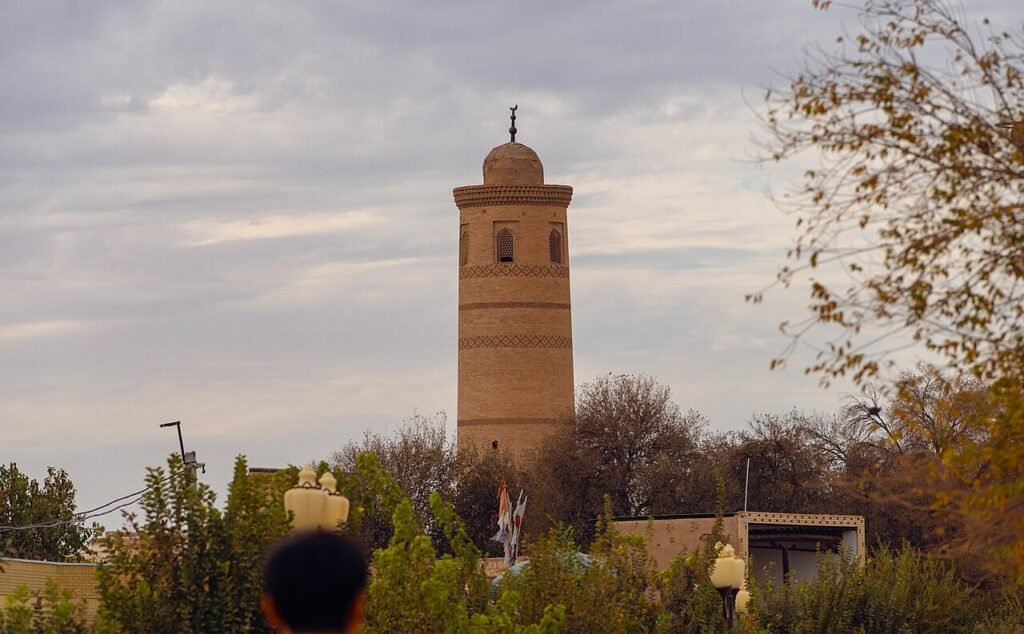
Photo: Kalan Minaret 04.jpg by Bgag, Wikimedia Commons, CC0.
The Kalyan Minaret is one of Bukhara’s defining landmarks: a tall, tapering tower of fired brick rising above the historic centre and the Poi Kalyan ensemble. Built in 1127 during the Karakhanid period, it has served as a religious landmark, a civic signal point and a visual guide across the city. Today, the best way to appreciate kalyan minaret bukhara is to see it not as an isolated tower, but as the vertical centrepiece of a historic square framed by the Kalyan Mosque and Mir-i Arab Madrasa.
Why the Kalyan Minaret matters
The minaret belongs to Bukhara’s Historic Centre, a UNESCO World Heritage property recognised for its remarkably intact medieval urban fabric and its importance as a centre of Islamic culture on the Silk Roads. UNESCO identifies the Poi Kalyan minaret as an outstanding Karakhanid-period monument and a masterpiece of brick decoration.
Its importance is architectural as well as symbolic. The tower gives the Poi Kalyan square its unmistakable profile, while its survival connects present-day visitors with the religious, scholarly and commercial life of medieval Bukhara. The surrounding ensemble developed over several centuries, so the minaret’s 12th-century structure stands beside major buildings associated with the 16th-century transformation of the site.
History and legends
The present minaret was built in 1127 under the Karakhanid ruler Arslan Khan. Official Uzbek tourism information associates the construction with the architect Bako, whose name is traditionally said to have been recorded on the upper part of the tower. The minaret replaced an earlier tower and mosque complex that had failed soon after construction.
The site had already been associated with congregational worship for centuries. According to Uzbekistan’s national tourism account, a congregational mosque with a minaret stood here after the Arab conquest in the 8th century. In the 12th century, Bukhara was rebuilt on a grander scale, and a new mosque and minaret were commissioned. The earlier tower reportedly collapsed, damaging much of the mosque, before the surviving Kalyan Minaret was built.
One of the most famous stories concerns Genghis Khan’s conquest of Bukhara in 1220. The popular legend says that when he looked up at the tower, his helmet fell off. As he bent to retrieve it, the gesture was interpreted as a bow, and the minaret was spared. This is a memorable tradition rather than a securely documented explanation for the monument’s survival, but it remains deeply embedded in Bukhara’s visitor culture.
The minaret’s principal function was religious: it provided a place from which the call to prayer could be proclaimed. Historical accounts also associate it with public announcements, observation and, at certain periods, executions. The nickname “Tower of Death” reflects this darker chapter, but it should not obscure the structure’s primary role within Bukhara’s religious landscape.
Architecture and brick decoration
The Kalyan Minaret is built from fired brick and has a powerful, carefully controlled silhouette. UNESCO documentation describes the tower as approximately 46.5 metres high, with a base about 9 metres in diameter. It narrows as it rises, creating a strong upward movement without relying on coloured tilework.
Look closely at the shaft rather than judging it only from a distance. Horizontal bands of brickwork create changing patterns of diamonds, ribs and woven-looking textures. The decoration is structural and ornamental at the same time: the masonry gives the tower rhythm, while the alternating patterns prevent such a large surface from appearing heavy or monotonous.
At the summit is a lantern-like rotunda with 16 arched openings beneath a stalactite-style cornice. The upper section once included an additional round element; UNESCO conservation documentation notes that only a cone-shaped remnant survives above the rotunda. From ground level, the open crown appears delicate compared with the massive shaft below.
The minaret is also an impressive example of historical engineering. Its circular plan, tapering body and carefully bonded brickwork allowed it to remain visually stable and highly legible across the cityscape. Its relationship with the square is equally important: the tower rises behind the open space, the mosque occupies one side, and the Mir-i Arab Madrasa faces it across the ensemble.
What to notice during a visit
- The changing brick patterns: Walk around the square and compare the decorative bands from different angles. Low afternoon light often brings out the relief of the masonry.
- The proportion of the tower: Notice how broad the base is compared with the narrow upper shaft. This gradual taper gives the minaret its sense of height.
- The crown: The arched openings and projecting cornice are easiest to study from the open square, where the tower is not crowded by nearby buildings.
- The ensemble: Frame the minaret with the Kalyan Mosque and Mir-i Arab Madrasa. Their later construction helps explain how Bukhara’s monumental religious centre evolved over time.
- The urban setting: Step back and observe how the minaret acts as a landmark within the dense historic town, much as it would have guided residents and travellers in earlier centuries.
A realistic visit plan
Allow around 45 minutes to an hour for the minaret and the surrounding square, or longer if you plan to visit the associated mosque and madrasa. Begin with a full view from the Poi Kalyan area, then walk slowly around the accessible edges of the ensemble to study the brickwork and the relationship between the buildings.
Morning light can be comfortable for photography and sightseeing, while late afternoon often gives the brick a warmer colour. In summer, the open square can be hot, so carry water and consider visiting earlier or later in the day. Bukhara’s historic centre is best explored on foot, but its surfaces may include uneven paving, steps and narrow passages.
The minaret itself is a functioning heritage monument rather than a modern observation tower. Do not assume that climbing access is available. Opening arrangements, restoration work, entry policies and photography rules can change; verify current conditions locally or through official visitor information shortly before your visit.
Etiquette, access and photography
The Poi Kalyan ensemble includes active and historically important religious buildings. Dress modestly, covering shoulders and knees, and behave quietly near prayer spaces. Follow signs and staff instructions, particularly during worship or official events.
Photography from the public square is generally the easiest way to capture the minaret, but restrictions may apply inside religious buildings or during ceremonies. Ask before photographing worshippers, staff or local residents. A wide-angle view from across the square usually communicates the monument better than standing directly beneath it.
Visitors with limited mobility should plan ahead. The square and surrounding historic streets may not provide fully step-free access, and the interior routes of associated monuments can be uneven. A companion or local guide may be useful for identifying the most manageable approach.
What to see nearby
The minaret is the centre of a compact walking route through Bukhara’s old town. Continue into the Kalyan Mosque to understand the religious setting of the tower, then look across to the Mir-i Arab Madrasa, whose façade forms one of the ensemble’s most recognisable views.
From Poi Kalyan, you can walk toward the covered Trading Domes of Bukhara, where the historic commercial life of the city is easier to imagine. The Ark of Bukhara offers a contrasting view of political power, while the Samanid Mausoleum provides an earlier and more intimate example of brick architecture.
Frequently Asked Questions
How old is the Kalyan Minaret?
The surviving minaret was built in 1127, during the Karakhanid period. The site itself had earlier congregational mosque and minaret structures.
How tall is the Kalyan Minaret?
UNESCO conservation documentation gives the height as approximately 46.5 metres. Measurements may be presented differently in popular descriptions, so treat small variations cautiously.
Can visitors climb the minaret?
Do not assume that climbing is permitted. Access can depend on conservation conditions, safety arrangements and current site policy. Check shortly before visiting.
What is the best time to photograph it?
Early morning and late afternoon usually provide gentler light. For the most complete composition, photograph from across the Poi Kalyan square rather than directly at the base.
Sources and further reading
- UNESCO World Heritage Centre: Historic Centre of Bukhara
- UNESCO World Heritage Centre: Bukhara Reactive Monitoring Report, Kalon Minaret Project
- Uzbekistan Travel: Poi-Kalon Architectural Ensemble
- uzbekistan.travel
- whc.unesco.org
- whc.unesco.org
Photo: Kalan Minaret 04.jpg by Bgag, Wikimedia Commons, CC0.




4 Comments
[…] provides an essential comparison with the better-known madrasa complex across the street. The later Kalyan Minaret Bukhara: History and Visitor Guide and nearby religious monuments often attract more attention, but Ulugh Beg Madrasa rewards visitors […]
[…] the historic centre, it works well as one stop in a compact walking itinerary. Continue toward the Kalyan Minaret and the surrounding Poi Kalyan area, or walk toward the old commercial quarter and its domed […]
[…] Talipach Gate as an introduction or conclusion to a wider Bukhara heritage route. The Kalyan Minaret and the Poi Kalyan Ensemble show the city’s monumental religious architecture, while the Trading […]
[…] comparison with the Kalyan Minaret in Bukhara is useful, but avoid treating Vobkent as merely a smaller copy. The two towers share proportions […]