
Polvon Qori Madrasa Khiva: Visitor Guide

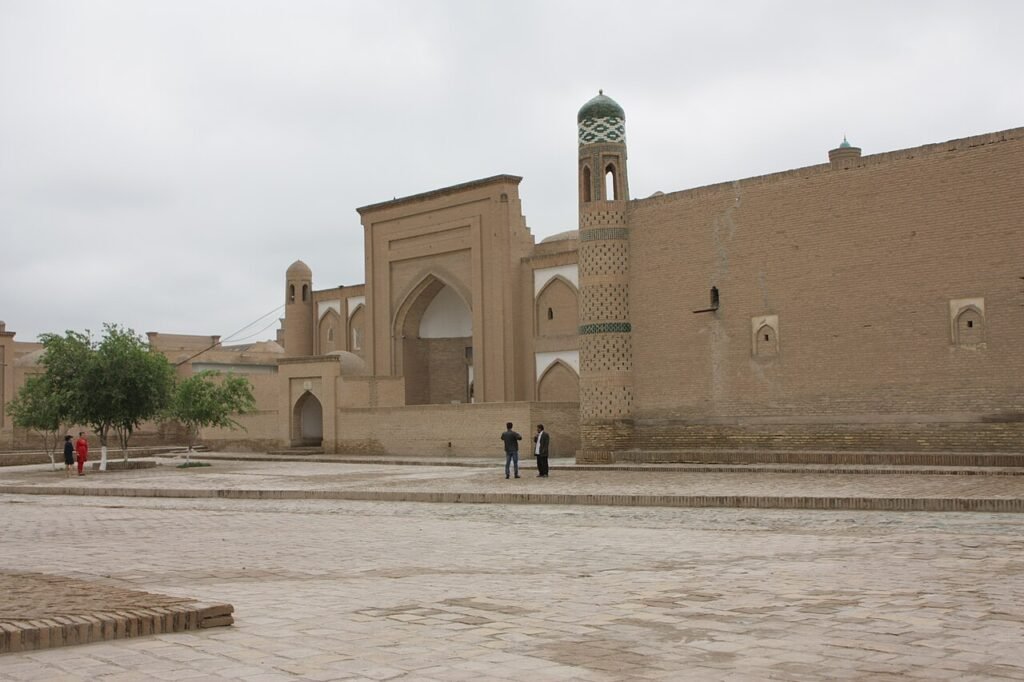
Photo: Polvon qori madrasasining minorasi 03.jpg by Panpanchik, Wikimedia Commons, CC BY-SA 4.0.
Polvon Qori Madrasa Khiva is an early twentieth-century religious and architectural complex in Dishan Kala, the historic outer city beyond Itchan Kala’s famous walls. Built for the Khivan merchant Polvon Qori, the complex combines a madrasa, mosque spaces and a striking minaret whose straight cylindrical form sets it apart from many older monuments in Khiva.
Why visit Polvon Qori Madrasa?
Most first-time visitors to Khiva concentrate on Itchan Kala, the walled inner city recognised by UNESCO for its dense collection of monuments, mosques, palaces and madrasas. Polvon Qori Madrasa offers a different perspective. It stands in Dishan Kala, where Khiva’s historic urban landscape is more dispersed and where monumental buildings are encountered among modern streets and everyday neighbourhood life.
The complex is especially worthwhile for travellers interested in how Khivan architecture developed at the turn of the nineteenth and twentieth centuries. Rather than repeating the proportions and decorative language of earlier madrasas exactly, Polvon Qori’s building reflects a period of experimentation. Its minaret is unusually broad and almost strictly cylindrical, while the madrasa is associated with European-influenced forms described in heritage documentation as having a truncated-cone character.
The site is also a useful reminder that Khiva’s heritage extends beyond the principal tourist circuit. After visiting the complex, you can continue towards Palvan Darvaza, Khiva’s eastern gate, or explore the wider history of Dishan Kala.
History and setting
Heritage records date the complex to 1905. It was commissioned by Polvon Qori, described as a prominent merchant of Khiva. According to the English-language heritage record, he was also connected with the court of Muhammad Rahim Khan II and played a role in the city’s commercial relations with places including the Russian Empire and Turkey. His wealth from trade helped finance the construction.
The madrasa was built at the intersection of Kariev Street and Polvon Qori Street in the eastern part of Dishan Kala. The area is historically linked with the Saidbiy complex, a group of religious buildings that included a two-storey madrasa, a minaret and a mosque. Descriptions of the Polvon Qori complex refer to more than fifteen rooms, winter and summer mosque spaces, and a substantial minaret.
Some heritage descriptions use the name “Madrasah and minaret of Palvan Kari,” while others use “Polvon Qori.” These are variant transliterations of the same name. The date is generally given as 1905, although broader cataloguing places the monument within the nineteenth–twentieth-century period. For a careful historical reading, it is best to treat 1905 as the commonly cited construction date rather than assume that every part of the surviving complex was completed in exactly the same phase.
Architecture and details
The minaret
The most memorable feature is the minaret, reported at approximately 21 metres high. Heritage descriptions identify it as one of the most monumental minarets in Dishan Kala. Its form is notably different from the tapering, segmented minarets that dominate the visual identity of older Khivan monuments.
Instead of narrowing markedly as it rises, the shaft appears strongly vertical and cylindrical. This departure from established local conventions has attracted the attention of researchers, although the exact reason for the design remains uncertain. It may reflect changing architectural tastes around the turn of the century, new construction ideas or the influence of wider regional contacts. Visitors should regard these explanations as interpretations rather than a settled answer.
From a distance, the minaret can be read as part of Khiva’s wider sequence of vertical landmarks. Inside Itchan Kala, towers and minarets help structure the skyline; in Dishan Kala, Polvon Qori’s tower performs a similar role on a more open urban stage.
The madrasa and decoration
The complex is comparatively restrained in its decoration. The principal concentration of ornament is around the entrance portal rather than across every wall. Green glazed tile appears in the upper part of the portal, while the small corner turrets are also associated with green decoration on their domes.
This limited use of colour is worth noticing. Khiva is often associated with brilliant blue and turquoise tilework, but not every important building is covered in elaborate ceramic patterns. At Polvon Qori, the contrast between plain wall surfaces, the entrance emphasis and the vertical minaret gives the complex a more architectural than theatrical character.
Look closely at the relationship between the madrasa and its associated religious spaces. The complex is described as having both winter and summer mosques, suggesting that seasonal comfort and changing patterns of use were built into the institution. As with many historic madrasas, the rooms would have supported study, residence and religious activity, although the surviving visitor experience may not make every original function immediately legible.
Planning your visit
Polvon Qori Madrasa works best as part of a wider walking or taxi-based excursion through Dishan Kala rather than as an isolated stop. Allow around thirty to forty-five minutes for the exterior, the minaret and the surrounding streets, adding time if the complex is open and you are able to see interior spaces.
- Start early or late in the day: softer light makes the minaret and entrance details easier to photograph, while summer afternoons can be very hot.
- Check access locally: public opening arrangements, restoration work, entrance fees and photography rules can change. Verify the current situation shortly before visiting through your accommodation, a local guide or the relevant heritage authority.
- Dress respectfully: this is a former religious complex, so modest clothing is appropriate. If prayer or community activity is taking place, keep a quiet distance and follow local instructions.
- Expect uneven surfaces: historic streets and thresholds may be difficult for visitors using wheelchairs or with limited mobility. Confirm the route in advance if step-free access is important.
- Bring water: Dishan Kala can feel exposed, and shade may be limited around the monument.
Photography is usually most rewarding from outside, where you can include the full minaret and the relationship between the complex and the surrounding streets. Avoid assuming that every interior, worship area or resident-facing space may be photographed. Ask before taking pictures of people.
What to see nearby
A visit to Polvon Qori can be combined with several other Khiva experiences. The eastern approach makes Palvan Darvaza a natural companion stop, especially for travellers interested in the movement between the outer and inner cities. Within Itchan Kala, compare Polvon Qori’s modernising architectural character with the more established madrasa traditions represented by the Muhammad Rahim Khan Madrasa or the Shergazi Khan Madrasa.
You can also visit the Uch Avliyo Mausoleum or continue towards the Oq Mosque. These comparisons help place Polvon Qori within Khiva’s broader religious landscape rather than viewing it only as a solitary monument.
Frequently Asked Questions
Where is Polvon Qori Madrasa?
It is in the eastern part of Dishan Kala, Khiva’s historic outer city, at the intersection of Kariev Street and Polvon Qori Street.
When was Polvon Qori Madrasa built?
The complex is commonly dated to 1905. Heritage catalogues also classify it broadly within the nineteenth–twentieth-century architectural period.
What is unusual about its minaret?
Its approximately 21-metre shaft is unusually straight and cylindrical rather than strongly tapering, making it distinct from many earlier Khivan minarets.
Can visitors go inside?
Access may depend on current conservation work, local management and religious use. Opening hours, fees and photography rules should be checked shortly before your visit.
Sources and further reading
- Meros.uz: Madrasah and minaret of Palvan Kari
- Meros.uz: Polvon Qori monument record
- UNESCO World Heritage Centre: Itchan Kala
- www.meros.uz
- api-portal.gov.uz
- www.meros.uz
Photo: Polvon qori madrasasining minorasi 03.jpg by Panpanchik, Wikimedia Commons, CC BY-SA 4.0.