
Ayaz-Kala Fortress: A Visitor Guide
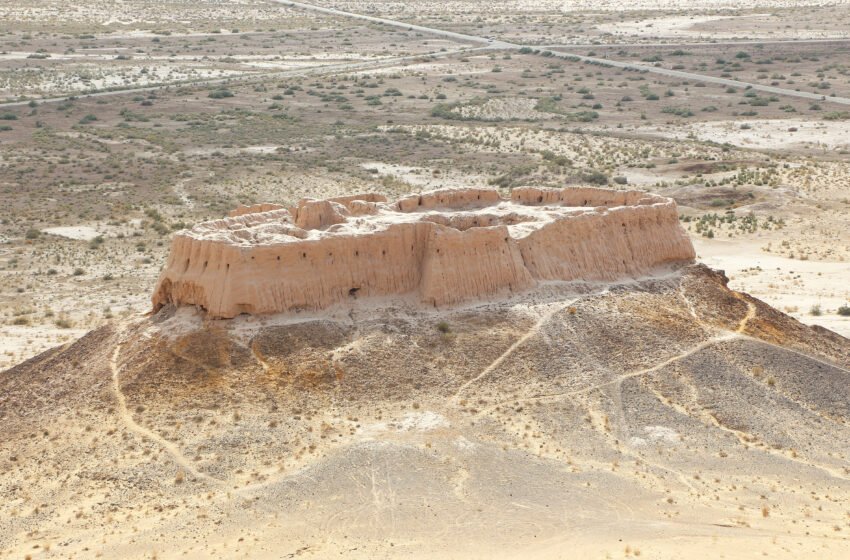
Ayaz-Kala 2, Karakalpakstan. Photo: Bernard Gagnon / Wikimedia Commons, CC0 1.0.
Ayaz-Kala is an archaeological complex in Karakalpakstan, Uzbekistan, consisting of three historic fortified sites in the Kyzylkum Desert. The settlements are located near the Ayazkol area and the former ancient Khorezmian center of Toprak-Kala. UNESCO identifies Ayaz-Kala 1 in Beruniy district and Ayaz-Kala 2 and Ayaz-Kala 3 in Ellikkala district. The complex lies about 20 kilometers northeast of Buston. Its mud-brick walls, hilltop position and wide desert setting make it one of the most memorable archaeological landscapes in the lower Amu Darya region.
Why visit Ayaz-Kala?
Ayaz-Kala is best understood as a group of related settlements rather than a single castle. The three sites occupy separate hills and nearby terrain at the foot of the Sultan-Uvais ridge, overlooking the desert. Their different layouts and building histories allow visitors to compare several forms of ancient fortification within one landscape.
The main attraction is the relationship between the ruins and their surroundings. Ayaz-Kala 1 occupies a high hill, while the other settlements extend across nearby rises and lower ground. From the hill, the view reaches across the open plain toward the Ayazkol area. Uzbekistan Travel renders the name as “fortress in the wind,” a fitting description of a site exposed to sun, dust and strong air currents.
This is a destination for travelers interested in ancient Khorezm, defensive architecture and the archaeology of desert oases. It is not presented as a restored medieval citadel or a conventional museum complex. Much of the experience comes from reading the surviving walls, towers and settlement outlines in relation to the terrain.
History and archaeological setting
The 2025 submission on UNESCO’s Tentative List dates Ayaz-Kala 1 to the fourth–third centuries BC, Ayaz-Kala 2 to the seventh–early eighth centuries AD, and Ayaz-Kala 3 broadly to the fourth century BC–third century AD. This guide follows that component-by-component chronology rather than combining differing dates from tourism summaries.
These are three distinct archaeological sites, not a documented sequence in which one fortress simply replaced another. Their different dates and layouts help visitors explore the long history of fortification in ancient Khorezm. They should not be taken as proof of uninterrupted occupation throughout the periods listed.
Ayaz-Kala 1 is the principal high fortress. The official description records double mud-brick walls, an outer wall reaching about 10 meters in height in places, and semicircular towers set at intervals. The hill provided a natural defensive advantage and allowed the settlement to command a broad view of the surrounding landscape. The entrance was arranged on the southern side, where the approach could be controlled through a more complicated passage.
Ayaz-Kala 3 adds a different perspective. Its powerful enclosing wall and surviving traces of a large palace-like structure show that the complex included more than isolated lookout posts. Ayaz-Kala 2, on a nearby separate hill, completes the group and helps explain why visitors should allow time to consider the three settlements together.
UNESCO’s Tentative List places Ayaz-Kala 1, Ayaz-Kala 2 and Ayaz-Kala 3 among a wider group of ancient towns and fortresses in Karakalpakstan. The Tentative List is not the same as inscription on the World Heritage List, but it records the sites as components of a broader cultural landscape associated with the history of the Aral Sea region and ancient Khorezm.
What to see
Ayaz-Kala 1 and its hilltop walls
Start with the high fortress, where the hill and the defensive architecture are easiest to understand together. Walk carefully around the surviving wall lines and look for the pattern of towers, the thickness of the mud-brick construction and the changes in elevation. The site’s strongest impression comes from the way the builders used the hill as part of the defense rather than treating the walls as a separate structure.
Ayaz-Kala 2
Ayaz-Kala 2 stands on a separate nearby hill. Its later history adds another chronological layer to the complex. Its compact hilltop outline offers a useful visual contrast with the larger enclosure of Ayaz-Kala 1. Consider each part of the complex separately when comparing its layout and history.
Ayaz-Kala 3
At Ayaz-Kala 3, focus on the scale of the enclosing wall and the surviving outlines inside it. The remains of large buildings and the entrance system help visitors imagine how movement, residence and defense were organized. Fragile mud-brick ruins can be easily damaged, so observe the walls without climbing or removing fragments.
The desert panorama
Set aside time for the landscape itself. The Uzbekistan Travel article published in May 2022 places the main fortress near Ayazkol and describes the saline reservoir as almost dry at that time. Conditions and the appearance of the surrounding lake or salt-marsh zone can change, so older photographs should not be treated as a reliable guide to what visitors will see on a particular day.
Access and desert conditions
Ayaz-Kala is approximately 20 kilometers northeast of Buston. Urgench, which has an airport and railway station, is about 80 kilometers away according to official tourism information. The same source describes access by rented or private transport, sightseeing excursions and journeys through Buston followed by a local transfer.
Ask your driver or guide which parts of the complex the itinerary covers and where the walking routes begin. Current road conditions, transfer availability and the final approach are not verified in this guide. Confirm them before departure with your accommodation, a reputable tour operator or an official tourism contact. Do not assume that public transport or a taxi will take you directly to every settlement.
General precautions for an outdoor archaeological visit: carry drinking water, sun protection, a hat and sturdy footwear, and check the weather before departure. Ask locally about shade, facilities and safe walking routes rather than assuming they are available. Do not climb the walls or approach edges whose stability you cannot judge. These are planning recommendations, not a current inspection of site conditions. Confirm opening hours, entrance arrangements, prices, access restrictions and photography rules before travelling.
Cultural etiquette and responsible visiting
Ayaz-Kala is an archaeological monument, and its surviving bricks, pottery fragments and stones are part of the evidence that makes the site valuable. Do not remove objects, mark walls or rearrange materials. Follow established tracks where possible and avoid driving across archaeological remains or unexplored mounds.
As a general rule for responsible visiting, keep noise low, take litter away and remain on established roads and paths. Avoid unnecessary off-road driving, especially near wall lines and settlement mounds. These recommendations are intended to protect archaeological remains and the surrounding landscape; they do not describe a verified local driving regulation.
If your itinerary includes a nearby yurt camp or contact with local residents, follow local guidance and ask permission before photographing people, homes, animals or private activities. Dress respectfully and make dietary restrictions clear before accepting food or tea. Participate in community activities only when invited.
Visitor planning
Ayaz-Kala can form part of a wider archaeological journey through the surrounding Karakalpakstan region, including other ancient sites such as Toprak-Kala. Allow time for transfers between locations and for walking over uneven ground. An early start may be more comfortable in hot weather, but the most suitable time depends on the season and conditions on the day.
Arrange return transport before setting out if travelling independently. Carry water and basic personal supplies rather than relying on services at the ruins. Current mobile coverage, fuel availability, local accommodation, yurt-camp services and card-payment facilities are not verified here and should be checked locally.
The most rewarding visit is slow and observant. Compare the three settlements, study how walls and towers relate to the hills, and consider the wider geography of ancient Khorezm. Ayaz-Kala’s appeal lies in the combination of archaeological scale, exposed desert terrain and the visible remains of fortified sites from different historical periods.
Frequently asked questions
Where is Ayaz-Kala?
Ayaz-Kala is in Karakalpakstan, Uzbekistan, about 20 kilometers northeast of Buston, near the Ayazkol area and the ancient settlement of Toprak-Kala. The three components are not all in the same district: UNESCO identifies Ayaz-Kala 1 in Beruniy district and Ayaz-Kala 2 and Ayaz-Kala 3 in Ellikkala district.
How many settlements make up the complex?
There are three principal settlements: Ayaz-Kala 1, Ayaz-Kala 2 and Ayaz-Kala 3. They occupy separate hills or nearby terrain and differ in date, layout and surviving remains.
Can I visit independently?
Independent travel is possible in principle, but the desert setting and the separate locations require advance planning. Confirm the route and final approach locally, arrange return transport, and carry water, sun protection and suitable footwear. An organized excursion or local guide may simplify transport and interpretation.
Are opening hours and ticket prices available?
Current opening hours, entrance fees, access restrictions and photography rules are not verified in this guide. Visitors must confirm operational details locally before travelling.
Sources
- Uzbekistan Travel — Ayaz-Kala Fortress
- Uzbekistan Travel — Ayaz-Kala Settlement
- UNESCO World Heritage Centre — Ancient towns and fortresses of the Aral Sea region
AI-assisted reference guide; historical statements and translations reviewed against the linked sources before publication. Not an on-site review. Current visitor arrangements should be confirmed locally.