Fayaztepa Buddhist Temple Complex: A Visitor Guide
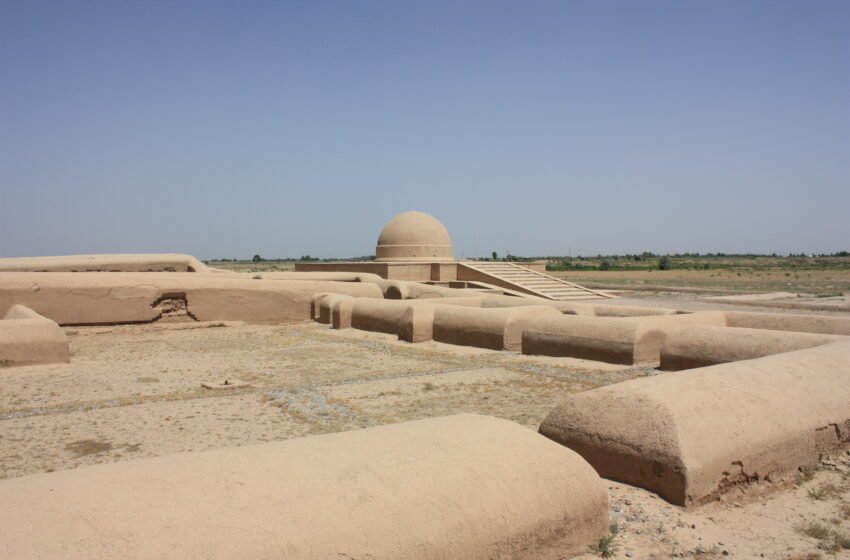
Fayaztepa monastery remains and the protective dome over the stupa, 2008. Photo: Arian Zwegers / Wikimedia Commons, CC BY 2.0.
Fayaztepa is a Buddhist archaeological complex in the territory of ancient Termez, in Uzbekistan’s Surkhandarya Region. Its remains include the outlines of a temple, monastic buildings, an inner courtyard and a small stupa associated with the complex. The site forms part of the archaeological landscape of Old Termez, a region where Buddhist, Iranian, Hellenistic and Central Asian cultural traditions met.
Fayaztepa is not a complete standing monument. Visitors mainly see conserved earthen ruins, low walls, room outlines and the layout of a former monastic community. It is best understood together with other ancient Termez sites, including Karatepa, Zurmala and Kampirtepa, and with the collections of the Termez Archaeological Museum.
Why Fayaztepa matters
Uzbekistan’s tourism information commonly dates Fayaztepa from the 1st century BC to the 3rd century AD. UNESCO’s description of Ancient Termiz gives a different chronology, placing Fayaztepa within a 1st–4th-century AD Kushan-period Buddhist landscape of northern Bactria. These ranges should be treated as differing source chronologies rather than as a single settled date. Both connect the site with the period when Buddhism was active in ancient Termez.
During this broad historical period, ancient Termez was a significant urban and cultural centre connected to routes along the Amu Darya and across Central Asia. The location helps explain why a Buddhist complex developed here. Merchants, religious communities and artistic traditions travelled between South Asia, Iran, the Hellenistic world and Central Asia. Fayaztepa therefore represents more than an isolated temple: it is evidence of the movement and adaptation of Buddhism in an interconnected ancient environment.
UNESCO describes Fayaztepa as an above-ground Buddhist temple complex, or sangharama, organized around a central courtyard. The broader complex included religious and residential spaces, while the courtyard was surrounded by galleries and decorated architectural elements. Archaeological remains from the site have contributed to understanding Buddhist architecture, painting and sculpture in the Kushan cultural sphere.
What to see at Fayaztepa
The complex plan. Start by studying the overall arrangement rather than viewing the ruins as isolated walls. Published descriptions identify three principal parts: a temple, a monastery and a courtyard with utility or service rooms. Another Uzbekistan tourism publication describes a monastic section with thirteen rooms, while the main Fayaztepa page describes a temple with nineteen separate rooms. Because these descriptions refer to different parts or interpretations of the complex, visitors should avoid treating either number as a complete, definitive plan of the entire site.
The central courtyard. The courtyard is one of Fayaztepa’s defining features. UNESCO describes a rectangular courtyard surrounded by religious premises and galleries, with painted walls and covered architectural spaces along its edges. The courtyard helps visitors imagine how movement, ritual activity and community life were organized within the complex.
The Buddhist triad. A Buddhist triad discovered at Fayaztepa is regarded by Uzbekistan’s tourism authority as the site’s most important find. The original is held by the State Museum of the History of Uzbekistan. A copy is reported to be displayed at the Termez Archaeological Museum. The triad helps explain the relationship between the surviving architecture and the sculptures once associated with it, although current museum display arrangements should be confirmed before visiting.
The stupa and its protective dome. The ancient stupa stands beside the monastery. The dome visible today is a modern shelter built during conservation work, following the form of the larger outer stupa recorded in excavations. It protects the surviving ancient structure; it is not an ancient dome preserved intact.
Traces of everyday activity. Archaeological descriptions mention cooking installations, coins, vessels, lamps with lotus imagery and other household objects. These finds show that Fayaztepa was not only a ceremonial setting but also a lived-in institution. The complex accommodated a monastic community, and one Uzbekistan tourism publication also associates it with lodging for pilgrims.
Historical context
Fayaztepa belongs to the wider Buddhist heritage of ancient Termez, which also includes Karatepa and other archaeological sites. UNESCO identifies ancient Termez as a large archaeological area containing a citadel, urban quarters and suburbs. In the Kushan period, the city functioned as an important centre of northern Bactria, with several Buddhist monasteries.
The site’s archaeological importance became more widely recognized after a Buddha image was found in the ancient Termez area in 1968. Subsequent investigations brought attention to Fayaztepa and helped encourage the study of other Buddhist sites in southern Uzbekistan. The complex’s modern name commemorates R. F. Fayazov, a local museum director and researcher associated with its study.
Fayaztepa was eventually buried by sand and debris and later exposed through archaeological work. Published accounts differ on details of its chronology and later history. The most cautious summary is that the complex was active during the period when Buddhism flourished in ancient Termez, with sources variously assigning it to the 1st century BC–3rd century AD range or the 1st–4th centuries AD.
Planning your visit
Uzbekistan’s tourism information places Fayaztepa approximately 4 kilometres from modern Termez. UNESCO describes Old Termez as lying about 5 kilometres northwest of the modern city, while individual monuments are dispersed across the wider archaeological zone. In practice, Fayaztepa is best approached as one stop on a broader Old Termez excursion rather than as a guaranteed short walk from the city centre.
Visitors should confirm current access arrangements locally before travelling. Verified current information on opening hours, ticket prices, staffing, photography rules, road conditions and the exact areas open to visitors was not identified in the reviewed official sources. Check with your accommodation, a local guide or the relevant heritage authority shortly before departure. Do not assume that older online descriptions reflect current operating conditions.
Prepare for an exposed archaeological environment. Sun protection, drinking water and practical footwear are sensible precautions, but local conditions can vary. Archaeological ground may be uneven, and conserved walls or exposed masonry can be fragile. Follow any barriers or instructions at the site and do not climb, sit on or remove material from the ruins.
Allow time for interpretation. A museum visit can make the architectural remains easier to understand, particularly if the Fayaztepa triad copy is available to view when you visit. Combining Fayaztepa with Karatepa and Zurmala can also provide a fuller picture of Buddhist architecture around ancient Termez, although transport arrangements and access to each location should be confirmed locally.
Site care and etiquette
Fayaztepa is an archaeological monument and a place of Buddhist religious heritage. Keep voices low, avoid touching surfaces and never take pottery fragments, bricks or other objects as souvenirs. Even apparently ordinary pieces may have archaeological value.
Dress respectfully, particularly if your itinerary also includes Islamic mausoleums or living religious sites in the Termez area. Follow local instructions concerning photography, movement through the site and access to restricted areas. Ask permission before photographing guides or other visitors, and leave no rubbish behind.
Frequently asked questions
How far is Fayaztepa from Termez?
Uzbekistan’s tourism information gives a distance of approximately 4 kilometres from modern Termez. The actual journey time depends on the route, transport and current access conditions, which should be confirmed locally.
When was Fayaztepa built?
There is no single chronology presented consistently across the reviewed sources. Uzbekistan tourism information commonly gives the range from the 1st century BC to the 3rd century AD, while UNESCO’s Ancient Termiz material places Fayaztepa in the 1st–4th centuries AD. The site should therefore be described as belonging broadly to the period when Buddhism was established in ancient Termez and developed within the wider cultural world of Bactria and the Kushan Empire.
What are the main features of the site?
Look for the temple and monastic layouts, the central courtyard, the small stupa associated with the complex, wall niches, conserved earthen structures and traces of service areas. The Termez Archaeological Museum is also associated with a copy of the Fayaztepa Buddhist triad, although current display arrangements should be confirmed before visiting.
Are opening hours and ticket prices published?
Current opening hours, admission prices, staffing, photography rules and visitor access were not verified in the reviewed official sources. Confirm all operational details locally before setting out, and do not rely on an old online listing.
Sources
- Uzbekistan Travel: Fayaztepa Buddhist Temple Complex
- Uzbekistan Travel: Surkhandarya, Cradle of Ancient Civilizations
- UNESCO World Heritage Centre: Ancient Termiz (Tentative List)
- Uzbekistan Travel: Archaeological Sites of Surkhandarya
- CRATerre–ENSAG / UNESCO: Fayaz Tepa conservation project report (2006)
Prepared using AI. Sources and translations rechecked on 4 October 2026, including the distinction between ancient remains and modern conservation work. This is a desk-researched reference guide, not a report of an on-site visit.