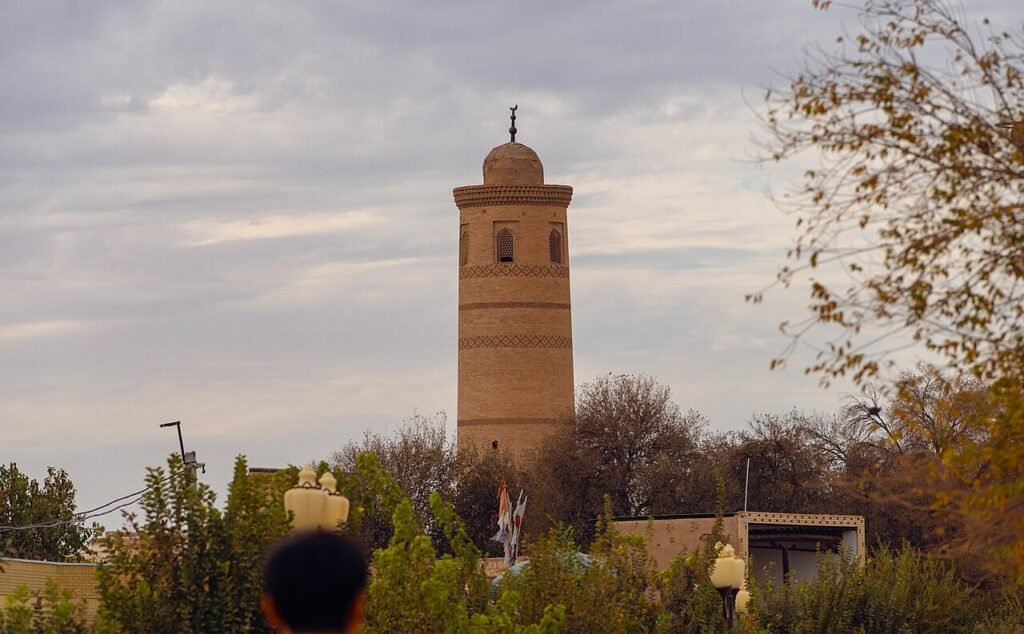

Sitorai Mokhi-Khosa Palace: A Visitor Guide from Bukhara

Photo: Sitorai Mokhi-Khosa Palace 02.jpg by Bgag, Wikimedia Commons, CC0.
The Sitorai Mokhi-Khosa Palace is one of the most distinctive places to visit outside Bukhara’s historic centre. Built as a summer residence for the last emirs of Bukhara, it combines local craftsmanship with European-inspired rooms, diplomatic interiors and a quieter garden setting. The result is a palace that feels different from the city’s medieval madrasas and mosques, yet reveals much about Bukhara’s final years as an emirate.
Why visit Sitorai Mokhi-Khosa Palace?
Sitorai Mokhi-Khosa Palace, whose name is commonly translated as “Palace of Moon-like Stars”, offers a different perspective on Bukhara. The city centre is celebrated for its Islamic architecture and Silk Road atmosphere; this residence instead presents the tastes, ambitions and contradictions of the emirate’s ruling family in the late nineteenth and early twentieth centuries.
The palace is especially worthwhile for visitors interested in decorative arts. Rooms contain examples of carved and moulded plasterwork, mirrors, furniture, textiles, glass, ceramics and other objects associated with court life. The building also demonstrates how Bukhara’s traditional artistic vocabulary was adapted to a residence influenced by Russian and European models.
History and historical context
The residence developed in stages. The older section is associated with an earlier, more traditionally eastern palace, while the newer complex was expanded and completed in the early twentieth century under Emir Said Alim Khan, who ruled from 1911 to 1920. Official tourism descriptions present the site as the country residence of the last emir of Bukhara.
Its location outside the main city was practical as well as prestigious. A suburban summer residence offered gardens, cooler air and space for court life away from the crowded urban centre. It also provided a setting for formal receptions and private domestic quarters.
The palace belongs to the final chapter of the Bukhara Emirate. In 1920, following the advance of Soviet forces, Said Alim Khan left Bukhara for Afghanistan. The palace subsequently changed function and is now used as a museum of decorative and applied arts. Because popular accounts sometimes simplify the chronology of the older and newer buildings, visitors should treat exact construction dates for individual structures cautiously.
Architecture and interiors
A meeting of eastern and European styles
The most important feature of Sitorai Mokhi-Khosa Palace is its deliberate stylistic contrast. The complex includes elements rooted in Central Asian building traditions alongside forms associated with Russian and European country residences. Local builders and craftsmen worked alongside outside specialists, producing an ensemble that is neither purely European nor conventionally eastern.
Approaching the palace, notice the richly treated entrance and the contrast between its formal façade and the more intimate garden environment. The colours, decorative relief and architectural details create a ceremonial first impression. The palace’s layout includes separate areas connected with men’s and women’s quarters, reflecting courtly social organisation.
Decorative craftsmanship
Inside, the most memorable spaces are the reception rooms. Look closely at the ganch work, a finely modelled and carved plaster tradition widely used in Central Asian interiors. In the palace, this technique appears beside painted decoration, mirrors, patterned glass and imported or foreign-inspired furnishings.
The White Hall is often singled out for its luxurious mirrored surfaces and elaborate plaster decoration. Other rooms include a summer room with coloured windows, a dining room designed with movable partitions and spaces associated with official receptions. Rather than rushing through the galleries, compare the rooms: some are designed for ceremony, while others feel more domestic or seasonal.
What to see during your visit
- The entrance and approach: Take time to observe the portal, colour scheme and relationship between the palace buildings and the surrounding grounds.
- The White Hall: Study the mirrored walls, moulded plaster and changing effects of light. This is one of the clearest expressions of the palace’s courtly ambition.
- Coloured windows and glass: Look for how filtered light changes the atmosphere of the summer rooms.
- Furniture and applied arts: The collections help place the architecture in the context of everyday court life rather than treating the palace as an empty monument.
- The courtyard and garden setting: The open spaces provide a useful contrast with the richly decorated interiors and make the palace feel like a seasonal retreat.
Photography can be tempting, but displays and rooms may have their own restrictions. Follow signs and staff instructions, particularly where flash photography could affect historic finishes or museum objects.
Planning a realistic visit
The palace is around four kilometres north of central Bukhara, so most visitors reach it by taxi or organised excursion rather than on foot from the old town. It works well as a half-day outing, especially when combined with other sites outside the densest central area.
Allow roughly one to two hours for the palace itself, depending on your interest in the museum collection and the pace of your visit. The grounds and interiors are rewarding for close observation, so a hurried stop may miss the subtle relationship between architecture and objects.
- Wear comfortable shoes: the visit may include uneven outdoor surfaces and standing in several rooms.
- Carry water during hot weather, but check museum guidance before taking food or drinks into the grounds.
- Dress respectfully. Although this is a museum and palace rather than an active mosque, modest clothing is appropriate at historic and cultural sites.
- Opening hours, admission prices, restoration work and photography rules can change. Verify current details shortly before visiting through a local tourism office, your accommodation or the museum’s current notices.
- Visitors with limited mobility should ask locally about the route, thresholds and access to individual rooms, as historic buildings may not provide fully step-free access.
For a broader overview of the city’s monuments and practical planning advice, see the Bukhara Travel Guide.
What to see nearby
Sitorai Mokhi-Khosa is best understood as part of a wider Bukhara itinerary. You can pair it with the Samanid Mausoleum, whose early medieval brickwork represents a very different architectural tradition. The Ark of Bukhara provides another perspective on political power, but within the historic city itself.
Travellers planning a longer cultural route may also visit the Bahouddin Naqshband Memorial Complex. Together, these places show the range of Bukhara’s heritage: dynastic authority, religious learning, Sufi traditions, urban life and late court culture.
Frequently Asked Questions
Where is Sitorai Mokhi-Khosa Palace?
The palace stands approximately four kilometres north of Bukhara’s historic centre. A taxi is generally the simplest option for independent travellers.
Who built the palace?
The residence developed over several periods. Its older section belongs to an earlier palace tradition, while the newer complex was expanded under Emir Said Alim Khan in the early twentieth century. Local craftsmen and Russian or European-influenced architects contributed to the later ensemble.
How long should I spend there?
Plan for about one to two hours, plus travel time. Visitors who enjoy interiors, museum collections and photography may prefer to stay longer.
Can I take photographs inside?
Rules may vary by room and can change. Check posted notices and ask staff before photographing museum objects, interiors or using flash.
Sitorai Mokhi-Khosa Palace is most rewarding when approached not simply as a luxurious residence, but as a record of transition. Its mirrored halls, Central Asian plasterwork, coloured glass and formal gardens preserve the image of a court trying to balance inherited traditions with a rapidly changing political and cultural world.
Sources and further reading
- Uzbekistan Travel: Sitora-i Mokhi-khosa, country residence of the last emir of Bukhara
- Meros.uz: Sitorai Mokhi-Khosa Palace
- UNESCO World Heritage Centre: Sitorai Mokhi Khosa Summer Palace
- Uzbekistan Government: Ancient Bukhara travel programme
- app.uzbekistan.travel
- uzbekistan.travel
Photo: Sitorai Mokhi-Khosa Palace 02.jpg by Bgag, Wikimedia Commons, CC0.