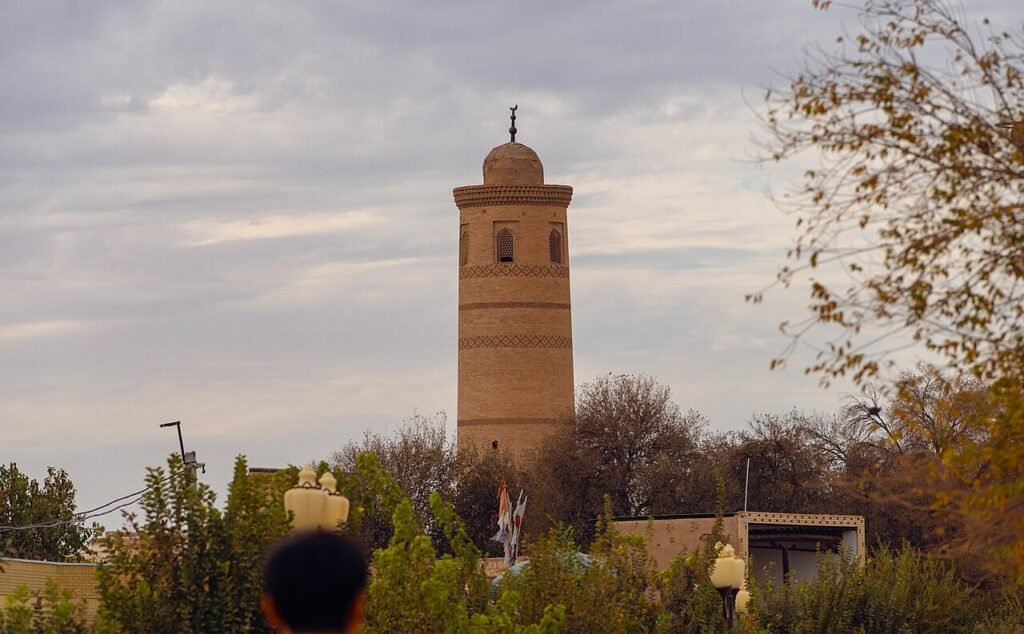

Fayzabad Khanaka Bukhara: A Visitor Guide
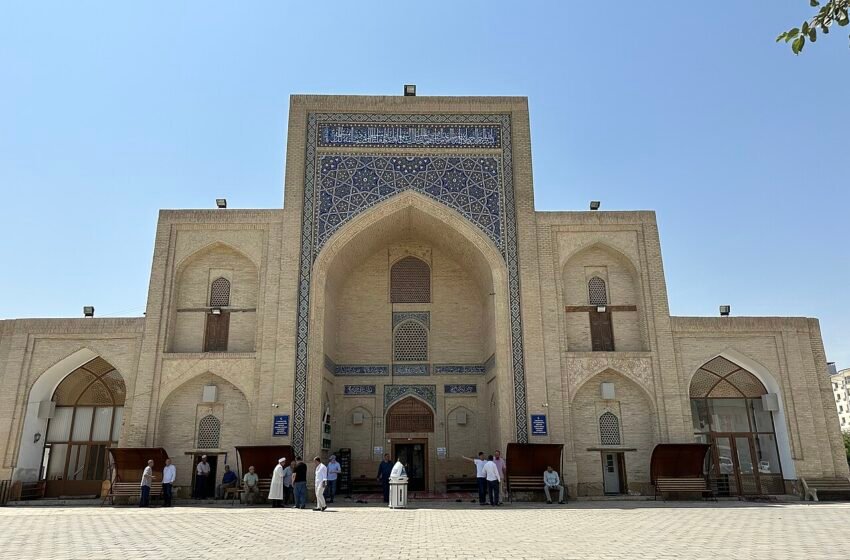
Photo: Faizabad Khanakah. Bukhara.jpg by Umid1108, Wikimedia Commons, CC BY-SA 4.0.
Fayzabad Khanaka is one of Bukhara’s quieter architectural landmarks: a late-sixteenth-century Sufi sanctuary built for prayer, spiritual gatherings and the temporary accommodation of dervishes. Its elegant central hall, domed galleries and surviving decorative details offer a more intimate experience than the city’s grandest ensembles. For visitors interested in religious architecture, Fayzabad Khanaka Bukhara provides a valuable glimpse into the devotional life of the city during the Shaybanid and early Ashtarkhanid era.
Why visit Fayzabad Khanaka?
A khanaka was a place associated with Sufi practice, where spiritual teachers and disciples could gather, worship and receive travellers. Unlike a madrasa, whose principal role was formal education, a khanaka combined religious, communal and sometimes charitable functions. Fayzabad Khanaka was also a mosque: historical descriptions identify it as a place for the five daily prayers as well as Friday prayer.
The building is especially rewarding for travellers who want to look beyond Bukhara’s headline monuments. Its importance lies not in a monumental portal or towering minaret, but in the way its plan brings together a ceremonial prayer space, covered galleries and residential cells. The result is an architectural expression of hospitality and religious community.
History and religious purpose
Fayzabad Khanaka was constructed in 1598–1599 by the Sufi figure Mavlono Poyand-Muhammad Ahsi, also associated with the name Fayzobodi. The dates place the building within a period when Bukhara was a major centre of Islamic scholarship, pilgrimage and long-distance trade. The historic city formed part of the wider cultural landscape of the Silk Roads and retains an unusually rich concentration of religious monuments.
The khanaka served several overlapping purposes. It accommodated Sufi ritual gatherings, provided a temporary residence for dervishes and functioned as a mosque for both ordinary and congregational prayer. This combination is important for understanding the building: it was not simply a shrine or a decorative monument, but a working religious institution connected to a living spiritual tradition.
Fayzabad’s founder is said to have died in 1601, only a short time after the building was completed. Details of the institution’s later history and present-day use are less consistently documented in visitor sources, so travellers should avoid assuming that every part of the former complex remains accessible or functions exactly as it did in the past.
Architecture and artistic details
The composition centres on a large, high and well-lit domed hall. On either side are open, arched galleries covered by smaller domes. These lateral spaces give the building a balanced appearance and create a gradual transition between the exterior courtyard environment and the main prayer hall.
Behind the mihrab—the niche indicating the direction of Mecca—were three levels of hujras, or small cells, intended for dervishes and temporary residents. Their position is a useful reminder that the khanaka was designed as both a place of worship and a place of residence. The accommodation was integrated into the religious building rather than placed in a separate hostel.
One of the most notable artistic features is the decoration of the interior dome. Descriptions of the monument refer to carved ganch, a traditional Central Asian plaster material, worked in a technique known as chaspak. Ganch decoration can appear delicate and almost lace-like, catching changing light across the curved surface. If the interior is open during your visit, look upward before moving quickly through the hall: the dome is the architectural detail most likely to reward a slow inspection.
The building’s appeal is therefore architectural rather than dependent on a large collection of movable objects. Notice the relationship between the tall central volume, the lower galleries and the rhythm of the arched openings. In Bukhara, where brick façades and blue-tiled portals often dominate the visitor experience, Fayzabad offers a more restrained study in proportion, light and space.
What to notice during your visit
- The central hall: Consider how its height and light create a sense of spaciousness within a relatively compact complex.
- The side galleries: Their repeated arches and domes provide the building’s strongest exterior and interior rhythm.
- The mihrab area: This helps explain the relationship between communal prayer and the residential cells behind it.
- The hujras: Look for evidence of the khanaka’s role as temporary accommodation for dervishes, while respecting any closed or restricted areas.
- The ganch work: Examine the dome decoration from different angles, especially where natural light changes the relief.
Planning a visit to Fayzabad Khanaka
Fayzabad Khanaka is best approached as part of a broader Bukhara heritage walk rather than as an isolated stop. Allow around 30–45 minutes if the monument is open and you would like time to observe the plan and details. The exact visiting arrangements may vary, including whether the interior, prayer spaces or residential sections can be entered. Opening hours, admission arrangements and photography rules can change, so verify them locally shortly before visiting.
Wear modest clothing suitable for a religious site. Shoulders and knees should be covered, and visitors may be asked to remove shoes before entering prayer areas. Keep voices low, avoid interrupting worshippers and ask permission before photographing people. Flash photography may be inappropriate or restricted, particularly in areas with fragile plaster decoration.
Accessibility may be limited. Historic religious buildings often have uneven surfaces, thresholds, steps and narrow passages, and the availability of ramps or adapted facilities is not reliably documented. Visitors using wheelchairs or travelling with mobility limitations should check access conditions in advance and consider visiting with a companion.
Bukhara’s summers can be intensely hot and dry, while winter days may be cool. An early-morning or late-afternoon visit is generally more comfortable for walking, although the best time depends on the monument’s current access schedule. Carry water, use sun protection and allow extra time for navigation through the old city’s lanes.
Nearby Bukhara sights
To place Fayzabad Khanaka in context, compare it with another Sufi residence in the city by visiting the Khoja Zaynuddin Mosque-Khanaka. Its combination of mosque, khanaka traditions and neighbourhood setting makes it a useful architectural counterpart.
For a more active central-city route, continue towards the Lyabi-Hauz Ensemble, where the Nadir Divan-Begi Khanaka forms part of a famous historic square. The contrast between Fayzabad’s quieter atmosphere and Lyabi-Hauz’s lively public setting illustrates the variety of Bukhara’s khanaka architecture.
You can also build a full day around the city’s best-known monuments with the Bukhara Travel Guide. The wider historic centre is recognised by UNESCO for its preserved urban fabric and exceptional concentration of Islamic architecture.
Frequently Asked Questions
What is Fayzabad Khanaka?
Fayzabad Khanaka is a late-sixteenth-century mosque and Sufi sanctuary in Bukhara. It served as a place of prayer, Sufi gatherings and temporary accommodation for dervishes.
When was Fayzabad Khanaka built?
The building was constructed in 1598–1599. It is associated with the Sufi figure Mavlono Poyand-Muhammad Ahsi, also known as Fayzobodi.
What architectural features are most important?
Look for the large central domed hall, the arched domed galleries on either side, the former three-storey hujras behind the mihrab and the carved ganch decoration of the interior dome.
Can tourists enter Fayzabad Khanaka?
Access conditions can vary. Some areas may be closed for worship, conservation or other local reasons. Confirm current opening arrangements, photography rules and any admission requirements shortly before your visit.
Sources and further reading
- Meros.uz: Fayzabad Khanqah
- UNESCO World Heritage Centre: Historic Centre of Bukhara
- Uzbekistan Travel: Bukhara
- Uzbekistan Travel: History of Bukhara
- www.meros.uz
- app.uzbekistan.travel
Photo: Faizabad Khanakah. Bukhara.jpg by Umid1108, Wikimedia Commons, CC BY-SA 4.0.