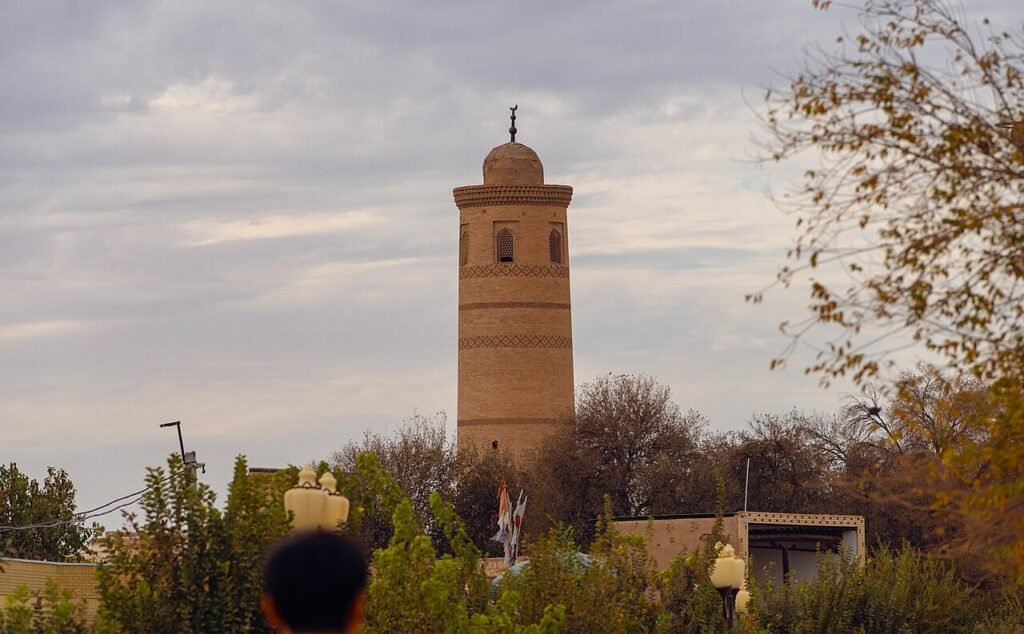

Bogbonli Mosque Khiva: A Visitor Guide

Photo: Bogbonli mosque.jpg by Carpodacus, Wikimedia Commons, CC BY-SA 4.0.
Bogbonli Mosque Khiva is one of the quieter monuments within Itchan Kala, the walled historic centre of Khiva. It does not compete with the city’s tallest minarets or most elaborate tile façades. Instead, it offers a closer look at the neighbourhood mosque tradition of Khorezm: compact prayer spaces, shaded ayvans, brick construction and carefully carved wooden details.
Why visit Bogbonli Mosque?
Most first-time visitors to Khiva follow the main monuments of Itchan Kala: the Juma Mosque, Kalta Minor, the khan’s palaces and the great madrasa façades. Bogbonli Mosque rewards a slower approach. Its value lies less in monumental scale than in the way it represents the religious and residential fabric of the old city.
UNESCO describes Itchan Kala as a coherent urban ensemble containing mosques, madrasas, mausoleums, markets, dwellings and narrow traditional streets. Bogbonli Mosque belongs to that larger story. It is best understood not as an isolated landmark, but as part of a living historic neighbourhood in which places of worship stood close to homes, workshops and routes through the city.
The monument is also useful for visitors interested in architectural comparison. The famous Juma Mosque in Khiva is an expansive hypostyle prayer hall known for its forest of columns. Bogbonli is more intimate, with a different spatial character that helps explain the variety of mosque design in Khiva.
History and setting
Bogbonli Mosque is also rendered as “Boghbon Mosque” or “Bagbanly Mosque” in some heritage references. The spelling varies because the name is transliterated from Uzbek and other regional forms. UNESCO’s inventory of monuments within Itchan Kala lists the mosque among the protected historic buildings of the walled city.
The available heritage descriptions place the mosque in the southern part of Itchan Kala. Its position is important: rather than serving only as a grand ceremonial building, it formed part of the ordinary religious life of the old city. In Khiva, many monuments were embedded in dense urban quarters, and their scale reflects local community use as much as royal patronage.
The precise construction history is not always presented consistently in visitor references. For that reason, it is safer to describe Bogbonli as a historic Khorezmian mosque within the mature architectural landscape of Itchan Kala rather than assign it a single confidently dated foundation without consulting a specialist inventory on site.
Itchan Kala itself has a history extending over two millennia and was inscribed on the UNESCO World Heritage List in 1990. The inner city was a final stopping point for caravans travelling across the oasis before the desert routes towards Iran. Its monuments preserve the traditions of Khorezmian builders, while its houses, streets and religious buildings together create the character that makes Khiva distinctive.
Architecture and details
The most useful architectural description of Bogbonli Mosque identifies a prayer hall with a domed covering and a single-column ayvan. An ayvan is a roofed, open-sided porch or gallery, often supported by wooden columns. In the hot, dry climate of Khorezm, this kind of shaded transitional space was both practical and architecturally expressive.
The arrangement differs from the large covered courtyard of Juma Mosque and from the formal monumental compositions of Khiva’s royal madrasas. Here, the relationship between the enclosed prayer room and the open porch is central. The ayvan provides shade, air movement and a place of transition before entering the more protected interior.
As with many Khiva monuments, the visual effect depends on restrained materials rather than an excess of surface decoration. Baked brick, plastered walls, timber and the play of light beneath the porch create a quieter atmosphere than the blue-and-white tilework associated with several of the city’s better-known buildings.
Look particularly at the wooden elements. Carved columns and beams are among the most distinctive features of Khorezmian architecture, and the surviving timber details in Khiva often preserve patterns, proportions and craftsmanship that are easy to miss when moving quickly between major attractions.
What to notice
- The scale: notice how the mosque feels integrated into the surrounding urban quarter rather than staged as a freestanding monument.
- The ayvan: study the relationship between the shaded porch and the prayer hall.
- The timber: inspect columns, capitals and beams for carving, joinery and signs of repair.
- The light: observe how the darker interior contrasts with the bright courtyards and sunlit brick streets.
- The urban context: look beyond the façade to the nearby lanes, walls and domestic buildings that form part of Itchan Kala’s heritage value.
These details also illustrate why UNESCO assesses Itchan Kala as an ensemble. The significance of Khiva is not limited to individual monuments. Its historic value comes from the harmony between major buildings, smaller religious structures, traditional houses, markets and defensive walls.
Planning your visit
Allow time for a walking circuit
Bogbonli Mosque is best included during a broader walk through Itchan Kala rather than treated as a stand-alone destination. Allow around 20 to 30 minutes for the mosque and its immediate surroundings, with additional time for the walk between other monuments. The old city is compact, but uneven paving, crowds and frequent stops for photographs can make short distances take longer than expected.
A practical route could begin near the southern section of Itchan Kala, continue towards the Juma Mosque and central monuments, and then proceed towards the palaces and eastern trading quarter. For wider orientation, the guide to Itchan Kala in Khiva is a useful companion.
Access, etiquette and photography
Historic surfaces in Itchan Kala are not uniformly level, and some entrances may include thresholds, steps or narrow passages. Visitors with limited mobility should plan conservatively and ask locally about the current approach before setting out. Accessibility can vary depending on conservation work and how the building is being used.
Bogbonli Mosque is a religious monument, not simply a photo stop. Dress modestly, keep voices low and avoid entering prayer areas during worship. If local worshippers are present, give them priority and follow any instructions from caretakers. Ask before photographing people, interiors or religious activity. Photography rules, access arrangements and opening conditions can change, so verify them shortly before your visit.
There is no reliable reason to assume that the mosque has fixed public opening hours or a separate ticket arrangement. Access may depend on the wider Itchan Kala system, conservation work or local use. Confirm current details at an official visitor point or with the monument’s caretaker on the day.
Nearby sights
Bogbonli Mosque fits naturally into a full day of sightseeing. The Khiva travel guide can help organise the wider route, while the city walls provide an essential perspective on the historic settlement and its defensive landscape.
For a contrast in scale and decoration, continue to the Tash Khauli Palace, where courtyards, carved wood and tilework express the ceremonial world of the khans. The Pahlavan Mahmud Mausoleum offers another change of mood, with a more strongly pilgrimage-oriented setting and richly decorated interiors.
Try to leave part of your schedule unplanned. Some of Khiva’s most memorable moments come from moving slowly through the lanes, noticing craftsmen at work, and comparing the monumental façades with the quieter buildings that support the city’s everyday character.
Frequently Asked Questions
Where is Bogbonli Mosque?
Bogbonli Mosque is in the southern part of Itchan Kala, the historic walled city of Khiva in Uzbekistan. It is one of the monuments included in heritage inventories of the UNESCO-listed inner city.
What is Bogbonli Mosque known for?
It is known for its compact Khorezmian mosque design, including a domed prayer hall and a single-column ayvan. Its intimate scale offers a useful contrast with Khiva’s larger congregational and royal monuments.
How long should I spend there?
Plan approximately 20 to 30 minutes for the mosque and its immediate setting, then combine it with other Itchan Kala monuments. The exact time depends on access, photography conditions and whether worship is taking place.
Can visitors enter and take photographs?
Access and photography permissions may vary according to religious use, conservation work and local instructions. Dress respectfully, ask before photographing people or interiors, and verify the current arrangements shortly before visiting.
Sources and further reading
- UNESCO World Heritage Centre: Itchan Kala
- UNESCO inventory: Ichan Kala of Khiva
- Meros: Juma Mosque and Minaret, including Khiva mosque typology
- Uzbekistan Travel: Khiva
- uzbekistan.travel
- www.dkm.gov.uz
Photo: Bogbonli mosque.jpg by Carpodacus, Wikimedia Commons, CC BY-SA 4.0.