

Palvan Darvaza Khiva: A Visitor Guide to the Eastern Gate

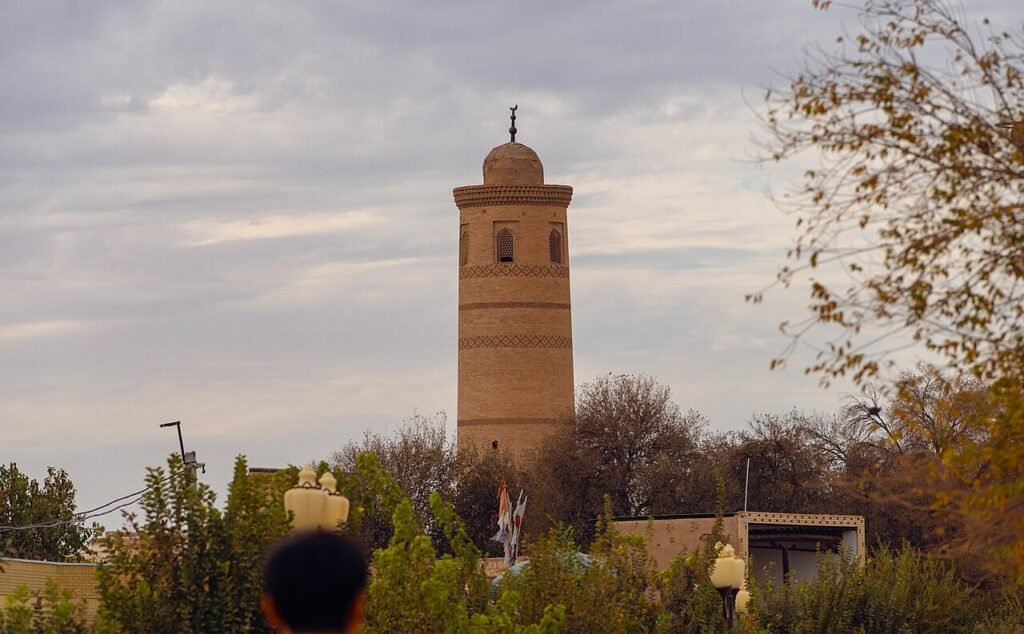
Photo: Palvan Darvoza 02.jpg by Bgag, Wikimedia Commons, CC0.
Palvan Darvaza Khiva is more than an entrance through the eastern wall of Itchan Kala. It is a compact historical district where a city gate, covered market passage, old bathhouse, neighbourhood mosque, madrasas and palatial architecture reveal how Khiva worked as a living urban centre. Allow time to look beyond the gateway itself: the surrounding streets contain some of the most rewarding details in the eastern part of the walled city.
Why Palvan Darvaza matters
Palvan Darvaza is the eastern gate of Itchan Kala, Khiva’s fortified inner city. UNESCO describes Itchan Kala as a remarkably preserved urban ensemble south of the Amu Darya, historically a last stopping place for caravans before the desert crossing towards Persia. Its compact plan preserves mosques, madrasas, palaces, markets, caravanserais and ordinary dwellings within high brick walls. (whc.unesco.org)
The gate is especially interesting because it combines defence and commerce. Instead of functioning only as a passage in the wall, it forms part of a built-up urban threshold. A covered corridor leads through the gate, while shops and other rooms occupy the adjoining spaces. The result is an architectural transition from the open streets outside to the dense commercial and residential fabric inside Itchan Kala.
History and the meaning of its name
The surviving inscription above the entrance records the construction date as 1221 in the Hijri calendar, corresponding to 1806. The gateway complex was completed under Allahquli Khan in 1835, reflecting the way Khiva’s major buildings were often developed in stages rather than created as a single project. The date and sequence are recorded by Uzbekistan’s cultural-heritage portal, although visitors may encounter slightly different spellings of the gate’s name in English, including Palvan, Palwan and Polvon Darvoza. (meros.uz)
The name honours Pahlavan Mahmud, the celebrated Khivan poet, wrestler and spiritual patron whose mausoleum became one of the city’s most important places of remembrance. “Pahlavan” or “Palvan” carries the sense of a strongman or champion. The name therefore connects the gate not only to a physical entrance but also to Khiva’s enduring local traditions of poetry, strength and saintly protection.
The area also has a difficult history. Historical accounts associate the space outside the gate with a slave market before its abolition in the nineteenth century, while the gate itself was used for public announcements and punishments. These subjects should be approached soberly: the commercial splendour of the trading quarter existed alongside unequal systems of power and coercion.
What to see around the gate
The gateway and covered passage
Begin by examining the entrance from both sides. Look for the defensive character of the walls, the arched portal and the relationship between the gate and the adjacent fortifications. Passing through, notice the sequence of roofed bays: the corridor is described as a stone-paved street covered by a chain of six domes. Beyond the entrance, a multi-domed trading gallery once accommodated merchants’ shops and small service spaces. (meros.uz)
Rather than viewing the gate as an isolated monument, read it as a piece of urban infrastructure. Its scale, shaded passage and built-in commercial rooms show how movement, trade and climate were negotiated in historic Khiva.
Oq Mosque and the Anush Khan bathhouse
Near Palvan Darvaza stands the modest but distinctive Oq Mosque, a neighbourhood mosque associated with the eastern gate. Its whitewashed appearance, domed prayer hall and surrounding aivan galleries make a useful contrast with the grander tiled monuments elsewhere in Itchan Kala. The mosque’s restrained decoration places emphasis on proportion, carved wood and the calm quality of its small courtyard. You can continue reading with our Oq Mosque in Khiva visitor guide.
The gate district also includes the Anush Khan bathhouse, founded in the seventeenth century and connected with the later development of the gate complex. Bathhouses were important civic institutions in Central Asian cities: they supported daily hygiene, social interaction and commercial life, while their domed roofs helped create a distinctive urban silhouette.
Madrasas, markets and palaces
Palvan Darvaza opens into one of Khiva’s richest architectural clusters. The ensemble includes the Allaquli Khan Madrasa, a covered trading dome known as a tim, a caravanserai and the Kutlug Murad Inaq Madrasa. Tash Khauli Palace is also nearby, with its courtyards, reception spaces and richly decorated tilework. For a fuller understanding of the palace, see our Tash Khauli Palace visitor guide.
Look for the contrast between monumental façades and the narrow, practical streets between them. Khiva’s beauty is not limited to blue tile. Brick vaults, carved doors, plaster surfaces, shaded passages and irregular junctions all contribute to the atmosphere of the district.
How to plan your visit
Most visitors enter Itchan Kala through the western Ata Darvaza, then walk across the walled city to Palvan Darvaza. This is a good approach because it lets you experience the gate as the eastern conclusion of a wider route rather than arriving only for a photograph. Itchan Kala is compact, but the hard surfaces, heat and frequent stops at monuments make a slow pace advisable.
- Allow 30–45 minutes for the gate, covered passage, Oq Mosque area and nearby streets.
- Allow two to three hours if combining the gate with Tash Khauli Palace, the Allaquli Khan trading quarter and nearby madrasas.
- Visit early or late for softer light, cooler temperatures and fewer groups.
- Carry water and wear comfortable shoes. Streets and thresholds can be uneven, and some passages are dim.
- Check current arrangements locally. Opening hours, monument access, entrance arrangements and photography rules can change, especially during restoration or official events.
For a broader orientation before exploring the eastern gate, use our complete Itchan Kala visitor guide.
Etiquette, access and photography
Palvan Darvaza is a heritage monument and a route used by residents, guides and visitors. Keep the passage clear, avoid climbing walls or decorative elements, and follow any temporary barriers. The Oq Mosque and nearby mausoleums remain places of religious and cultural significance, so dress modestly and lower your voice when entering prayer or pilgrimage spaces.
Photography is generally part of the Khiva experience, but ask before photographing worshippers, shopkeepers or craft workers at close range. Do not assume that tripods, flash photography or photography inside every religious building are permitted. Follow posted instructions and staff guidance.
Access is challenging for many travellers with limited mobility. Historic thresholds, cobbled or uneven surfaces, narrow passages and steps can make independent movement difficult. A companion or local guide can help identify the least demanding route, but conditions should be assessed on the day.
Nearby ideas
After visiting Palvan Darvaza, continue towards Tash Khauli Palace and the Allaquli Khan commercial quarter. The Allaquli Khan Madrasa and trading quarter guide is useful for understanding how commerce shaped this part of Itchan Kala.
You can also walk towards the Pahlavan Mahmud Mausoleum, whose blue-domed complex is central to Khiva’s religious memory. Alternatively, follow the city walls and compare the eastern gate with the other entrances. The differences between gates help explain how Khiva’s defensive architecture was adapted to changing traffic and urban needs.
Frequently Asked Questions
Where is Palvan Darvaza?
Palvan Darvaza is on the eastern side of Itchan Kala, the walled inner city of Khiva.
What is Palvan Darvaza known for?
It is known for its historic gateway, domed covered passage, commercial spaces and position beside the Oq Mosque, Anush Khan bathhouse and several important Khivan monuments.
How old is the gate?
An inscription records a construction date of 1806, while the gate complex reached its completed form under Allahquli Khan in 1835.
Can I visit Palvan Darvaza independently?
Yes. The gate lies within the walkable historic centre of Itchan Kala. A guide is not essential, but one can help explain the gate’s commercial history, religious context and architectural details.
Sources and further reading
- UNESCO World Heritage Centre: Itchan Kala
- Meros.uz: Palvan Darvaza
- Meros.uz: Itchan Kala
- Meros.uz: Oq Mosque in Khiva
- whc.unesco.org
- whc.unesco.org
Photo: Palvan Darvoza 02.jpg by Bgag, Wikimedia Commons, CC0.




2 Comments
[…] extends beyond the principal tourist circuit. After visiting the complex, you can continue towards Palvan Darvaza, Khiva’s eastern gate, or explore the wider history of Dishan […]
[…] Xiva merosi asosiy sayyohlik yo‘li bilangina cheklanmasligini eslatadi. Majmuani ko‘rgach, Xivaning sharqiy darvozasi — Polvon darvoza tomon yurish yoki Dishan qal’a tarixini kengroq o‘rganish […]