

Dishan Kala Khiva: Guide to the Outer City
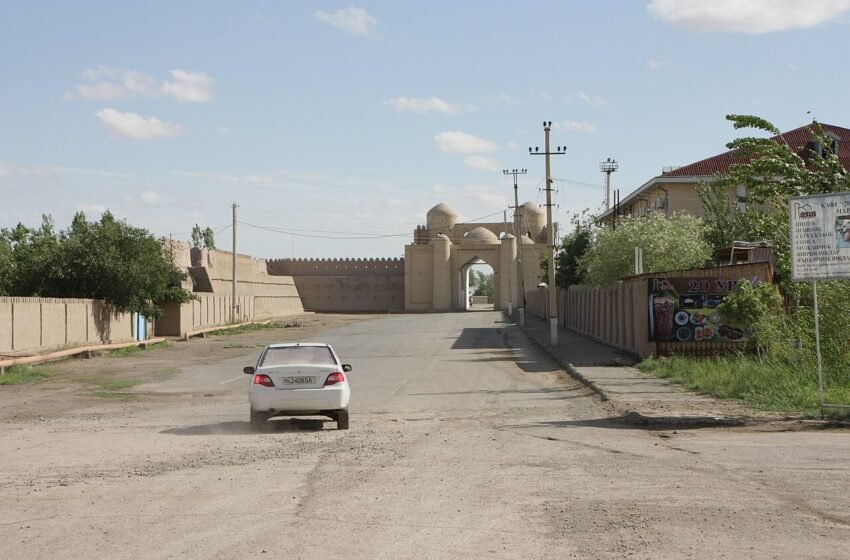
Photo: Ditchan Kala south gate.jpg by Davide Mauro, Wikimedia Commons, CC BY-SA 4.0.
Dishan Kala Khiva is the city’s outer defensive ring: a historic landscape of walls, gates, residential mahallas, water reservoirs and 19th-century buildings beyond the better-known monuments of Itchan Kala. It is less compact and less polished than the walled inner city, but it is essential for understanding how Khiva functioned as a living oasis capital rather than simply a collection of monumental buildings.
What is Dishan Kala?
The name Dishan Kala is usually translated as “outer city” or “external fortress,” in contrast to Itchan Kala, Khiva’s inner walled town. The two areas formed a connected urban system. Itchan Kala concentrated the khan’s citadel, major mosques, madrasas, mausoleums, markets and palace buildings. Dishan Kala extended beyond those walls into a broader defensive and residential zone.
For visitors, the distinction matters. Itchan Kala is a concentrated heritage site with a clearly defined circuit. Dishan Kala is a larger and more varied urban area where historic fragments stand alongside ordinary streets, homes, modern development and active neighbourhood life. Some sections are easy to explore on foot; others are best understood from a local guide, map or short taxi ride.
UNESCO’s documentation treats Dishan Kala as part of the historic setting and proposed buffer zone associated with the World Heritage property of Itchan Kala, rather than as a separate World Heritage property. Its importance lies partly in the relationship between the inner and outer city, and in the survival of traditional urban fabric beyond the famous walls.
History and urban form
The outer defensive circle was developed during the rule of Allakuli Khan in the 19th century. Official Uzbek tourism material places the construction of the defensive ring in the mid-19th century, while a 2025 government report identifies 1842 as the date associated with the building of Dishan Kala. The outer wall was intended to protect the expanding city, its neighbourhoods, gardens, roads and economic activity.
Dishan Kala reflects the traditional Central Asian pattern of a fortified centre surrounded by suburbs, residential quarters and productive land. The city was not only a royal seat. It depended on water management, craft production, trade, religious institutions and domestic compounds. The outer area therefore helps explain the practical infrastructure behind Khiva’s monumental image.
Historic descriptions identify a substantial defensive circuit with gates and towers. The wall was built largely from local earthen and mud-brick materials, which give Khiva its warm, textured appearance but also require regular maintenance. Erosion, weather, road construction and unplanned development have affected the survival of the circuit.
What to see
Surviving walls and gates
The most obvious starting point is the remaining outer wall. It is not preserved as continuously or as dramatically as the walls of Itchan Kala, so approach the visit as an exercise in reading the landscape. Look for changes in elevation, stretches of compacted earth, rebuilt sections, towers, gateways and the way streets follow or cut across the former defensive line.
Several historic gates are associated with Dishan Kala, although their condition and accessibility can change. A local guide can help identify surviving gates and distinguish original fabric from later repairs. Do not assume that every wall-like structure is safely accessible or open for climbing.
Nurullabay and other historic buildings
Dishan Kala contains or has historically contained important 19th-century buildings outside the inner fortress. The Nurullabay complex is especially significant as a royal residence associated with the later Khiva khans. It offers a useful contrast with the compact ceremonial architecture of Itchan Kala: the outer city included larger compounds, gardens and buildings connected to changing court life.
Heritage documentation also records the Matvafo Karavon Boshi summer residence, the Mamad Maram madrasa and minaret, historic water reservoirs known as khauzes, and remaining sections of the outer gates. Not all of these places are presented as a standard visitor circuit, and some may be closed, altered or difficult to locate. Verify current access locally before making them the centre of your itinerary.
Mahallas and everyday architecture
The most revealing feature of Dishan Kala may be its residential character. Traditional houses often use mud brick, plaster, timber and inward-facing courtyards to moderate heat and protect family life. Streets can feel quieter and less monumental than those inside Itchan Kala, with fewer grand façades and more evidence of ordinary urban routines.
Walk respectfully. A residential mahalla is not an open-air museum, and photographing doors, courtyards or residents without permission can be intrusive. Notice building proportions, shade, boundary walls, small mosques, trees and water-related features rather than searching only for decorated monuments.
How to visit Dishan Kala
Allow at least two to three hours if you want to combine a wall walk with one or two heritage buildings. A longer visit is worthwhile for travellers interested in conservation, traditional housing or the relationship between historic monuments and modern neighbourhoods.
- Begin inside Itchan Kala. Visit the inner city first, then leave through a gate and continue into the outer urban area. This makes the contrast between the two defensive zones easier to understand.
- Use a map and local orientation. Dishan Kala is spread out, and notable sites are not always signposted consistently. A licensed guide or hotel-arranged guide can save time.
- Choose cooler hours. Khiva’s climate is dry and hot in summer. Start early or walk later in the afternoon, carrying water, sun protection and comfortable shoes.
- Expect uneven conditions. Surfaces may include dust, broken paving, loose earth and narrow streets. Accessibility is limited in places, especially around earthen walls and older residential lanes.
- Check access shortly before visiting. Opening hours, ticket arrangements, restoration zones and photography rules can change, particularly while conservation and redevelopment projects are under way.
There is no reason to rush through Dishan Kala as though it were another compact monument. Its value is cumulative: a surviving wall here, a historic reservoir there, a traditional house front, a gate, a tree-lined lane and a view back towards the towers of Itchan Kala.
Heritage and conservation
Dishan Kala is also a place where the pressures of heritage protection are visible. UNESCO decisions have expressed concern about demolition and the loss of non-monumental urban fabric, while emphasising that the inner and outer parts of historic Khiva should be understood together.
In May 2025, Uzbekistan’s government reported plans to restore parts of the outer fortress, create green areas and improve public access along sections of the wall. The report described extensive damage to the circuit and proposed relocating some buildings near the wall. These plans indicate that Dishan Kala is entering a new phase of tourism and conservation, but works may change the appearance and accessibility of individual areas.
For visitors, the responsible approach is simple: stay on public routes, follow barriers, do not climb fragile earthen structures, avoid entering unmarked compounds and support local guides and craftspeople where appropriate. Photograph conservation work from a safe distance and ask before taking pictures of people or private homes.
Nearby ideas
Pair Dishan Kala with a focused visit to Itchan Kala, where the city’s principal monuments are concentrated. The Khiva city walls and watchtowers provide useful architectural context, while a visit to the Nurullabay Palace is a natural extension if it is open during your stay. Inside Itchan Kala, compare the outer-city landscape with the royal and religious architecture of the Tash Khauli Palace.
Frequently Asked Questions
Is Dishan Kala the same as Itchan Kala?
No. Itchan Kala is Khiva’s inner fortified city and the UNESCO World Heritage property. Dishan Kala is the historic outer city and defensive zone beyond it. The two formed one connected urban landscape.
Is Dishan Kala included on the normal Khiva sightseeing route?
Some visitors see only a small section near the inner walls or major roads. A more complete understanding requires extra time, a map and often a local guide because the outer city is spread across active residential areas.
Can I walk on the Dishan Kala walls?
Do not assume that any section is safe or officially open for walking. Earthen walls can be unstable, and access may be restricted during restoration. Follow signs, barriers and local instructions.
How long should I spend there?
Allow two to three hours for a meaningful first visit. Add more time if you want to explore several neighbourhoods, visit an open heritage building or study the conservation work around the outer fortress.
Sources and further reading
- UNESCO World Heritage Centre: Itchan Kala
- UNESCO World Heritage Committee decision on Dishan Kala
- Uzbekistan government report on Dishan Kala restoration plans
- Uzbekistan Travel: History of Khiva
- uzbekistan.travel
- uzbekistan.travel
Photo: Ditchan Kala south gate.jpg by Davide Mauro, Wikimedia Commons, CC BY-SA 4.0.




1 Comment
[…] the guide to Itchan Kala before your walk. If you are exploring beyond the central monuments, the Dishan Kala guide provides useful context for Khiva’s outer city and its relationship with the walled inner […]