

Nurullaboy Palace Khiva: A Visitor Guide
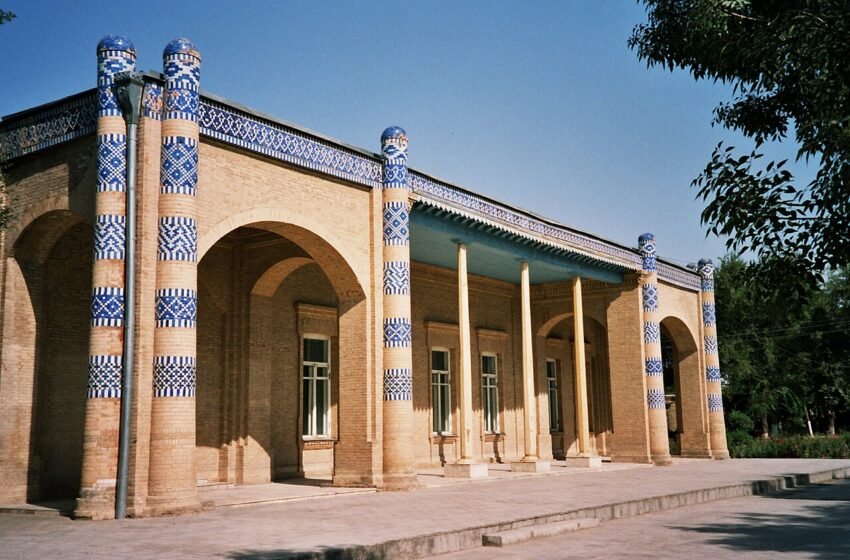
Photo: Nurullah Bai Palace, Khiva (481513).jpg by upyernoz from Haverford, USA, Wikimedia Commons, CC BY 2.0.
Nurullaboy Palace Khiva offers a different view of the city’s royal past. While monuments inside Itchan Kala often emphasize medieval Islamic architecture, this palace reflects the final decades of the Khiva Khanate, when local traditions were combined with imported technology, Russian design influences and an increasingly international court culture.
Why visit Nurullaboy Palace?
Nurullaboy Palace is one of Khiva’s most revealing late-period monuments. It was not simply a ceremonial building or a fortress. It was a palace residence with gardens, service areas, courtyards and formal rooms intended to represent the authority and modernity of the khan.
The complex is especially worthwhile for visitors who have already seen the more familiar Tash Khauli Palace. Tash Khauli is celebrated for its richly tiled courtyards and traditional Khorezmian palace planning, while Nurullaboy introduces a more eclectic atmosphere. Here, carved decoration and local craftsmanship appear alongside parquet floors, porcelain heating stoves, painted ceilings and electric chandeliers.
History and setting
The palace takes its name from Nurullabay, a wealthy Khivan whose garden was acquired for the royal project. According to the established account, Muhammad Rahim Khan II requested the garden and agreed that its original name would be preserved. The site then became associated with a summer residence planned for his son, Asfandiyar Khan.
The palace’s final form belongs largely to the period after Asfandiyar Khan came to the throne. A separate reception building was added for official visitors and dignitaries. Its design reflects cooperation between Khivan builders and outside specialists. Sources describe architects working under the Russian engineer A. M. Roop as being involved in the reception hall, alongside other public projects in Khiva.
Descriptions of the palace’s urban position vary. It is commonly associated with the north-western area of historic Khiva and with the outer city, Dishan Kala, while some tourism descriptions place it in relation to Itchan Kala. For practical purposes, visitors should treat it as a separate palace complex rather than assume that it lies within the main walled monument zone.
The palace is generally dated to the early twentieth century, with 1912 often given as the date of completion or creation in heritage listings. Its later history also matters. During the Soviet period, parts of the complex were used for public and educational purposes, including a museum and a House of Enlightenment. Restoration has since returned the residence to a more palace-like presentation.
Architecture and interiors
Nurullaboy Palace combines the spatial logic of a Khorezmian residence with decorative and technical features that were unusual in Khiva at the time. The complex is enclosed by high walls and organized around several courtyards. The entrance area traditionally included rooms for guards and administrative work, reminding visitors that this was a functioning court rather than an isolated ornamental villa.
The reception building is the visual centre of the visit. Specially produced bricks were used for its construction, while the roof was covered with thin iron sheets. Interior floors included parquet, and Mennonite Germans living in Khiva are recorded as having been invited to help with flooring, windows and doors. These details show how the palace brought together different communities and building traditions.
The ceremonial rooms are decorated with oil-painted walls, carved patterns and elaborate ceilings. Floral imagery, geometric ornament, gilding and figurative details create an interior very different from the restrained brick surfaces of many older Khivan monuments. One of the rooms is particularly associated with a richly decorated ceiling incorporating precious materials and peacock feathers, although the condition and presentation of individual rooms may change as conservation work continues.
Imported porcelain stove-fireplaces were installed in the palace halls. Electric chandeliers were another striking innovation. A small engine was reportedly used to illuminate the lamps, making the palace a showcase for modern technology as well as royal luxury.
What to notice during your visit
1. The contrast between local and imported design
Look closely at the way Khivan geometric patterns sit beside European-style doors, parquet and heating equipment. The palace is not purely “Eastern” or “Russian”; its interest lies in the deliberate combination of both.
2. The reception hall
Allow extra time for the ceremonial reception rooms. Their painted ceilings and chandeliers express the court’s desire to appear sophisticated and technologically current at the end of the khanate period.
3. The relationship between formal and practical spaces
Notice the transition from the entrance and guard rooms to the formal interiors, then to gardens and service areas. This sequence helps explain how the palace operated as a residence, administrative setting and stage for diplomacy.
4. The garden setting
Nurullaboy was created on the site of a garden, and the surviving open spaces are important to its character. In warm weather, the courtyards and planted areas provide a useful pause from Khiva’s bright sun and dusty streets.
Planning a realistic visit
For most travellers, allow around one hour for the palace itself, or longer if the reception rooms are open and you enjoy decorative detail. Combine it with a broader Khiva itinerary rather than treating it as a quick stop between monuments in central Itchan Kala.
- Best time: Visit in the morning or late afternoon, especially during the hot season. Exterior walls and open courtyards can feel intense in midday sun.
- What to wear: Choose light, respectful clothing and comfortable shoes. Some surfaces may be uneven, and the complex includes outdoor areas.
- Tickets and hours: Opening times, entrance fees, guide availability and access to individual rooms can change. Verify current details locally or through official tourism information shortly before visiting.
- Photography: Ask before photographing staff, local visitors or interior details where signs or attendants indicate restrictions. Flash photography may be discouraged around painted surfaces and restored decoration.
- Accessibility: The historic layout may include steps, thresholds, uneven ground and limited accessible routes. Visitors with mobility concerns should check the current route before arrival.
A guide can add useful context, particularly when explaining the relationship between Asfandiyar Khan’s court, Russian influence and the technical innovations introduced into the palace. Without interpretation, some of the most important details—such as the electrical system and imported stoves—can be easy to miss.
What to see nearby
Build a palace-focused day by comparing Nurullaboy with the Kunya-Ark Fortress and Tash Khauli. Together, they show different sides of Khivan rulership: military authority, domestic court life and late-period diplomatic display.
For the wider historic setting, use the guide to Itchan Kala before or after visiting the palace. The city walls and watchtowers are also useful for understanding the distinction between Khiva’s inner and outer urban areas; see the guide to Khiva’s city walls and watchtowers.
If you are interested in late nineteenth- and early twentieth-century palace culture across Uzbekistan, Nurullaboy makes a useful comparison with Bukhara’s Sitorai Mokhi-Khosa Palace, though the two residences developed in different political and architectural contexts.
Frequently Asked Questions
Is Nurullaboy Palace inside Itchan Kala?
The palace is associated with the north-western historic area of Khiva and is often described in relation to Dishan Kala, the outer city. Descriptions differ, so confirm the current entrance location locally rather than relying only on a map label.
Who built Nurullaboy Palace?
The complex was commissioned by the Khivan court under Muhammad Rahim Khan II and developed further during the reign of Asfandiyar Khan. Khivan craftsmen worked alongside outside specialists connected with the reception building.
What makes the palace different from Tash Khauli?
Tash Khauli is known for its traditional tiled courtyards and richly ornamented Khorezmian palace architecture. Nurullaboy is later and more eclectic, combining local forms with parquet, painted interiors, imported porcelain stoves and electric lighting.
Can I visit without a guide?
Independent visits may be possible, depending on the current ticketing and access arrangements. A guide is recommended if you want to understand the palace’s construction history, technology and decorative programme rather than simply view the rooms.
Sources and further reading
- Uzbekistan Travel: Nurullabay Palace
- Meros: Nurullaboy Palace Complex
- Uzbekistan Travel: Khorezm Region
- UNESCO World Heritage documentation mentioning Nurullaboy Palace
- uzbekistan.travel
- uzbekistan.travel
Photo: Nurullah Bai Palace, Khiva (481513).jpg by upyernoz from Haverford, USA, Wikimedia Commons, CC BY 2.0.




1 Comment
[…] The Khiva city walls and watchtowers provide useful architectural context, while a visit to the Nurullabay Palace is a natural extension if it is open during your stay. Inside Itchan Kala, compare the outer-city […]