
Yakubbay Khoja Madrasa Khiva: Visitor Guide

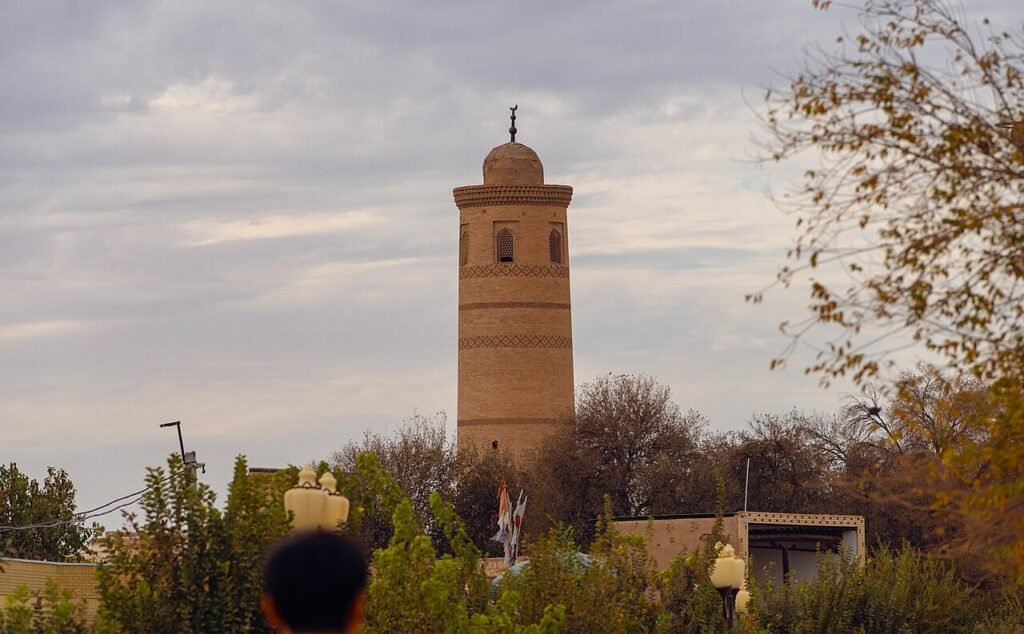
Panoramic view of Itchan Kala, the historic quarter containing Yakubbay Khoja Madrasa. This photograph illustrates the surrounding old city rather than the madrasa itself. Photo: Khiva-(Uzbekistan) banner.jpg by Panorama-view Khiva-(Uzbekistan).jpg: Euyasik derivative work: Jjtkk, Wikimedia Commons, CC BY-SA 3.0.
Panoramic view of Itchan Kala, the historic quarter containing Yakubbay Khoja Madrasa. This photograph illustrates the surrounding old city rather than the madrasa itself.
Yakubbay Khoja Madrasa Khiva is a modest but characterful monument in the historic heart of Itchan Kala. Built in 1873 by a Khivan merchant, the madrasa offers a quieter architectural experience than the city’s grander landmarks. Its compact courtyard, domed spaces and carved wooden doors reveal how religious schools and small urban foundations formed part of everyday life in late nineteenth-century Khiva.
At a glance
- Location: Itchan Kala, Khiva, west of the Pahlavan Mahmud Mausoleum.
- Date: 1873.
- Founder: The Khivan merchant Yakubbay Khoja.
- Character: A compact courtyard madrasa with a small domed mosque and carved wooden doors.
- Best for: Travellers interested in Khivan urban history, traditional building techniques and local crafts.
The monument’s name appears in several transliterations, including Yakubboy Khoja, Yakub-bai-Hadja and Yakubbay Khoja. These variations reflect differences between Uzbek, Russian and English transliteration rather than separate buildings.
History and setting
Yakubbay Khoja Madrasa was constructed in 1873, during the period when Khiva’s inner city was being filled with religious foundations, mausoleums, merchant residences and commercial buildings. Its founder, Yakubbay Khoja, is identified in heritage records as a Khivan merchant. Like many smaller madrasas in Itchan Kala, the building combined religious, educational and residential functions within a limited urban plot.
The madrasa stands west of the Pahlavan Mahmud Mausoleum, one of Khiva’s most important sacred complexes. This location places Yakubbay Khoja Madrasa within a dense historical neighbourhood rather than beside one of the city’s large ceremonial squares. The surrounding streets reward slow walking: a short distance can take you from a major pilgrimage monument to a small foundation whose scale is much more intimate.
Its inclusion in the monument inventory of Itchan Kala also helps explain its importance. Khiva is not preserved only through spectacular buildings such as palaces, minarets and major mosques. The historic city’s character depends equally on smaller madrasas, corner mosques, workshops and service buildings that establish the rhythm of its lanes.
Architecture and details
In plan, the madrasa is an elongated rectangular structure oriented broadly from west to east. The entrance vestibule leads through an arched doorway into the courtyard, with a domed room marking the transition between the street and the inner space. This sequence is typical of Islamic architecture in the region: the entrance does not reveal the whole building at once, but gradually moves the visitor from the busy street into a more enclosed and ordered courtyard.
A small brick-domed mosque occupies the north-eastern corner. Its presence shows that the madrasa was more than a collection of student rooms. Prayer, instruction and residence were brought together in a compact institution. The restrained exterior should not be mistaken for a lack of design. In Khiva, proportion, brickwork, shade and the relationship between rooms and courtyard are often as important as brightly glazed decoration.
Look closely at the doors
The carved wooden doors are among the most rewarding details to examine. Khivan craftsmen decorated them with deep, carefully arranged carving, turning a practical entrance into a statement of local workmanship. Look for the way the timber surface is divided into panels and how the carving catches changing light during the day.
The building’s domed rooms are also worth noticing. Domes helped cover square or nearly square spaces while creating a distinct interior atmosphere. In a small madrasa, the dome could mark a prayer room, vestibule or teaching space, giving the otherwise low courtyard complex a sense of vertical emphasis.
Do not expect the extensive tile mosaics associated with some of Khiva’s major monuments. Yakubbay Khoja Madrasa is valuable precisely because it presents another side of Khivan architecture: compact, functional and closely connected to the craft traditions of doors, brick construction and small domed chambers.
How to visit
Allow around 20–30 minutes for the madrasa itself, or longer if a craft demonstration or workshop is operating. The official regional tourism itinerary has listed Yakubboy Khoja Madrasa as a stop for a silk-carpet weaving workshop and master class. Such activities may not operate every day, and schedules can change, so verify locally shortly before visiting.
- Begin near the Pahlavan Mahmud Mausoleum and walk west through the surrounding lanes.
- Pause outside to understand the building’s modest scale and its relationship to neighbouring monuments.
- Enter slowly, allowing your eyes to adjust from the bright street to the shaded courtyard.
- Examine the entrance passage, carved doors, domed spaces and the small corner mosque.
- If a workshop is open, observe respectfully and ask before photographing people or craftwork.
Opening arrangements, admission practice and access to individual rooms can change. Confirm the current situation at the city’s heritage visitor facilities or with your accommodation before setting out. The historic lanes are generally walkable, but surfaces may be uneven and doorways can be narrow. Visitors with limited mobility should ask in advance about the most practical route and whether the interior is accessible on the day.
Etiquette and photography
Dress modestly when visiting religious or formerly religious buildings, and keep voices low inside enclosed spaces. If the mosque area is in use, follow local instructions and do not interrupt prayer. Photography may be restricted in particular rooms or during demonstrations; ask permission rather than assuming that every interior or craft process can be photographed.
What to see nearby
Yakubbay Khoja Madrasa fits easily into a walking circuit of southern and central Itchan Kala. Pair it with the Pahlavan Mahmud Mausoleum for a contrast between a major sacred complex and a smaller educational foundation. From there, continue towards the Juma Mosque, where a forest of carved wooden columns creates one of Khiva’s most distinctive interiors.
For a broader understanding of the city’s historic fabric, consult the guide to Itchan Kala before your walk. If you are exploring beyond the central monuments, the Dishan Kala guide provides useful context for Khiva’s outer city and its relationship with the walled inner town.
Travellers interested in Khiva’s madrasa tradition can also compare Yakubbay Khoja with the more monumental Islam Khoja Complex. The contrast is instructive: one is a compact nineteenth-century foundation shaped around a small courtyard, while the other presents a highly visible early twentieth-century ensemble dominated by its minaret.
Frequently Asked Questions
When was Yakubbay Khoja Madrasa built?
The madrasa was built in 1873. Heritage records attribute its construction to the Khivan merchant Yakubbay Khoja.
Where is Yakubbay Khoja Madrasa located?
It is in Itchan Kala, Khiva, west of the Pahlavan Mahmud Mausoleum. The monument is best reached on foot through the historic lanes of the walled city.
What should I look for inside?
Focus on the entrance vestibule, the courtyard arrangement, the small domed mosque in the north-eastern corner and the richly carved wooden doors made by Khivan craftsmen.
Can I see carpet weaving at the madrasa?
Yakubboy Khoja Madrasa has been included in an official Khorezm tourism itinerary featuring a silk-carpet weaving workshop and master class. Availability and times can change, so check locally before planning your visit around a demonstration.
Sources and further reading
- Meros.uz: Yakubbay Khoja Madrasa heritage record
- UNESCO World Heritage Centre: Itchan Kala monument list
- Uzbekistan Travel: Khorezm three-day travel itinerary
- uzbekistan.travel
- dkm.gov.uz
- uzbekistan.travel
Panoramic view of Itchan Kala, the historic quarter containing Yakubbay Khoja Madrasa. This photograph illustrates the surrounding old city rather than the madrasa itself. Photo: Khiva-(Uzbekistan) banner.jpg by Panorama-view Khiva-(Uzbekistan).jpg: Euyasik
derivative work: Jjtkk, Wikimedia Commons, CC BY-SA 3.0.