

Chor-Bakr Necropolis Bukhara: A Day-Trip Guide

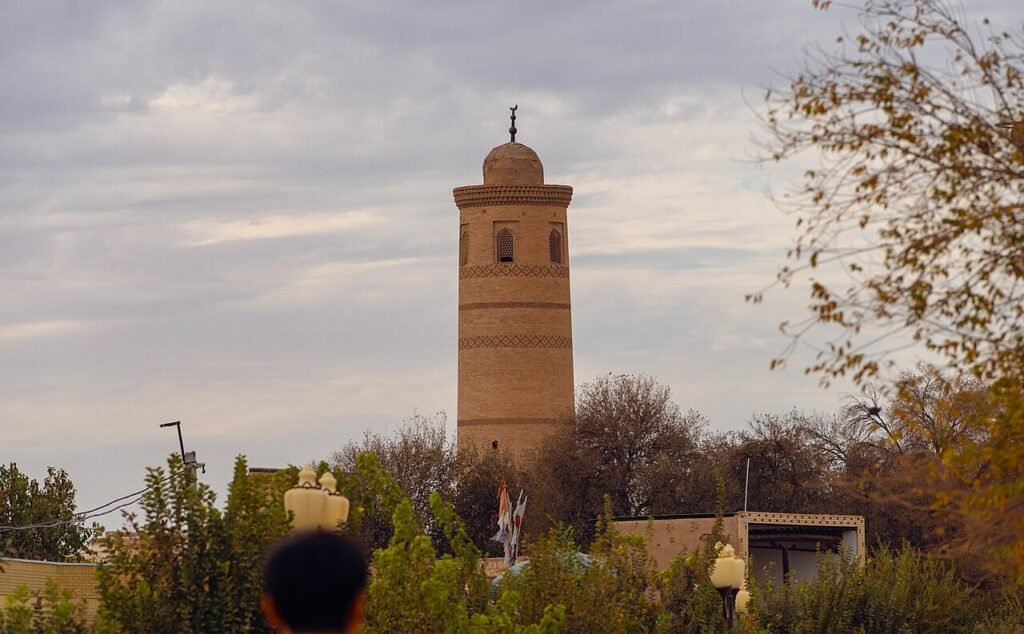
Photo: Chor-Bakr Mausoleum 01.jpg by Bgag, Wikimedia Commons, CC0.
For travellers seeking a quieter counterpoint to Bukhara’s busy historic centre, Chor-Bakr Necropolis Bukhara offers a deeply atmospheric excursion into the city’s religious and architectural landscape. Located west of Bukhara near the village of Chor Bakr, the complex combines family burial courtyards, a mosque, a khanaka, small domed tombs and richly decorated portals.
Why visit Chor-Bakr?
Chor-Bakr is not simply a single mausoleum. It is a walled necropolis that developed over several centuries, with paths and courtyards leading between memorial structures. The name is commonly explained as “Four Bakrs”, referring to four revered figures associated with the site and the Djuybar religious family, although historical explanations and transliterations vary.
The setting is part of the experience. Outside the dense urban core, the complex is surrounded by open land, village roads and mature trees. The relative quiet makes it easier to appreciate the site as a place of remembrance and pilgrimage rather than as a monument designed only for sightseeing.
Chor-Bakr is also useful for understanding Bukhara’s wider spiritual history. Between the medieval period and the early modern era, Bukhara was a major centre of Islamic learning, including Sufi traditions. The necropolis reflects the close relationship between religious authority, scholarship, family lineage and political patronage.
History and cultural meaning
The site’s sacred association reaches back to the burial of Abu Bakr Said, traditionally dated to the tenth century. Over time, the area became a cemetery for members of the Djuybar sayyid family, whose religious influence was important in Bukhara.
The monumental ensemble took shape much later. Official heritage descriptions generally associate its main architectural development with the sixteenth century, when Abdullakhan II supported the construction of a mosque, khanaka and related buildings near the family burials. Later additions continued into the eighteenth, nineteenth and early twentieth centuries. Some popular accounts assign particular buildings to specific years, but the complex is better understood as a layered ensemble rather than a project completed at one moment.
This long development explains the site’s varied appearance. Tomb courtyards, gateways, religious buildings and later additions do not form a single uniform composition. Instead, Chor-Bakr records changing practices of commemoration and the continuing importance of the necropolis to Bukhara’s religious community.
The complex is included in Uzbekistan’s UNESCO-related heritage documentation and has been associated with proposed Silk Roads heritage listings. Its importance lies especially in its plan, its funerary architecture and its illustration of the spiritual culture of Bukhara and the wider region.
Architecture: khaziras, courtyards and domes
The defining architectural feature is the khazira: an enclosed burial courtyard entered through a decorated gateway. Unlike a freestanding tomb, a khazira creates a small, intimate architectural world. High walls frame the sky, while brick corridors and portals control the movement from one family memorial space to another.
Look for the contrast between plain sunlit brickwork and areas of coloured tile decoration. Some portals use geometric patterns and inscriptions, while gravestones may carry carved epigraphic and vegetal ornament. Domed coverings mark several burial structures, but not every part of the complex has survived equally well.
The central religious buildings include a mosque and a khanaka, traditionally understood as a lodge or gathering place connected with Sufi practice. There are also hujras, or small chambers, and a modest minaret. Together, these elements show that Chor-Bakr was not only a cemetery but also a place of worship, teaching, residence and pilgrimage.
Compare the spatial character of Chor-Bakr with the more monumental public buildings in central Bukhara. The Samanid Mausoleum is a compact dynastic tomb, while Chor-Bakr is a much more expansive landscape of related burial spaces. That difference is essential to understanding its architectural character.
What to notice on site
- The entrance sequence: Notice how gateways and walls gradually reveal the interior rather than presenting everything at once.
- Brick craftsmanship: Study the patterns created by projecting, recessed and angled bricks, especially where decoration has faded.
- Khazira courtyards: Observe how each enclosed space creates a distinct scale and atmosphere.
- Inscribed gravestones: Treat the carved stones as historical documents as well as funerary objects; do not touch or climb on them.
- The relationship between buildings: Look from the mosque and khanaka towards the surrounding tombs to understand how worship and burial were integrated.
- Landscape and silence: Allow time for the less obvious details: trees, shadows, worn paths and the transition from city to countryside.
Planning your day trip
Chor-Bakr is commonly visited by private car, taxi or organised excursion from Bukhara. It lies several kilometres west of the city, and the exact journey time depends on traffic, road conditions and your starting point. Arrange the return journey in advance if you are not travelling with a guide, since local transport availability near the complex may be limited.
A realistic visit usually takes between one and two hours, depending on whether you explore the courtyards carefully, pause for photography and have access to all open areas. Add travel time and combine the excursion with another western Bukhara sight only if you have confirmed the route and opening arrangements beforehand.
Suggested half-day structure
- Leave Bukhara in the morning or during the cooler part of the afternoon.
- Allow time outside the main ensemble to understand its rural setting.
- Walk slowly through the gateways, courtyards and religious buildings that are open.
- Take a quiet break before returning to the city.
- Continue with a central-Bukhara visit such as the historic centre of Bukhara, rather than trying to rush through too many distant sites.
Opening hours, entrance arrangements, guide availability and photography rules can change. Verify current information locally or through an official tourism source shortly before travelling.
Etiquette, access and photography
Chor-Bakr remains a sacred place, so dress modestly: shoulders and knees should be covered, and loose, comfortable clothing is practical in hot weather. Speak quietly, avoid blocking entrances and give way to worshippers or pilgrims. Do not sit on graves, step onto burial platforms or treat the courtyards as picnic areas.
Ask before photographing people, especially visitors engaged in prayer. Photography of architecture may be permitted in many areas, but restrictions can apply inside religious buildings or during ceremonies. A small amount of respectful patience is more valuable than trying to photograph every room.
Paths and thresholds may be uneven, and historic courtyards are not necessarily designed for wheelchairs. Visitors with limited mobility should ask their driver or guide about the current route and accessible entrances before setting out. Bring water, sun protection and shoes suitable for dusty or irregular surfaces.
Nearby ideas
Back in the city, Chor-Bakr pairs naturally with Bukhara’s funerary and religious monuments. The Chashma Ayub Mausoleum offers a very different urban mausoleum experience, while the Lyabi-Hauz Ensemble is ideal for a slower evening walk around historic courtyards and shaded water.
If your interest is specifically in Bukhara’s religious architecture, allow time for the Poi Kalyan Ensemble. Its monumental scale contrasts with Chor-Bakr’s enclosed family courtyards and makes the two visits especially useful together.
Frequently Asked Questions
How far is Chor-Bakr from Bukhara?
The necropolis is several kilometres west of Bukhara, near Chor Bakr village. Travel time varies, so confirm the route with your driver or guide on the day.
How long should I spend at Chor-Bakr?
Plan on roughly one to two hours at the site, plus transport time. A slower visit is worthwhile if you want to study the portals, inscriptions and burial courtyards.
Is Chor-Bakr suitable for a non-Muslim visitor?
Yes. Visitors of all backgrounds can appreciate its architecture and history, provided they follow local etiquette and remember that it remains a sacred cemetery and pilgrimage site.
Can I take photographs?
Exterior photography is often possible, but rules may differ by building, event and local management. Ask before photographing people or entering interiors, and verify current restrictions before your visit.
Sources and further reading
- UNESCO World Heritage Centre: Chor-Bakr
- Uzbekistan Travel: Bukhara Region heritage sites
- Meros.uz: Chor-Bakr Necropolis
- UNESCO: Silk Roads Sites in Uzbekistan
- whc.unesco.org
- uzbekistan.travel
Photo: Chor-Bakr Mausoleum 01.jpg by Bgag, Wikimedia Commons, CC0.




1 Comment
[…] half-day excursion. It can also be combined with other sites outside the city, including the Chor-Bakr Necropolis Bukhara, if you are arranging a broader pilgrimage and heritage […]