Gaukushon Complex Bukhara: Architecture and Visitor Guide

Photo: Gaukushon madrasa 01.jpg by Davide Mauro, Wikimedia Commons, CC BY-SA 4.0.
The Gaukushon Complex is one of Bukhara’s most instructive architectural ensembles: a sixteenth-century madrasa, congregational mosque, minaret and former water-and-market setting shaped by the city’s dense historic streets. It is less monumental than Poi Kalyan, but its irregular plan and layered urban history offer a closer look at how Bukhara’s religious, commercial and residential quarters developed together.
Why Gaukushon matters
Gaukushon belongs to the historic centre of Bukhara, a UNESCO World Heritage property recognised for its exceptionally rich Islamic urban fabric. UNESCO places the Gaukushon madrasa within the wider Hodja-Kalon ensemble and identifies it among the major monuments associated with the Shaybanid period, when Bukhara became the political and cultural centre of the Uzbek state.
The complex is valuable not only because of individual buildings, but because it preserves the relationship between them. A madrasa stood beside a mosque, a minaret marked the religious quarter, and a water channel once passed through the space between the madrasa and mosque. This combination reflects Bukhara’s traditional urban life, where education, worship, trade, water management and neighbourhood activity were closely connected.
For a broader introduction to the city’s monuments and historic layout, see the Bukhara Travel Guide.
History and the meaning of the name
The Gaukushon madrasa was built during the sixteenth century under Shaybanid rule. The English spelling varies: visitors may see Gaukushon, Gaukushan, Govkushon or Khodja Gaukushan. The name is commonly connected with the Uzbek expression meaning “bull-killer”, reflecting the area’s association with a butchers’ market or slaughtering quarter.
The madrasa is generally dated to 1570. Its foundation is associated with Khoja Saad, a prominent Juybari religious figure known as Khoja Kalon, or “Great Khoja”. A congregational mosque, often called the Khoja Mosque, was added in 1598 to the north of the madrasa. The complex therefore developed over several decades rather than appearing as a single unified construction project.
Some published accounts describe the ensemble’s history and dates with slightly different terminology. The safest interpretation is that the madrasa represents the later sixteenth-century Shaybanid building programme, while the mosque and associated elements belong to the continuing development of the same religious and urban quarter.
What to see
The madrasa courtyard
The madrasa follows a courtyard plan, but its footprint is unusual. It is described as trapezoidal because the building occupies a fork in the historic street network. Rather than forcing the site into a perfect rectangle, its designers adapted the architecture to the existing urban pattern. This is one of the most revealing details at Gaukushon: the monument records the shape of the city around it.
Look for the contrast between the formal entrance portal and the more intimate interior court. The courtyard was surrounded by student cells, or hujras, with teaching and prayer spaces incorporated into the complex. The surviving arrangement helps visitors imagine the madrasa as an institution of daily study and religious life, not simply as a decorative façade.
Brickwork and portal decoration
Gaukushon is a good place to observe the Bukhara school’s economical but highly expressive use of materials. Fired brick was used structurally and decoratively, with patterns created through changes in brick placement, relief and geometry. Parts of the entrance decoration include glazed plant-like ornament and calligraphic panels.
Allow your eyes to move slowly across the façade. From a distance, the brickwork can appear restrained; at close range, small shifts in projection, colour and texture create a fine surface rhythm. This is characteristic of Bukhara, where architectural richness often comes from masonry detail rather than from extensive coloured tilework.
The mosque and minaret
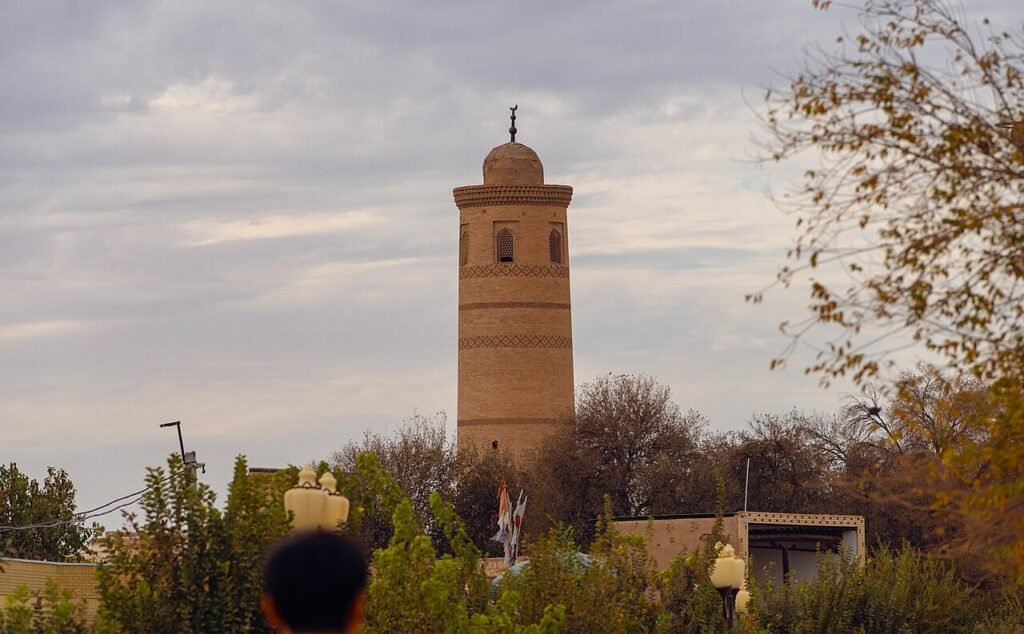
The mosque to the north formed the congregational focus of the ensemble. Its entrance portal, courtyard arcades and prayer spaces should be read together with the madrasa rather than as an isolated building. The minaret is particularly notable for its tapering brick construction and upper lantern-like section. Historic descriptions give its height as approximately 19.5 metres, although measurements and terminology may vary between sources.
A roof-level arched bridge is traditionally associated with access to the minaret. From ground level, notice how the tower’s decorative brick courses become visually lighter and more delicate as they rise. The effect is modest but elegant, especially when viewed against Bukhara’s low historic skyline.
The vanished channel and water landscape
A branch of the Shohrud channel once ran between the madrasa and mosque. The channel was covered during the twentieth century, so visitors should not expect to see an open watercourse today. Its former presence is nevertheless important: water channels and hauzes shaped movement, hygiene, shade and social life across old Bukhara.
UNESCO documentation has also discussed the rehabilitation of historic hauzes and public spaces in the Gaukushon area. Conservation work can change the appearance and accessibility of the surroundings, so treat current landscaping, paving and visitor access as subject to change.
How to visit
Gaukushon works well as part of a walking route through central Bukhara. Plan roughly 30 to 60 minutes for the ensemble itself, depending on whether the madrasa or mosque interiors are open and how closely you study the brickwork. The most rewarding approach is to arrive on foot, first viewing the complex from the surrounding streets before entering any accessible courtyard.
- Best time: Early morning or late afternoon is usually more comfortable for walking and photography, especially in hot weather.
- Opening arrangements: Access to individual buildings, interior spaces and any ticketed areas may change. Verify locally shortly before visiting.
- Dress: Wear clothing that covers shoulders and knees when entering religious spaces, and bring a light scarf if useful.
- Behaviour: Speak quietly, follow staff instructions and avoid stepping into restricted areas or leaning against historic brickwork.
- Photography: Exterior photography is generally the easiest option, but interior photography and flash use may be restricted. Ask before photographing worshippers, custodians or ceremonies.
- Accessibility: Historic streets, uneven paving, steps and narrow thresholds may make access difficult for wheelchair users and visitors with limited mobility. Confirm conditions on arrival.
Gaukushon is best appreciated as part of Bukhara’s wider architectural landscape. Compare its courtyard madrasa plan with the grander Poi Kalyan Ensemble, then continue towards the city’s trading domes and the Lyabi-Hauz Ensemble.
Nearby ideas
A compact central-Bukhara itinerary can link Gaukushon with the Kalyan monuments, the trading domes, Magoki Attori Mosque and Lyabi-Hauz. The Trading Domes of Bukhara are particularly useful for understanding how commerce connected the city’s religious institutions and neighbourhoods.
If you have more time, visit the Samanid Mausoleum to see an earlier and more compact expression of brick architecture. Together, these sites show how Bukhara’s builders developed a durable architectural language across different centuries.
Frequently Asked Questions
What is the Gaukushon Complex?
It is a historic architectural ensemble in Bukhara comprising the Gaukushon madrasa, the Khoja congregational mosque, a minaret and associated urban spaces.
When was Gaukushon built?
The madrasa is generally dated to 1570, during the Shaybanid period. The congregational mosque is commonly dated to 1598.
Why is it called Gaukushon?
The name is commonly linked to a former butchers’ market or slaughtering area. Spellings vary, including Gaukushan, Govkushon and Khodja Gaukushan.
Can visitors enter the Gaukushon buildings?
Access depends on current conservation work, religious use, local management and opening arrangements. Check on site shortly before visiting, and follow all photography and dress rules.
Sources and further reading
- UNESCO World Heritage Centre: Historic Centre of Bukhara
- Meros.uz: Khodja Gaukushan Ensemble
- UNESCO: State of Conservation documentation for Bukhara
- Uzbekistan Travel: History of Bukhara
- whc.unesco.org
- www.meros.uz
Photo: Gaukushon madrasa 01.jpg by Davide Mauro, Wikimedia Commons, CC BY-SA 4.0.