
Poi Kalyan Ensemble in Bukhara: Minaret, Mosque and Madrasa
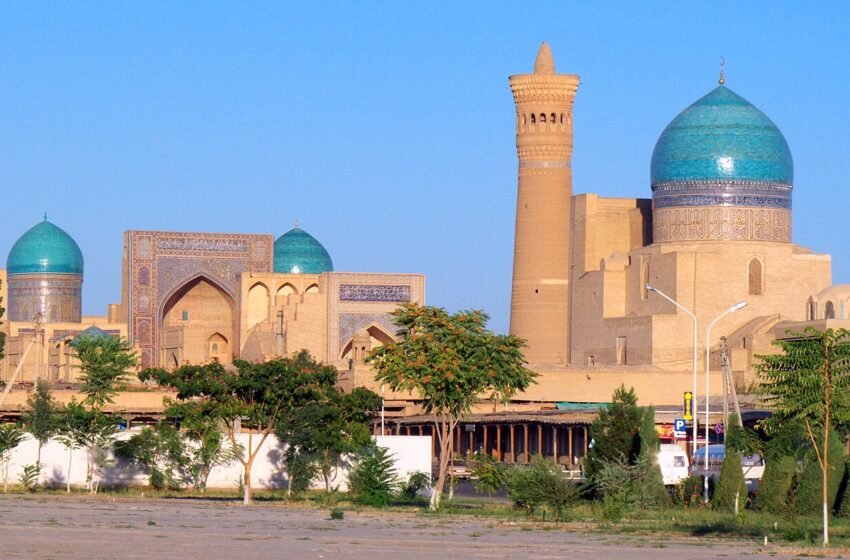
Photo: Fulvio Spada from Torino, Italy / Wikimedia Commons. CC BY-SA 2.0. Source: https://commons.wikimedia.org/wiki/File:Poi_Kalon_Ensemble,_Bukhara_(4933989373).jpg License: https://creativecommons.org/licenses/by-sa/2.0
The Poi Kalyan Ensemble is Bukhara’s defining architectural composition. A vast mosque courtyard, an active madrasa and the soaring Kalyan Minaret frame a public space whose scale can be understood only by standing within it. The name is commonly interpreted as “at the foot of the great one,” a reference to the minaret that has dominated the skyline for centuries.
Although the three principal structures belong to different periods, they form a remarkably coherent urban ensemble. Their relationship explains why Bukhara’s value lies in more than isolated façades: architecture, movement and open space work together to create a centre of religious and civic gravity.
The Kalyan Minaret
The minaret was completed in the twelfth century during Karakhanid rule. Its tapering cylindrical shaft is organised by bands of patterned brick, demonstrating how builders achieved rich decoration without relying on extensive coloured tile. A lantern crowns the structure and makes it visible from routes across the old city.
The minaret survived the Mongol destruction that erased much of earlier Bukhara. Stories about its survival have accumulated over time, but its architectural importance is clear without legend: it is one of the most accomplished monuments of medieval brick construction in Central Asia.
Kalyan Mosque
The present Kalyan Mosque largely reflects sixteenth-century rebuilding. Its expansive courtyard is bordered by arcades and oriented toward a domed prayer space. The repetition of bays gives the complex a calm rhythm, while the blue dome and tiled mihrab area create visual emphasis at the sacred end of the axis.
Because the mosque is a religious building, access may be affected by prayer times or special occasions. Visitors should dress modestly, avoid crossing directly in front of worshippers and keep voices low. The courtyard is particularly impressive when relatively empty in the morning.
Mir-i-Arab Madrasa
Opposite the mosque, Mir-i-Arab Madrasa presents a monumental portal flanked by domed chambers. Founded in the sixteenth century, it became one of Bukhara’s most important centres of Islamic education and continues to have an active religious role.
The functioning school is not an ordinary museum. Visitors generally appreciate the exterior composition and any areas specifically opened to the public. Respect barriers and do not photograph students without permission. From the square, compare the madrasa’s vertical emphasis with the mosque’s broad horizontal courtyard.
Best viewpoints and nearby route
Arrive once in the morning for detail and again near sunset for atmosphere if the itinerary allows. A low viewpoint emphasises the minaret’s height, while the edges of the square help frame all three monuments. Blue hour can be beautiful, but tripod rules and access conditions should be checked locally.
The trading domes and paired Ulugh Beg and Abdulaziz Khan madrasas lie a short walk east. To the west, the Ark of Bukhara anchors the civic landscape. See our Bukhara travel guide for a complete walking sequence.
Practical information
Most landmarks in central Bukhara are close enough to explore on foot. Begin early, rest during the hottest part of the day and return toward sunset, when brick façades gain warmer colour. Comfortable shoes are essential because paving can be uneven. Mosques, madrasas and mausoleums may have separate ticket or access rules, and restoration work occasionally changes routes. Confirm current opening hours locally and treat prayer spaces with appropriate respect.
Before you go: Opening hours, ticket prices, restoration closures and photography rules can change. Confirm current conditions at the official ticket office, museum or your accommodation. Never climb on historic fabric, and ask permission before making close portraits of residents or vendors.
Frequently asked questions
What buildings form Poi Kalyan?
The principal ensemble consists of the Kalyan Minaret, Kalyan Mosque and Mir-i-Arab Madrasa.
Can visitors enter Mir-i-Arab Madrasa?
It is an active educational institution, so access is limited to areas opened locally at the time of the visit.
What is the best time for photographs?
Morning offers quieter detail, while late afternoon and sunset produce warm light across the brick and tilework.
Sources and editorial note
This independent guide was written in original language and fact-checked against the authoritative references below. It does not reproduce their text. Practical details should be rechecked close to the date of travel.
Featured photo: Poi Kalon Ensemble, Bukhara (4933989373).jpg by Fulvio Spada from Torino, Italy, Wikimedia Commons. CC BY-SA 2.0. Resized for display.