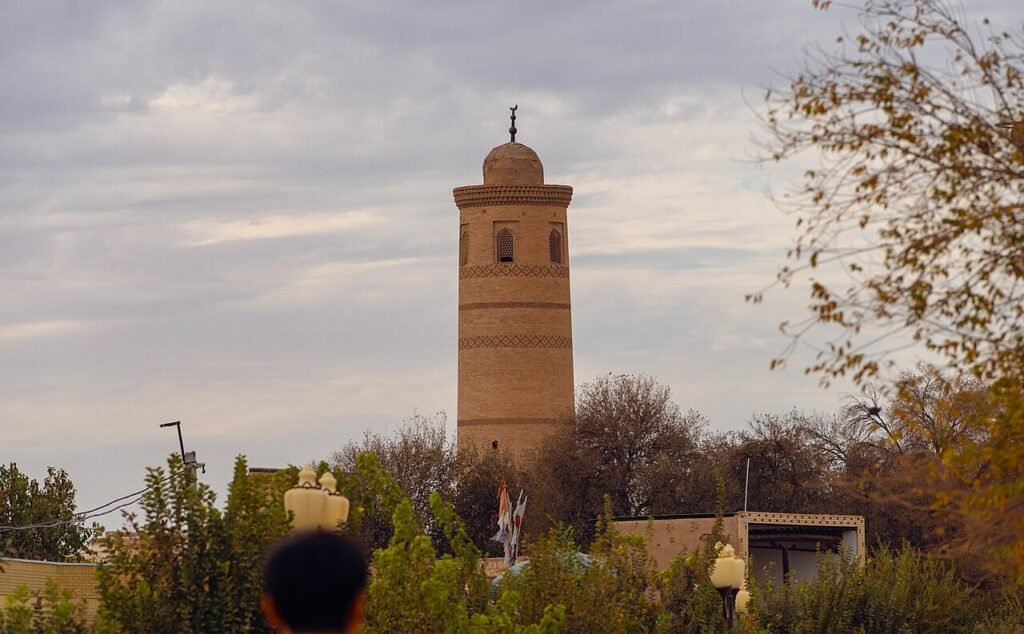

Shergazi Khan Madrasa Khiva: A Visitor Guide

Photo: Shergʻozixon madrasasi.jpg by Oybarchin0302, Wikimedia Commons, CC BY-SA 4.0.
Shergazi Khan Madrasa is one of the most historically charged monuments in Khiva’s Itchan Kala. Built in the early eighteenth century beside the Pahlavan Mahmud Mausoleum, it combines the atmosphere of an old centre of learning with a difficult history of conquest, forced labour and royal power. It is less visually imposing than some of Khiva’s later monuments, but it rewards visitors who look closely and take time to understand its setting.
Why visit Shergazi Khan Madrasa?
The madrasa stands in the heart of Itchan Kala, Khiva’s walled inner city and a UNESCO World Heritage property. UNESCO identifies Itchan Kala as a historic ensemble containing 51 monumental structures, including Shergazi Khan Madrasa, the Pahlavan Mahmud Mausoleum, the Juma Mosque and several other madrasas. This dense concentration of monuments makes the building especially valuable as part of a wider urban landscape rather than as an isolated attraction. (whc.unesco.org)
For many travellers, the strongest reason to enter is the connection between architecture and biography. The madrasa is associated with the eighteenth-century ruler Shergazi Khan, the Turkmen poet Makhtumkuli, and a long tradition of Islamic education in Khorezm. The building also helps explain how Khiva’s monuments served practical functions: teaching, housing students, preserving religious knowledge and expressing the authority of the khanate.
History and historical context
Official heritage information dates the madrasa to approximately 1718–1720. It was commissioned by Shergazi Khan after a campaign towards Khorasan and Mashhad. Accounts preserved in Uzbek heritage materials describe the use of captives taken during the campaign as labourers, and relate that the ruler promised them freedom after the building was completed. The story should be read as part of the monument’s difficult historical context, not as a romantic construction legend. (meros.uz)
Sources differ on the precise chronology of the khan’s death and the completion of the building. Some accounts associate his killing with an uprising during the construction, while others give a later date for the finished complex. The safest conclusion is that Shergazi Khan died before the madrasa had reached its final form and that his mausoleum was incorporated into the western side of the complex. Visitors may see references to a historical inscription connected with this episode. (meros.uz)
The madrasa became known as a place of scholarship. Heritage sources connect it with Makhtumkuli, one of the major figures of Turkmen poetry, who studied or taught there in the eighteenth century. This association reflects the wider intellectual links between Khiva, Turkmenistan, Khorasan and other centres of Central Asian learning. Modern displays in the building may change, but the site remains associated with educational and literary history as well as architecture. (meros.uz)
Architecture and details to notice
Shergazi Khan Madrasa is a relatively compact, largely single-storey building, with a more prominent two-storey entrance section. Its plan includes a courtyard, hujras for students, vaulted spaces and iwans. The building is not presented as a single monumental façade in the manner of some later Khivan madrasas; instead, its interest lies in the relationship between the entrance, internal court and surrounding sacred buildings.
The entrance and inscription
Begin at the main portal and look for the historical inscription traditionally associated with the madrasa’s construction and the death of Shergazi Khan. Its presence gives the entrance an unusually direct connection with the building’s political history. Architectural inscriptions in Khiva often function as both decoration and historical record, although interpretations and translations can vary.
The courtyard and hujras
Inside, notice the modest scale of the student cells and the rhythm created by repeating doorways and vaulted chambers. These spaces make the educational purpose of the madrasa easier to imagine than a grand exterior alone would do. Look for differences in light between the open courtyard and shaded interior rooms, particularly in the strong sun of Khorezm.
The setting beside Pahlavan Mahmud
The madrasa’s location beside the Pahlavan Mahmud Mausoleum is essential to understanding the ensemble. The mausoleum is one of Khiva’s most important religious and artistic sites, while the madrasa represents learning and institutional life. Together they form a powerful cultural cluster where pilgrimage, scholarship, memory and royal patronage meet.
How to plan your visit
Allow around 30–45 minutes for the madrasa itself, or longer if an exhibition is open and you want to study the rooms. Add extra time for the neighbouring mausoleum and for walking through the surrounding lanes. It is easy to combine the visit with a broader route through Itchan Kala, where many monuments stand within a short walking distance.
- Best approach: Visit earlier in the day for softer light and cooler conditions, then return to the area in the late afternoon if you want photographs of the exterior.
- What to wear: Choose respectful clothing covering shoulders and knees, especially because the madrasa stands beside an important mausoleum and religious heritage site.
- Footwear and access: Expect uneven historic surfaces, thresholds and possibly steps. Visitors with limited mobility should ask locally about the current route before entering.
- Opening arrangements: Access, ticketing, exhibitions and opening hours can change. Verify the current arrangements shortly before visiting, particularly outside the main travel season.
- Photography: Exterior photography is generally the least sensitive option, but interior or mausoleum photography may be restricted. Follow posted notices and staff instructions, and ask before photographing people.
To place the monument in context, read it alongside the complete guide to Itchan Kala. The walled city is compact, but its monuments span many centuries, so a guide helps distinguish early Khorezmian traditions from the grander nineteenth-century building campaigns.
What to see nearby
A useful walking sequence begins at the western side of Itchan Kala and continues through the central monuments. The Juma Mosque is notable for its forest of carved wooden columns and quiet interior. From there, continue towards the Kunya-Ark Fortress to explore the former citadel and royal spaces.
For a contrasting example of later Khivan architecture, compare Shergazi Khan Madrasa with the Muhammad Amin Khan Madrasa and the nearby Kalta Minor. The later monuments use greater scale and stronger visual colour, while Shergazi Khan feels older, more enclosed and more closely tied to the city’s scholarly and funerary landscape.
Frequently Asked Questions
Where is Shergazi Khan Madrasa?
It is in Itchan Kala, the walled inner city of Khiva, directly beside the Pahlavan Mahmud Mausoleum.
When was the madrasa built?
Heritage sources generally date its construction to 1718–1720, although accounts differ over the exact sequence of construction, the ruler’s death and the final completion of the complex.
Who studied at Shergazi Khan Madrasa?
The madrasa is especially associated with Makhtumkuli, the celebrated Turkmen poet. Local and heritage accounts also connect the site with other scholars and literary figures, but individual details should be treated cautiously where sources vary.
Is Shergazi Khan Madrasa worth visiting?
Yes, particularly if you are interested in Khiva’s history, Islamic education and the relationship between monuments. It is best experienced as part of the Pahlavan Mahmud and Itchan Kala ensemble rather than as a standalone photo stop.
Sources and further reading
- Shergazi-Khan Madrasah, Khiva — Meros.uz
- Itchan Kala — UNESCO World Heritage Centre
- Itchan Kala monument list — UNESCO World Heritage Centre
- Khorezm region travel itinerary — Uzbekistan Travel
- www.meros.uz
- www.meros.uz
Photo: Shergʻozixon madrasasi.jpg by Oybarchin0302, Wikimedia Commons, CC BY-SA 4.0.