Cathedral of the Sacred Heart in Tashkent: Visitor Guide
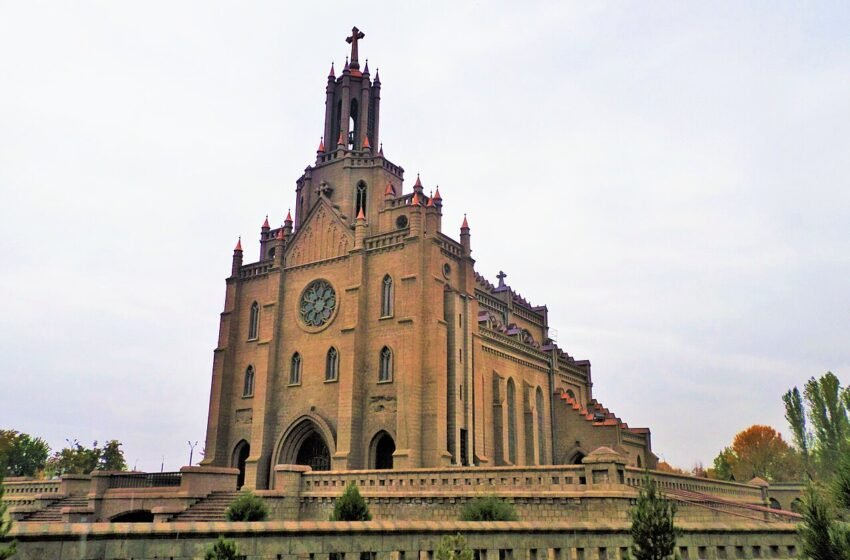
Photo: Bobyrr / Wikimedia Commons. CC BY-SA 4.0. Source: https://commons.wikimedia.org/wiki/File:Sacred_Heart_Cathedral,_Tashkent_14-03.JPG License: https://creativecommons.org/licenses/by-sa/4.0
The sacred heart cathedral tashkent is one of the capital’s most distinctive religious landmarks. Known locally as the Polish Church, the Cathedral of the Sacred Heart of Jesus introduces a striking Gothic silhouette into a city better known for Islamic monuments, Soviet modernism and broad tree-lined avenues. It remains an active Catholic church as well as an architectural and historical monument.
Why visit the cathedral
The Cathedral of the Sacred Heart of Jesus is unusual in Tashkent for both its appearance and its historical associations. Its pointed forms, vertical emphasis and Gothic decorative language contrast with the blue domes, courtyards and brickwork more commonly associated with Central Asian religious architecture. The building is also an important reminder of the city’s diverse communities and of the Catholic presence that developed in the region during the late imperial and early Soviet periods.
For travellers, the cathedral offers a quieter experience than Tashkent’s busiest museums and public squares. It is a place of worship first, so visits are best approached with the same care and restraint expected at any functioning religious site. Visitors who arrive outside a service may be able to appreciate the interior, but access can depend on parish activities and the day’s schedule.
History and restoration
Construction of the present Catholic church began in 1912. Historical accounts connect the project with Catholic soldiers and other members of the Polish community in the Russian imperial military environment of Turkestan. Skilled specialists, including builders and craftsmen, were involved in creating a substantial church rather than a temporary chapel.
The building’s later history was complicated. As with many religious properties in the Soviet period, its original ecclesiastical function was interrupted. After Uzbekistan became independent, the church was returned to the Tashkent Catholic parish in 1992. A major restoration began in 1993 under architect Sergey Adamov and engineer Alexander Ponomaryov, with the restored cathedral consecrated on 22 October 2000 by Archbishop Marian Oles.
The restoration incorporated an older chapel associated with the early Catholic community. This is especially significant because the chapel and crypt preserve a physical link with the first phase of the church’s history. The building was also recognised as an architectural and historical monument in 1981, before the later restoration was completed.
Architecture and interior details
The cathedral is designed in a Gothic or Neo-Gothic style, with a tall, pointed profile that makes it visually distinctive in central Tashkent. Look for the vertical rhythm of the façade, pointed openings, spires and coloured windows. These details give the building a European ecclesiastical character while its materials and craftsmanship reflect the local history of construction and restoration.
What to notice inside
- Stained-glass windows: The coloured glass adds changing light and visual focus to the otherwise solemn interior.
- Stone finishes: Marble and granite contribute to the cathedral’s formal, monumental atmosphere.
- Woodwork: Doors, pews and furnishings are made from valuable woods and form an important part of the interior design.
- The main altar: A prominent two-metre statue of Christ stands near the altar and tabernacle.
- The organ: The main hall contains a 26-stop organ presented by the parish of St Paul in Bonn.
- The crypt chapel: This is described as the oldest surviving part of the complex, dating from before 1916.
Craftsmanship is visible in smaller features too: chandeliers, candleholders, railings, window grilles, door fittings and other metalwork were produced or restored by parishioner and blacksmith Vladimir Pilipchuk. The result is more intimate than the exterior might suggest. Rather than relying only on monumental scale, the cathedral rewards attention to material detail.
Planning your visit
Allow around 30–60 minutes for a respectful sightseeing visit, longer if you attend Mass or take time to study the interior. The cathedral is in the central part of Tashkent and is best combined with other city-centre sights rather than treated as a full-day destination.
Masses have been reported in several languages, including English, Russian, Korean and Polish. Published visitor information is not entirely consistent about whether services are held daily or primarily on Sundays, and schedules may change for parish reasons, religious holidays or other events. Confirm the current timetable directly with the parish or at the entrance shortly before visiting.
There is no reliable basis here for stating a current admission fee, fixed tourist opening hours or a guaranteed photography policy. These details can change. If you are making a special journey, verify access, service times and whether visitors may enter beyond the vestibule before setting out.
Etiquette and photography
- Dress modestly, with shoulders and knees covered where practical.
- Keep voices low, especially near the altar, chapel and confession areas.
- Do not walk through a service or interrupt worship to take photographs.
- Ask permission before photographing parishioners, clergy or ceremonies.
- Turn off flash unless church staff clearly permit it.
- Follow any local signs or instructions, even if they differ from general visitor guidance.
Accessibility may vary between the entrance, main levels, crypt and ancillary rooms. Travellers using wheelchairs or with limited mobility should check in advance whether ramps, lifts or step-free routes are available for the areas they hope to see.
What to see nearby
The cathedral works well as part of a wider central Tashkent itinerary. For architectural variety, continue to Prince Romanov Palace in Tashkent or explore the city’s ceremonial spaces around Independence Square in Tashkent. The Alisher Navoi Theatre offers another opportunity to see how European, Russian and Central Asian influences were interpreted in the capital.
For a broader introduction to the city’s layered religious and cultural landscape, consult the Tashkent Travel Guide. It can help place the cathedral within a route that also includes museums, markets, Soviet-era monuments and Islamic heritage sites.
Frequently Asked Questions
What is the official name of the church?
Its full name is the Cathedral of the Sacred Heart of Jesus. It is also widely called the Sacred Heart Cathedral or the Polish Church.
When was the cathedral built?
Construction began in 1912. The building was later restored after its return to the Catholic parish, and the restored cathedral was consecrated on 22 October 2000.
Can non-Catholic visitors enter?
Visitors of other faiths may be welcome when the church is open, but it remains an active place of worship. Entry can be restricted during services or parish events, so behave as a guest rather than a museum visitor.
Are Masses held in English?
English-language Masses have been reported, alongside services in Russian, Korean and Polish. Confirm the current schedule before visiting because times and languages may change.
Sources and further reading
- Uzbekistan Travel: Catholic Church in Tashkent
- Uzbekistan Government Directorate: Cathedral of the Sacred Heart of Jesus
- Uzbekistan Government Directorate: Roman Catholic Church in Tashkent
- gbsforum.outsource.gov.uz
- uzbekistan.travel
- uzbekistan.travel
Featured photo: Sacred Heart Cathedral, Tashkent 14-03.JPG by Bobyrr, Wikimedia Commons. CC BY-SA 4.0. Resized for display.