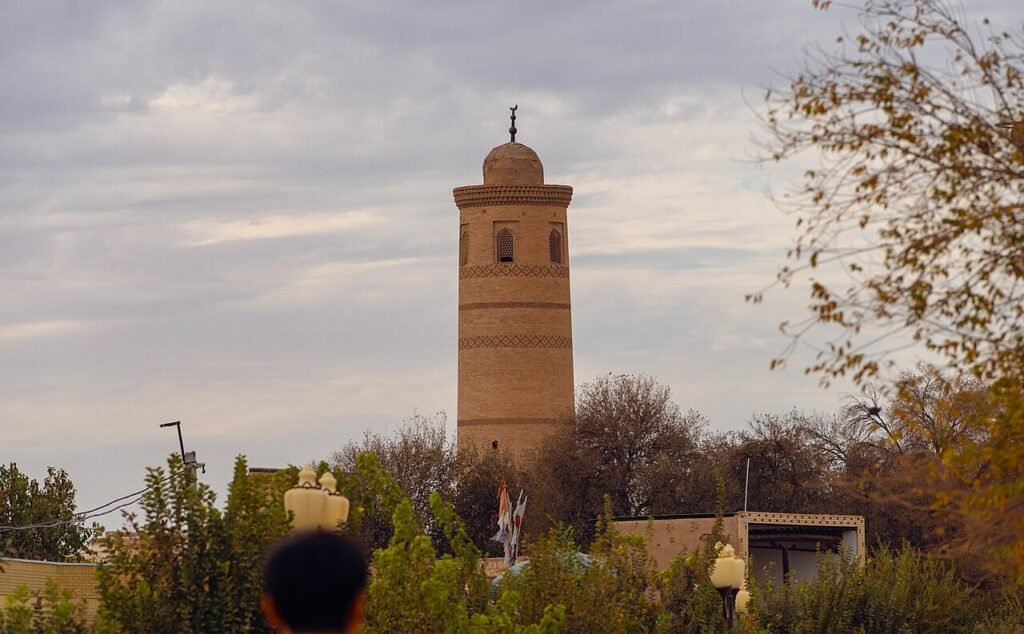

Holy Assumption Cathedral in Tashkent: Visitor Guide

Photo: Bobyrr / Wikimedia Commons. CC BY-SA 4.0. Source: https://commons.wikimedia.org/wiki/File:Cathedrale_de_la_Dormition_de_Tachkent_02.JPG License: https://creativecommons.org/licenses/by-sa/4.0
The Holy Assumption Cathedral is one of Tashkent’s most important Christian landmarks and the principal Orthodox cathedral of the capital. Set near Mirabad Market and Tashkent’s central railway station, it offers visitors a quieter and more reflective experience than the city’s grand public squares and museums. The complex combines religious life, 19th-century origins, later reconstruction and a distinctly Tashkent blend of classical architecture and Central Asian urban history.
Why visit the cathedral
For travellers interested in Tashkent’s religious and architectural diversity, the Holy Assumption Cathedral provides an essential counterpoint to the city’s mosques, madrasas and Soviet-era monuments. Its golden domes, pale façades and blue decorative details create a calm visual presence in a busy central district. The cathedral is also a living place of worship rather than a preserved monument visited only for sightseeing, so the atmosphere may change according to the Orthodox calendar and the daily service schedule.
The cathedral is often referred to in English as the Holy Assumption Cathedral, while other translations use “Cathedral of the Dormition of the Mother of God” or “Assumption Cathedral.” These names refer to the same Orthodox complex. It should not be confused with Tashkent’s Catholic Cathedral of the Sacred Heart of Jesus, commonly known as the Polish Church.
History and religious context
The cathedral developed from a smaller church associated with a military cemetery and the former Tashkent military hospital. According to Uzbekistan’s national tourism information, the church was expanded during the 19th century, with the enlarged building completed in 1879. This date marks the key early phase of the present complex, although the site and buildings have changed considerably over time.
During the Second World War, the church premises were used for hospital needs. After the war, the building reopened and became the principal Orthodox church in Tashkent. The complex was subsequently reconstructed and enlarged, particularly during the Soviet period and again after Uzbekistan became independent. These changes help explain why the cathedral should be understood as a layered historical site rather than as a building preserved in one single original form.
Today, the cathedral complex includes the main Assumption Cathedral, a church dedicated to St Luke of Crimea, facilities connected with water blessing and baptism, and the Orthodox theological seminary. It remains an active centre for worship and religious education in Uzbekistan’s capital.
Visitors who want broader context on the city’s changing religious landscape can pair the cathedral with the Hazrati Imam Complex in Tashkent, a major Islamic centre in the Old City. The contrast between the two sites reveals the plural architectural history of modern Tashkent.
Architecture and what to notice
The approach to the cathedral leads through a prominent triple-arched entrance topped by a golden-coloured dome. This gateway creates a ceremonial transition from the street into the quieter courtyard. Inside the grounds, the buildings share a coherent classical vocabulary, with light façades, blue-and-white detailing and carefully arranged open space.
Look closely at the relationship between the domes and the bell tower. Both have been altered during later reconstruction, so the appearance visitors see today reflects several periods of repair and redesign. The five-tiered bell tower is one of the most visually distinctive features of the ensemble. Its openwork structure adds vertical emphasis without overwhelming the main cathedral.
The grounds include a small garden and fountain, offering a useful pause before or after entering the church. A marble plaque commemorating the centenary of the Tashkent diocese is also part of the site’s visible historical markers. The overall impression is one of brightness and order: white and pale-blue surfaces, gold accents and open courtyard space soften the scale of the complex.
Inside the cathedral and its shrines
The interior is designed to feel more spacious than the exterior approach might suggest. A large multi-tiered chandelier contributes to the sense of height and luminosity, while the icons and liturgical furnishings create the atmosphere expected of an active Orthodox cathedral.
Tourism information identifies several venerated objects and icons associated with the cathedral. These include an icon of the Dormition of the Mother of God, an icon of St Panteleimon, the Iveron icon of the Mother of God, icons of St Basil the Great and St Nicholas the Wonderworker, and an ark containing particles associated with the Holy Cross. The complex is also described as holding relics connected with the saints of the Kyiv Caves tradition.
These are religious objects, not simply museum exhibits. Visitors should observe them quietly and avoid treating the interior as a photo backdrop. If a service is taking place, remain at the rear or in an area indicated by attendants and allow worshippers to move freely.
Planning your visit
Allow time for a short, respectful stop
Most travellers can see the exterior, gateway, courtyard and main interior in around 30 to 45 minutes. Allow longer if you plan to attend a service, sit quietly, or visit during a major feast day when the cathedral may be especially busy.
The cathedral is near Mirabad Market and the central railway station, making it easy to combine with a wider central-Tashkent itinerary. You could visit in the morning, continue towards the railway district, and then explore another nearby cultural attraction. For a broader overview of the capital’s landmarks, see our Tashkent Travel Guide.
Published tourism information lists services at 9:00 in the morning and 17:00 in the afternoon. Service times, access arrangements and the portions of the complex open to visitors can change, particularly on Orthodox feast days, during ceremonies or for maintenance. Verify current details locally shortly before your visit rather than relying solely on an old guidebook.
Etiquette, photography and accessibility
- Dress modestly, with shoulders and knees covered where possible.
- Speak quietly and switch mobile phones to silent mode.
- Do not enter restricted areas or interrupt clergy and worshippers.
- Ask before photographing people, religious ceremonies or close views of icons.
- Follow any posted instructions about photography, candles and movement inside the church.
There is no reliable public information confirming universal step-free access throughout every building in the complex. Travellers with mobility concerns should check conditions at the entrance and ask staff for the most suitable route. Courtyard access may be easier than access to all interior spaces, but this can vary according to current arrangements.
What to see nearby
The cathedral’s location makes it practical to combine a religious visit with several central Tashkent sights. The Prince Romanov Palace offers a different architectural perspective, reflecting the imperial and aristocratic history of the city. The Alisher Navoi Theatre is another worthwhile stop for visitors interested in monumental public architecture and Tashkent’s cultural life.
For a more distinctly local experience, continue towards Chorsu Bazaar, where covered market halls, food stalls and everyday commerce provide a lively contrast to the cathedral’s contemplative setting. If you are planning a full day of city exploration, allow time for traffic and heat, especially in summer.
Frequently Asked Questions
Where is Assumption Cathedral Tashkent located?
The cathedral is in central Tashkent, near Mirabad Market and the central railway station. The complex is commonly associated with 1st Nukus Passage, number 4, although visitors should confirm directions locally before travelling.
Is the cathedral open to tourists?
It is an active Orthodox place of worship, and visitors may generally enter respectfully when access is permitted. Opening arrangements can change during services, religious holidays, ceremonies and restoration work.
Can I take photographs inside?
Photography rules may vary. Ask permission or follow posted instructions, and never photograph worshippers or ceremonies without consent. When in doubt, photograph the exterior and courtyard instead.
How long should I spend there?
Plan on 30 to 45 minutes for a brief visit. Add more time if you want to attend a service, examine the icons respectfully or visit other parts of the complex when they are open.
Sources and further reading
- Uzbekistan Travel: Holy Assumption Cathedral Church in Tashkent
- Uzbekistan Cabinet of Ministers Directorate: Assumption Cathedral in Tashkent
- uzbekistan.travel
- uzbekistan.travel
- uzbekistan.travel
- uzbekistan.travel
Featured photo: Cathedrale de la Dormition de Tachkent 02.JPG by Bobyrr, Wikimedia Commons. CC BY-SA 4.0. Resized for display.