

Kalyan Mosque Bukhara: History and Visitor Guide

Photo: Bukhara Kalyan Mosque main entrance.jpg by Ymblanter, Wikimedia Commons, CC BY-SA 4.0.
Kalyan Mosque Bukhara is one of the defining monuments of the city’s historic centre: a large congregational mosque facing the Miri-Arab Madrasa across the celebrated Poi Kalyan square. Its broad courtyard, repeated domes, restrained turquoise decoration and relationship with the Kalyan Minaret make it an essential stop for anyone exploring old Bukhara.
Why Kalyan Mosque matters
The mosque is part of the Poi Kalyan architectural ensemble, whose name is commonly explained as “at the foot of the Great,” referring to the position of the mosque and related monuments beneath the Kalyan Minaret. The ensemble developed over several centuries and includes the mosque, the minaret, Miri-Arab Madrasa and the smaller Amir-Alimkhan Madrasa. Together, these buildings express Bukhara’s long role as a centre of Islamic learning, worship and urban life. (uzbekistan.travel)
Unlike a small neighbourhood mosque, Kalyan was designed for large Friday congregations. Its scale is immediately apparent from the open court and the long, shaded galleries that surround it. The complex is also important because it shows how Bukhara’s monumental architecture was repeatedly rebuilt, adapted and preserved on the same sacred urban site.
History and historical layers
A congregational mosque is believed to have stood in this area from the early Islamic period. The site was rebuilt in the twelfth century, when Bukhara underwent major urban changes under the Karakhanids. The Kalyan Minaret completed in 1127 is the best-known surviving monument from that phase, while the mosque associated with the earlier period was later destroyed and replaced. (uzbekistan.travel)
The present mosque belongs mainly to the period of the Shaybanids. Meros identifies its completion with 1514, while describing the building as a fifteenth- and early sixteenth-century monument shaped by successive stages of construction. This is a useful reminder that the mosque should not be treated as the product of a single moment: archaeological evidence and written sources point to earlier structures beneath or around the present building. (meros.uz)
The mosque’s history is therefore layered rather than linear. Medieval Bukhara’s political changes, religious institutions and building traditions are all visible in the sequence from the early congregational mosque, through the Karakhanid rebuilding, to the large Shaybanid structure visitors see today. The mosque forms part of the Historic Centre of Bukhara, which is recognised by UNESCO as a World Heritage property.
Architecture and details to notice
The great courtyard
Begin by taking in the courtyard as a whole. The plan is rectangular, with covered galleries running around the perimeter. These galleries are carried by numerous supports and topped by a rhythm of small domes. Meros records 208 pillars and 288 domes, figures that help convey the building’s remarkable repetition and scale. (meros.uz)
Look for the way the courtyard creates both monumentality and shade. The repeated bays are practical as well as decorative, offering sheltered space in Bukhara’s hot, dry climate. From different positions, the pattern of arches and domes changes subtly, making the courtyard particularly rewarding for slow observation rather than a quick photograph.
The western prayer hall and blue dome
The main axis of the courtyard leads towards the mosque’s prayer hall, or maksura, marked by a substantial portal and a prominent blue dome. The dome is not an isolated ornament: it identifies the principal sacred focus of the building and gives the otherwise horizontal courtyard a strong vertical conclusion.
Decoration is concentrated rather than spread evenly across every surface. Glazed tiles, patterned brickwork and mosaic details appear most strongly around the principal façade, portal and mihrab area. The restrained palette allows the structure itself—brick, arches, domes and geometric order—to remain legible.
Brickwork and the neighbouring minaret
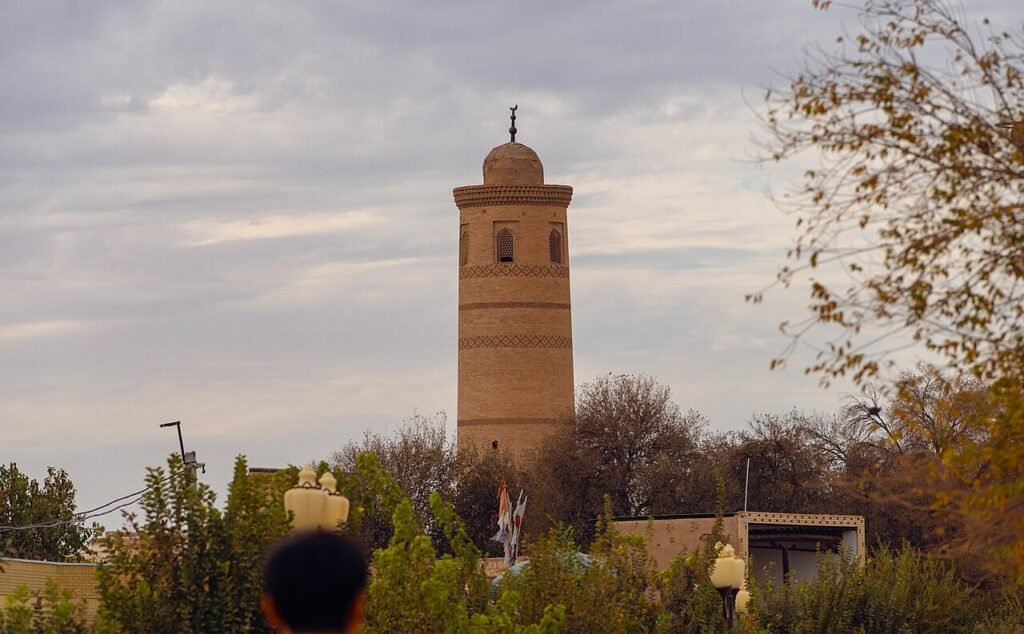
From the square, compare the mosque’s broad horizontal mass with the slender Kalyan Minaret. The minaret’s baked-brick surface is organised into bands of geometric ornament, while the mosque relies more on courtyard rhythm and domed galleries. Together they show two complementary approaches to monumentality: one vertical and urban-scaled, the other expansive and congregational. The minaret was built in 1127 and remains the visual anchor of the ensemble. (meros.uz)
How to plan your visit
Allow around 45 minutes for the mosque itself if you want time to walk around the courtyard, inspect the galleries and appreciate the view towards the minaret. Add more time if you are visiting the full Poi Kalyan ensemble or waiting for softer light on the brick and glazed surfaces.
- Start outside: From Poi Kalyan square, first study the relationship between the mosque, minaret and Miri-Arab Madrasa.
- Enter slowly: Pause at the portal before moving into the courtyard so the change from the busy historic centre to the enclosed religious space is noticeable.
- Walk the perimeter: The covered galleries reveal the mosque’s repeating structural system and provide useful shade.
- Look back: From inside, frame the Kalyan Minaret through the courtyard or entrance bays.
- Visit early or late: Morning and late afternoon generally offer gentler light and a calmer atmosphere, though actual access conditions can change.
Opening arrangements, entrance charges, access to interior areas and photography rules may change. Check locally or verify shortly before your visit, especially on religious holidays and during restoration or official events.
Etiquette, access and photography
Kalyan Mosque is a historic monument and a religious site. Dress modestly, covering shoulders and knees, and follow any instructions from staff or worshippers. Speak quietly, avoid blocking entrances and do not walk into areas marked as restricted. If prayer or a religious ceremony is taking place, give priority to worshippers and wait for guidance before entering sensitive areas.
Photography may be permitted in some parts of the complex, but rules can differ by area and can be revised. Ask before photographing people, religious activity or interior details. Tripods and flash may be inappropriate even where general photography is allowed.
The historic setting includes uneven paving, steps and surfaces that may be difficult for visitors with limited mobility. Because accessibility can vary between the entrance, courtyard and prayer areas, visitors who need step-free access should confirm conditions in advance or ask locally on arrival.
What to see nearby
Kalyan Mosque is best visited as part of a walking route through central Bukhara. The Miri-Arab Madrasa in Bukhara stands directly opposite, although its active religious function can affect visitor access. For a broader explanation of the square and its monuments, see the guide to the Poi Kalyan Ensemble.
From Poi Kalyan, continue towards the city’s historic commercial quarter and explore the Trading Domes of Bukhara. Another useful pairing is the Magoki Attori Mosque, whose partly sunken position and earlier historical layers offer a striking contrast with Kalyan’s open monumental scale.
Frequently Asked Questions
Where is Kalyan Mosque?
It stands in central Bukhara on Poi Kalyan square, beside the Kalyan Minaret and opposite the Miri-Arab Madrasa.
When was Kalyan Mosque built?
The present mosque was built mainly during the Shaybanid period and is commonly dated to the late fifteenth or early sixteenth century. Meros records completion in 1514, while the site itself has much earlier mosque-building history. (meros.uz)
Can visitors enter the mosque?
Access arrangements can vary according to religious use, restoration, local rules and special events. Check the current situation shortly before visiting and follow on-site instructions.
What is the most important detail to notice?
Do not focus only on the blue dome. The mosque’s identity lies in the combination of its vast courtyard, hundreds of repeated domed bays, carefully concentrated tilework and powerful relationship with the Kalyan Minaret.
Sources and further reading
- Uzbekistan Travel: Poi-Kalyan Architectural Ensemble
- Meros: The Kalyan Mosque
- Meros: The Kalyan Minaret
- UNESCO World Heritage Centre: Historic Centre of Bukhara Gallery
- uzbekistan.travel
- whc.unesco.org
Photo: Bukhara Kalyan Mosque main entrance.jpg by Ymblanter, Wikimedia Commons, CC BY-SA 4.0.




1 Comment
[…] minaret is the centre of a compact walking route through Bukhara’s old town. Continue into the Kalyan Mosque to understand the religious setting of the tower, then look across to the Mir-i Arab Madrasa, whose […]