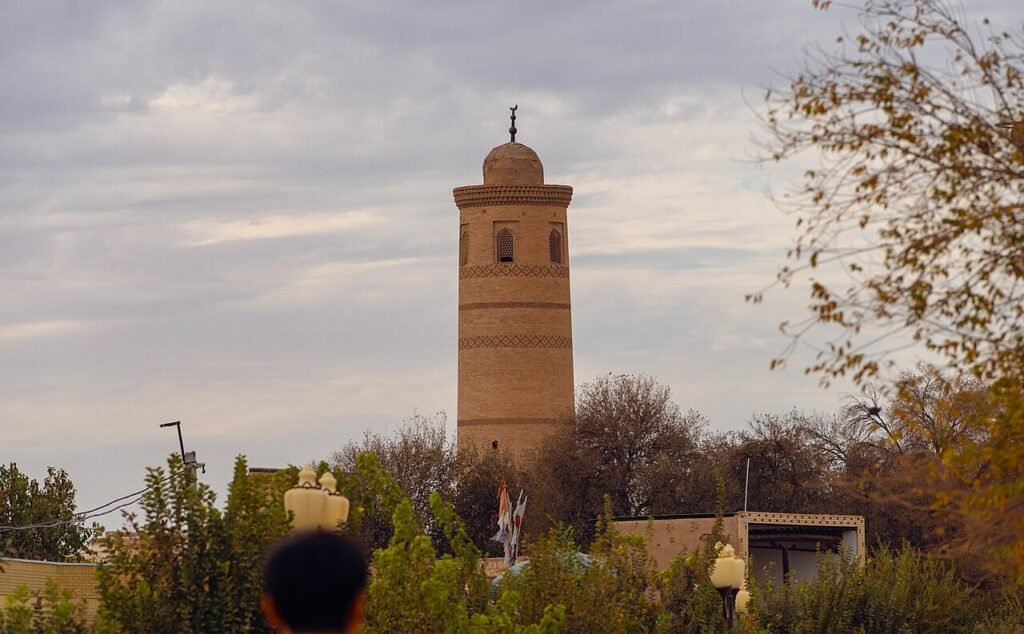
Barak Khan Madrasa in Tashkent: A Visitor Guide

Photo: Bgag / Wikimedia Commons. CC0. Source: https://commons.wikimedia.org/wiki/File:Barak-Khan_Madrasa.jpg License: http://creativecommons.org/publicdomain/zero/1.0/deed.en
Barak Khan Madrasa in Tashkent is one of the most atmospheric monuments in the city’s old quarter. Set within the Khast Imam, or Hazrati Imam, complex, it combines a sixteenth-century Islamic school with mausoleums, domed chambers and richly decorated brick-and-tile architecture. It is also a place of living religious importance, so visitors should approach it as both a historic monument and an active sacred environment.
History and cultural setting
The madrasa was built in the sixteenth century as an Islamic school under the patronage of Nauruz Ahmad Khan, a grandson of the Timurid astronomer and ruler Mirzo Ulugh Beg. Nauruz Ahmad was commonly known as Barak Khan, a name generally translated as “fortunate” or “lucky”. The building therefore belongs to a period when Tashkent was developing under Shaybanid rule and religious education, dynastic legitimacy and urban life were closely connected.
Barak Khan Madrasa is not a completely uniform building created in a single campaign. Its surviving ensemble grew around earlier sacred structures and includes mausoleums associated with important rulers. One is linked with Suyunchkhoja Khan, regarded by Uzbekistan’s tourism authorities as the first Tashkent ruler of the Shaybanid dynasty. Another was erected over the burial place of Barak Khan, although Barak Khan was later reburied in Samarkand. This layered history helps explain why the site feels more like a compact religious precinct than a standalone school.
Today, the madrasa forms part of the Khast Imam complex, the spiritual heart of Tashkent’s old city. The wider ensemble includes the Tillya Sheikh Mosque, the Abu Bakr Kaffal Shashi Mausoleum and the Imam al-Bukhari Islamic Institute. The complex is also associated with the celebrated Qur’an manuscript commonly known as the Uthman Qur’an, which is displayed separately in the complex’s religious and manuscript institutions. Barak Khan Madrasa should therefore be understood within this wider setting rather than viewed in isolation.
Architecture and details to notice
The first feature most visitors notice is the monumental entrance portal. Its deep arch creates a strong transition from the busy streets of old Tashkent into a quieter architectural world of courtyards and domes. Look closely at the contrast between the broad portal, smaller side chambers and the rounded forms of the mausoleums behind it.
Traditional Central Asian madrasa design usually centred on an internal courtyard surrounded by student cells, teaching rooms, prayer spaces and service areas. At Barak Khan, the courtyard arrangement is especially useful for understanding how a madrasa functioned: it was not simply a decorative façade, but a place where study, residence, worship and administration were brought together.
Notice the relationship between plain fired brick and areas of glazed decoration. Blue, turquoise, white and ochre tones appear in the ornamental scheme, while geometric patterns and Islamic calligraphic traditions enliven the entrances and domed structures. The effect is more restrained than the brilliant tile surfaces of some monuments in Samarkand, but the combination of colour, shadow and curved masonry is highly distinctive.
What to look for on site
- The scale and depth of the main entrance portal.
- The transition from the public square into the enclosed courtyard.
- Domed mausoleum forms set among the madrasa structures.
- Glazed tilework and geometric ornament around entrances and upper sections.
- The contrast between restored surfaces and older-looking brickwork.
- The relationship between Barak Khan Madrasa and the other buildings of Khast Imam.
Restoration has shaped the appearance of the complex, as it has with many historic monuments in Tashkent. Rather than expecting every visible surface to be untouched medieval fabric, read the building as a preserved and functioning historic ensemble whose present appearance reflects both its long history and later conservation.
How to visit Barak Khan Madrasa
Barak Khan Madrasa is easiest to visit as part of a walk through the Khast Imam complex. Allow roughly 30 to 60 minutes for the madrasa itself, and longer if you want to explore the surrounding mosques, mausoleum and manuscript-related institutions at a respectful pace. Early morning or late afternoon usually provides softer light for architectural details and a calmer atmosphere, although religious activity and access conditions vary.
There is no single visitor experience that can be guaranteed every day. Some rooms may be closed, worship may be taking place, and access can change during religious events, restoration or official functions. Opening hours, entrance arrangements, photography rules and any fees can change, so verify current conditions shortly before visiting through an official local tourism source or with your accommodation.
For orientation, begin outside the main portal and take time to understand the madrasa’s position within the larger complex. Continue into the courtyard only where access is permitted, then visit the neighbouring buildings rather than rushing straight to photographs. A guide can be useful if you want more detail about the dynasties, mausoleums and manuscript tradition connected with Khast Imam.
Etiquette, photography and accessibility
Although Barak Khan Madrasa is a major attraction, it remains part of a religious environment. Wear clothing that covers the shoulders and knees, avoid loud conversation and keep a respectful distance from worshippers and students. Women may wish to carry a light scarf, particularly when visiting prayer-related areas, but local instructions should always take priority.
Ask before photographing people, religious ceremonies, interior rooms or manuscript displays. Do not use flash where it is prohibited, and follow signs or staff instructions even if other visitors appear to be taking photographs. Tripods and large camera equipment may not be practical in busy passages.
Accessibility may be uneven. Historic courtyards can include steps, raised thresholds, uneven paving and narrow passages. The open areas may be easier to navigate than interior rooms, but visitors with limited mobility should check access in advance. A companion or local guide can help with routes through the wider complex.
What to see nearby
The most natural companion visit is the rest of the Hazrati Imam Complex in Tashkent, where Barak Khan Madrasa can be placed in its broader religious and architectural context. The complex rewards slow exploration, especially in the evening when the courtyards and façades are illuminated.
For a different view of Tashkent’s sixteenth-century madrasa tradition, compare it with the Kukeldash Madrasa in Tashkent. Kukeldash stands closer to the old commercial heart of the city and offers a useful contrast between a religious school associated with a major bazaar district and the more shrine-centred atmosphere of Khast Imam.
After visiting the monuments, continue towards Chorsu Bazaar in Tashkent. Its food stalls, produce markets and craft traditions provide a lively counterpoint to the quiet courtyards of the madrasa. If you are planning a longer stay, the wider Tashkent Travel Guide can help connect the old city with museums, Soviet-era landmarks and modern neighbourhoods.
Frequently Asked Questions
Where is Barak Khan Madrasa?
It is in the Khast Imam, also called Hazrati Imam, complex in the old city of Tashkent. The madrasa stands among several important religious and historic buildings.
When was Barak Khan Madrasa built?
The madrasa dates from the sixteenth century and was built under the patronage of Nauruz Ahmad Khan, known as Barak Khan.
Can visitors enter the madrasa?
Visitors may be able to enter permitted parts of the complex, but access is not guaranteed to every room or courtyard. Religious activity, restoration and official events can affect the route.
Is photography allowed?
Photography may be allowed in some outdoor areas, but restrictions can apply inside religious spaces and manuscript-related institutions. Ask before photographing people or ceremonies and follow current signs and staff guidance.
Sources and further reading
- Uzbekistan Travel: Barak Khan Madrasah
- Uzbekistan Travel: Khazrati Imam Complex
- Uzbekistan Travel: Tourist Route Through the Main Zierat Objects of Tashkent
- uzbekistan.travel
- app.uzbekistan.travel
- uzbekistan.travel
Featured photo: Barak-Khan Madrasa.jpg by Bgag, Wikimedia Commons. CC0. Resized for display.