Muhammad Amin Khan Madrasa in Khiva: History and Visitor Guide

Photo: Bernard Gagnon / Wikimedia Commons. CC0. Source: https://commons.wikimedia.org/wiki/File:Muhammad_Aminkhan_Madrasa_01.jpg License: http://creativecommons.org/publicdomain/zero/1.0/deed.en
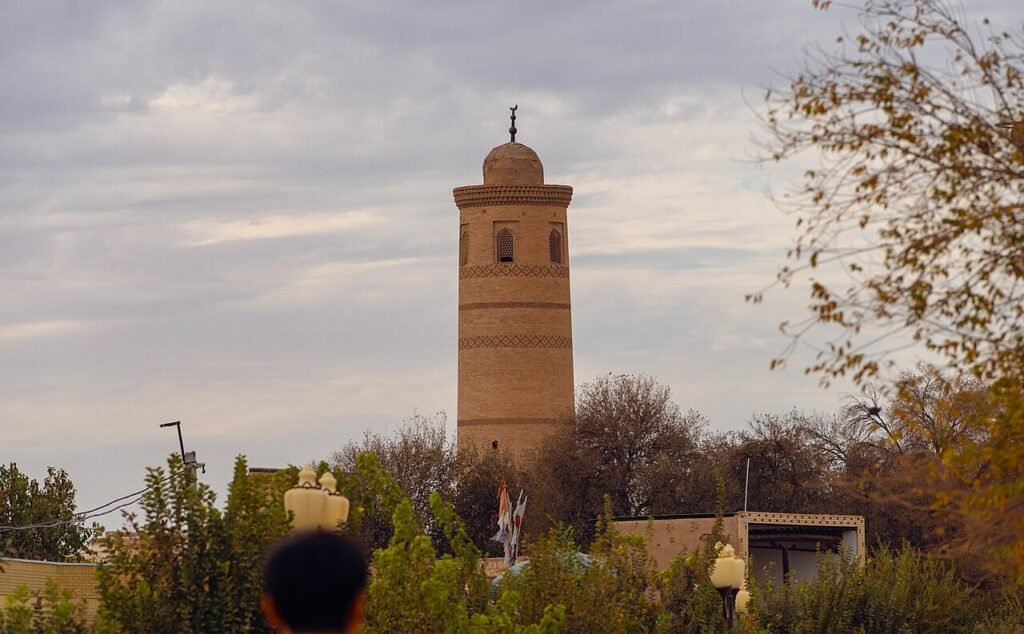
Muhammad Amin Khan Madrasa dominates the western entrance to Itchan Kala beside Kalta Minor. Built in the 1850s, its broad two-storey façade, corner towers and rows of arched loggias make it one of Khiva’s largest educational monuments. The famous unfinished minaret was conceived as part of the same ambitious project.
Today the building has been adapted for visitor services and accommodation, so it must be experienced differently from a museum-madrasa with fully open cells. The exterior, entrance zone and relationship with the city gate remain essential even when private-use areas cannot be entered.
Muhammad Amin Khan’s great project
The madrasa was commissioned by Muhammad Amin Khan and built between 1852 and 1855. Its scale advertised royal patronage at the principal western approach to the inner city. Historical descriptions emphasise the large number of student cells arranged on two levels around a courtyard.
Construction coincided with work on Kalta Minor. The khan’s death in 1855 ended the minaret project, leaving its massive decorated base as a dramatic contrast to the completed horizontal volume of the madrasa.
Architecture on an exceptional scale
The entrance façade uses a central portal framed by towers and repeated arches. Upper-level cells include loggias facing outward, an unusual feature that animates the long elevations. Glazed decoration concentrates attention around the portal while brick surfaces communicate the building’s size.
Walk across the open space near Ata Darvaza to see the complete composition. Then move closer to study tile panels, inscriptions and the junction with Kalta Minor. The best photograph usually includes both structures, because their difference in form explains the ambition of the ensemble.
From madrasa to modern use
Adaptive reuse has helped keep the large building occupied, but it also means that parts function as a hotel or related tourist facilities. Guests and staff have privacy, and interior access should never be assumed. Enter only spaces clearly marked as public.
Reusing a protected monument involves a balance between conservation and modern services. Visitors can recognise that tension without treating the building as either untouched heritage or merely commercial property. UNESCO status belongs to the wider Itchan Kala townscape in which the madrasa plays a major role.
The western gate itinerary
Begin at Ata Darvaza, examine the madrasa and Kalta Minor, then continue to the Kunya-Ark. These monuments establish Khiva’s scale immediately and can fill a relaxed morning when courtyards and museum rooms are included.
Allow thirty minutes for the exterior and any public interior areas, more if you are staying in the building. Early morning gives the clearest wide view before day visitors gather near the western gate. The Itchan Kala guide covers gates, tickets and a route through the rest of the walled city.
Practical information
The core of Khiva is compact, but the concentration of monuments rewards an unhurried visit. An early start gives quieter streets and softer light; evening is ideal for seeing the walls and minarets change colour. Surfaces can be uneven and shade is limited in summer. A combined ticket may cover several museum-monuments, although inclusions can change, so verify the current arrangement at the official ticket office. Dress respectfully in mosques and mausoleums.
Before you go: Opening hours, ticket prices, restoration closures and photography rules can change. Confirm current conditions at the official ticket office, museum or your accommodation. Never climb on historic fabric, and ask permission before making close portraits of residents or vendors.
Frequently asked questions
When was Muhammad Amin Khan Madrasa built?
It was constructed from 1852 to 1855 under Muhammad Amin Khan.
Is it connected with Kalta Minor?
Yes. The unfinished minaret formed part of the same monumental ensemble beside the madrasa.
Can visitors enter every part?
No. Adaptive reuse means some areas are private or dedicated to accommodation and services.
Sources and editorial note
This independent guide was written in original language and fact-checked against the authoritative references below. It does not reproduce their text. Practical details should be rechecked close to the date of travel.
Featured photo: Muhammad Aminkhan Madrasa 01.jpg by Bernard Gagnon, Wikimedia Commons. CC0. Resized for display.