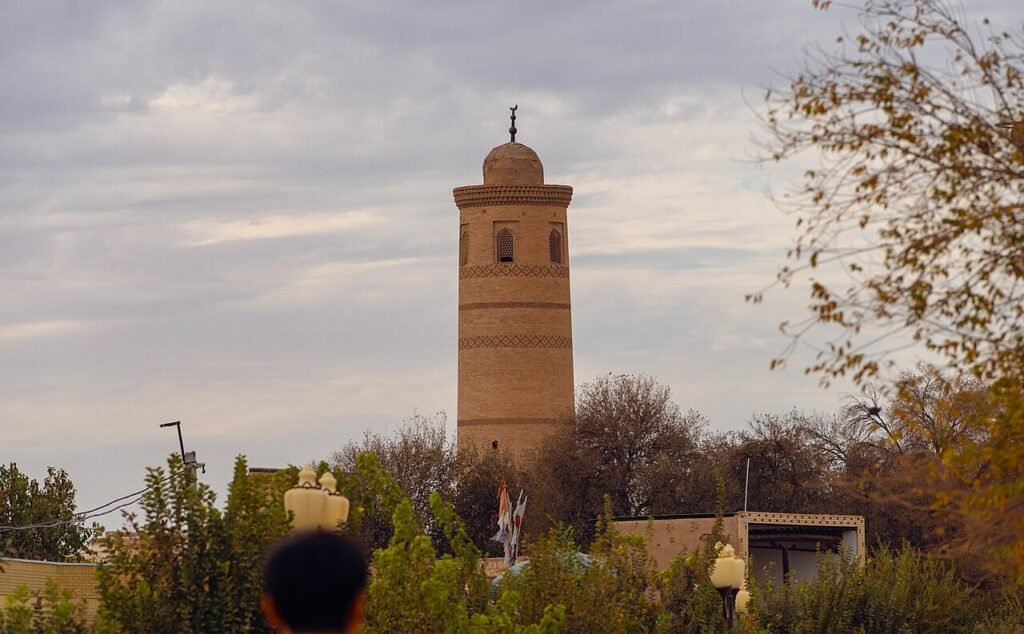

Tosh Darvoza Khiva: A Visitor Guide to the Southern Gate

Photo: Itchan Kala south gate.jpg by Davide Mauro, Wikimedia Commons, CC BY-SA 4.0.
Tosh Darvoza Khiva is the southern gateway of Itchan Kala, the walled inner city at the heart of historic Khiva. Less visually ornate than some of the city’s madrasas and minarets, it is a powerful piece of urban architecture: a fortified passage where travellers, merchants, guards and customs officials once moved between the oasis city and the roads beyond its walls.
What is Tosh Darvoza?
Tosh Darvoza, also written as Tash Darvaza or Tosh Darvoza, is one of the historic gates set into the defensive walls of Itchan Kala. The name is commonly translated as “Stone Gate”, although the gateway itself is built chiefly from brick and forms part of the larger earthen-and-brick fortification system.
Itchan Kala is the inner town of Khiva, enclosed by substantial walls and recognised by UNESCO as a World Heritage property since 1990. UNESCO describes the city as a coherent example of Central Asian Islamic architecture and notes its historic importance as the last major stopping place for caravans before the desert route towards Iran. Tosh Darvoza belongs to this wider urban setting rather than standing as an isolated monument. (whc.unesco.org)
The gate stands on the southern side of the old city. For visitors walking through Khiva, it offers a useful change of perspective: instead of looking at a single palace or religious building, you can read the way the city controlled movement, protected its population and connected monumental architecture with everyday commerce.
History and role
Available heritage descriptions place the construction of Tosh Darvoza in the 1830s and 1840s, during the period of Allaquli Khan, with the structure completed or altered by 1873. Allaquli Khan ruled the Khiva Khanate from 1825 to 1842, a period of major building activity in the city. His reign saw the construction and expansion of palaces, madrasas, mosques, caravan facilities and other urban works.
The gate’s position reflects Khiva’s commercial geography. Heritage documentation records that caravans arriving from the direction of the Caspian Sea entered the city through Tosh Darvoza. Customs and guard rooms were located on either side of the passage, giving the gate a practical role beyond defence. It was a checkpoint, controlled entrance and small administrative zone in one. (meros.uz)
That combination of commerce and security is important to understanding historic Khiva. The walls did not simply separate a “historic centre” from the outside world. They regulated the movement of people, animals, goods and information. A caravan entering through the southern gate would have passed through a carefully organised threshold before reaching the streets, markets and religious institutions of Itchan Kala.
Architecture and details
Tosh Darvoza is a substantial, compact structure with a symmetrical north–south axis. The southern façade is framed by two large tower-like masses, while the central route passes through a sequence of vaulted and domed spaces. Heritage records describe a six-chamber composition: two principal sections along the roadway, connected by arched openings to smaller enclosed rooms at the sides.
Those side rooms are thought to have served customs officers, guards and commercial functions. Their presence makes the gate especially interesting for visitors who want to understand how architecture supported administration. The gate was not only an opening in a wall; it was a building designed to observe, question, collect and protect.
The decoration is restrained. Unlike the blue-and-white tilework associated with many of Khiva’s best-known monuments, Tosh Darvoza relies largely on the texture and rhythm of exposed brickwork. Look for the repeated arches, the thickness of the walls and the transition from the bright exterior light into the cooler, shaded passage. The effect is deliberately monumental but not ornamental.
Published measurements vary between heritage descriptions. One record gives an overall plan of approximately 9.7 by 17 metres and a height of about 9.3 metres, while another gives a larger plan measurement of approximately 19.7 by 17 metres and a height of around 10 metres. The difference may reflect different methods of measuring the projecting sections and wall structure, so these figures are best treated as approximate rather than definitive. (meros.uz)
How to visit Tosh Darvoza
Tosh Darvoza is best visited as part of a walking circuit of Itchan Kala. Allow around 15 to 30 minutes if you are concentrating on the gate itself, or longer if you want to photograph the passage, study the masonry and imagine its relationship with the southern approach to the city.
What to look for
- The projecting masses on the southern side of the gate.
- The deep, shaded roadway and its sequence of arches.
- The contrast between the plain brick surfaces and Khiva’s richly tiled monuments.
- The smaller side chambers associated with guard, customs and trading activity.
- The way the gate sits within the thickness of the city wall rather than in front of it.
Opening arrangements, ticket requirements and access rules for monuments in Itchan Kala can change. Check the current information locally or with the official museum-reserve authorities shortly before your visit, especially if you are travelling in the low season or planning an early-morning or evening walk.
The passage is generally experienced at ground level, but the historic masonry, uneven surfaces and confined spaces may be difficult for visitors using wheelchairs or those with limited mobility. If accessibility is important, ask locally about the most practical route and current conditions. Wear shoes with a firm grip, particularly after rain.
Photography is usually one of the pleasures of walking through Itchan Kala, but avoid blocking the passage or photographing people at close range without permission. Dress respectfully around mosques, mausoleums and other religious buildings nearby. Uzbekistan’s official tourism guidance advises visitors to cover exposed shoulders, backs and legs when visiting religious sites. (uzbekistan.travel)
Nearby sights
Tosh Darvoza works well as the southern starting point for a broader exploration of Khiva’s inner city. To understand the defensive setting, continue with the guide to Khiva City Walls and Watchtowers. For a wider orientation to the protected historic centre, see Itchan Kala in Khiva.
From there, you can follow the streets towards the central monuments and compare the gate’s plain brick architecture with the more decorative buildings of the khanate. The Allakuli Khan Madrasa and Trading Quarter is particularly useful for understanding the commercial world that Tosh Darvoza helped regulate. The Tash Khauli Palace offers a contrasting view of Allaquli Khan’s architectural ambitions, with enclosed courtyards, glazed tilework and ceremonial spaces.
If you have more time, walk towards the western side of Itchan Kala to see the famous Kalta Minor and the main western entrance, or explore the southern and eastern residential streets where the city’s traditional scale is often most apparent. The value of Khiva lies not only in its individual monuments but also in the relationship between gates, walls, markets, courtyards and narrow streets.
Frequently Asked Questions
Where is Tosh Darvoza in Khiva?
Tosh Darvoza is on the southern side of Itchan Kala, the walled inner city of Khiva. It is built into the historic defensive wall and forms one of the city’s principal southern approaches.
When was Tosh Darvoza built?
Heritage sources generally associate the gate with the 1830s and 1840s, during the reign of Allaquli Khan, with later work or completion connected with the 19th century. Exact dating should be treated cautiously because published descriptions do not give identical dates.
Why is Tosh Darvoza important?
It shows how Khiva combined defence, customs administration and trade within a single architectural threshold. Historical accounts also associate the gate with caravan routes approaching from the Caspian Sea.
Is Tosh Darvoza worth visiting?
Yes, especially for visitors interested in urban history, fortifications and the practical side of Silk Road cities. It may not have the colourful tilework of Khiva’s most famous monuments, but its scale, brick construction and passage through the city wall reveal how Itchan Kala functioned as a lived and controlled urban centre.
Sources and further reading
- Meros.uz: Tosh Darvoza heritage record
- Meros.uz: Tash Darvaza architectural description
- UNESCO World Heritage Centre: Itchan Kala
- Uzbekistan Travel: Khiva destination information
- uzbekistan.travel
- uzbekistan.travel
Photo: Itchan Kala south gate.jpg by Davide Mauro, Wikimedia Commons, CC BY-SA 4.0.