
Matniyaz Divan Begi Madrasa Khiva: Visitor Guide

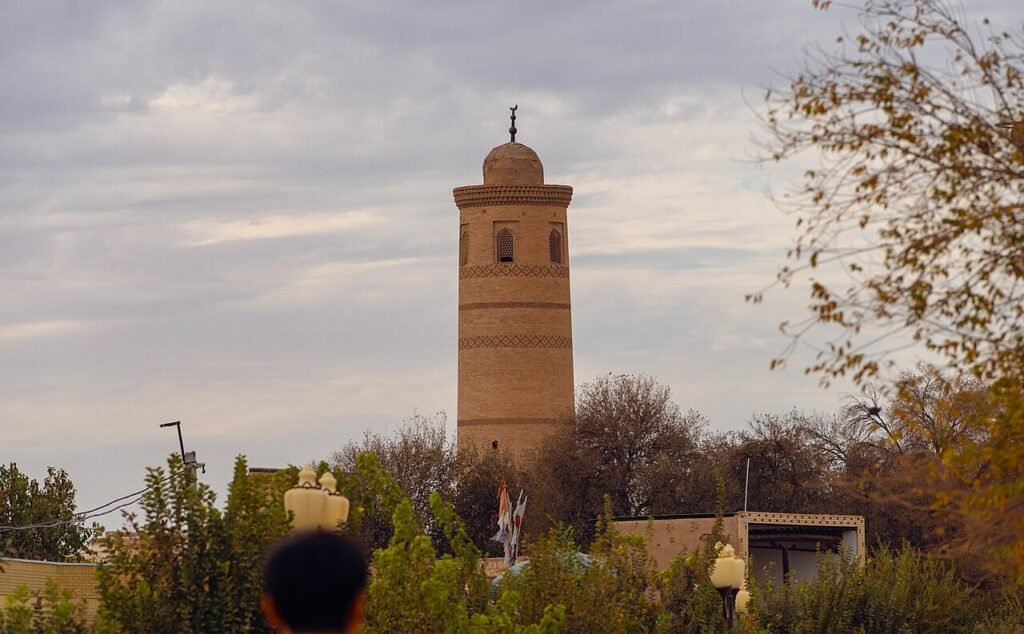
Photo: Matniyaz Divanbegi Madrasa.jpg by Bgag, Wikimedia Commons, CC0.
Matniyaz Divan Begi Madrasa is a compact but significant monument in the heart of Khiva’s Itchan Kala. Built in 1871 beside Muhammad Amin Khan Madrasa, it offers a more intimate architectural experience than some of the city’s grandest landmarks, with a restrained façade, a small internal courtyard and finely worked decorative details.
Why visit Matniyaz Divan Begi Madrasa?
The madrasa is easy to overlook because it stands close to more famous monuments, including Muhammad Amin Khan Madrasa and the Kalta Minor Minaret. That proximity is part of its appeal. A visit helps you understand how Itchan Kala was formed not only by monumental portals and tall minarets, but also by smaller educational, commercial and residential buildings woven into the urban fabric.
Unlike a single-purpose monument viewed only from the street, Matniyaz Divan Begi Madrasa also illustrates the changing life of historic buildings. It was adapted for tourism use during the Soviet period and has long been associated with restaurant and visitor facilities. Current access and use may change, so travellers should check locally before planning to enter the interior.
History and cultural context
The madrasa was commissioned in 1871 by Muhammad Niyaz Divan Begi, also known as Matniyaz, who served as the khan’s finance minister. The building formed part of a wider urban project: a covered market, or chorsu, was constructed beside it. This pairing reflects the close relationship between education, trade and public life in late nineteenth-century Khiva.
Historical records describe the madrasa as having 21 student cells, classrooms and a winter mosque. A library was also associated with the institution. Nineteen cells were arranged on the ground floor, while two were located above the entrance portal. The reported dimensions are approximately 36.4 metres long and 31.8 metres wide, with an inner courtyard measuring about 21 by 17 metres.
The institution is best understood within the broader setting of Itchan Kala, the walled inner town of Khiva. UNESCO recognises Itchan Kala as an exceptionally coherent example of Central Asian Islamic architecture, where madrasas, mosques, mausoleums, markets and domestic buildings remain part of a connected historic townscape rather than isolated monuments.
Architecture and decoration
Matniyaz Divan Begi Madrasa follows a familiar Khorezmian madrasa plan, but its scale is relatively modest. The principal entrance faces west and is concentrated in a decorated portal. At the corners, small tower-like guldasta forms frame the building and give the otherwise low structure a stronger silhouette.
The entrance is reached through a small vestibule with three domed sections. This transition from street to courtyard is typical of madrasa architecture: it creates a clear threshold between the busy public lane and the quieter world of study inside.
The main decorative emphasis is on the entrance façade. The portal contains glazed ceramic tilework with vegetal islimi patterns, while the double wooden door carries related carved ornament. A marble inscription panel above the entrance adds a literary and commemorative dimension to the façade. The side elevations are more restrained; one northern side includes a shallow arcade, while other façades are comparatively plain.
Decoration with a message
The inscription associated with the entrance celebrates knowledge and learning. It presents education as a source of happiness, respect and lasting remembrance. This message is especially appropriate for a madrasa, where instruction, reading and scholarly life were central to the building’s original purpose.
Look closely at the contrast between the decorated portal and the quieter walls around it. The arrangement directs attention toward the entrance, while the courtyard and cells provide the practical setting for study. In Khiva, ornament is often concentrated at architectural thresholds rather than spread evenly across every surface.
What visitors should notice
- The relationship with Muhammad Amin Khan Madrasa: compare the compact, more intimate scale of Matniyaz Divan Begi with its larger neighbour.
- The west-facing portal: study the tile patterns, the inscription panel and the carved double doors.
- The corner guldastas: these small vertical elements help define the building’s outline.
- The courtyard proportions: imagine the daily rhythm of students moving between cells, classrooms, the mosque and the library.
- The contrast between public and private space: the entrance vestibule acts as a deliberate transition from the street into the madrasa.
Planning your visit
Allow around 20–30 minutes for the madrasa itself if the interior is open. Add more time if you want to examine the façade carefully, photograph architectural details or combine the stop with nearby monuments. Early morning and late afternoon usually provide softer light for the entrance façade, while the middle of the day can be harsh and hot, particularly in summer.
Because the building has been adapted for modern use, the experience may depend on current operations. Opening arrangements, interior access, restaurant activity, ticketing and photography rules can change. Verify details shortly before visiting through local staff, the Itchan Kala reserve or your accommodation.
Wear practical footwear: the historic lanes of Itchan Kala can be uneven, and courtyards may have steps or raised thresholds. Modest clothing is appropriate throughout the old town, especially when visiting active religious sites nearby. Ask permission before photographing staff, performers or local residents.
Visitors with limited mobility should ask about the current entrance route before arrival. The portal, vestibule and courtyard may not provide step-free access, and conditions can vary depending on how the building is being used.
Nearby sights
The madrasa is well placed for a walking circuit through central Itchan Kala. Begin with Muhammad Amin Khan Madrasa and the nearby Kalta Minor Minaret. From there, continue toward the Kunya-Ark Fortress for palace history and elevated views, or follow the lanes toward the Pahlavan Mahmud Mausoleum.
For a broader understanding of the setting, read the guide to Itchan Kala before exploring. The madrasa makes most sense when seen as one component of the walled city’s connected architectural landscape.
Frequently Asked Questions
When was Matniyaz Divan Begi Madrasa built?
It was built in 1871, during the late nineteenth-century period of Khiva’s khanate. It was commissioned by Muhammad Niyaz Divan Begi, the khan’s finance minister.
Where is the madrasa located?
It stands in the central part of Itchan Kala, close to Muhammad Amin Khan Madrasa and the Kalta Minor Minaret.
Can visitors enter Matniyaz Divan Begi Madrasa?
Interior access depends on current use and local arrangements. Since historic buildings may be adapted for tourism or hospitality purposes, confirm access shortly before visiting.
What is the most interesting feature of the madrasa?
For many visitors, the most rewarding details are the entrance portal, vegetal tilework, carved wooden doors and inscription panel. The compact courtyard and surviving description of student cells also reveal how the building functioned as an educational institution.
Sources and further reading
- UNESCO World Heritage Centre: Itchan Kala
- UNESCO Periodic Report: Itchan Kala conservation and adaptive reuse
- Uzbekistan Travel: Khorezm regional itinerary
- www.meros.uz
- whc.unesco.org
- www.meros.uz
Photo: Matniyaz Divanbegi Madrasa.jpg by Bgag, Wikimedia Commons, CC0.