

Kutlug Murad Inaq Madrasa in Khiva: Visitor Guide

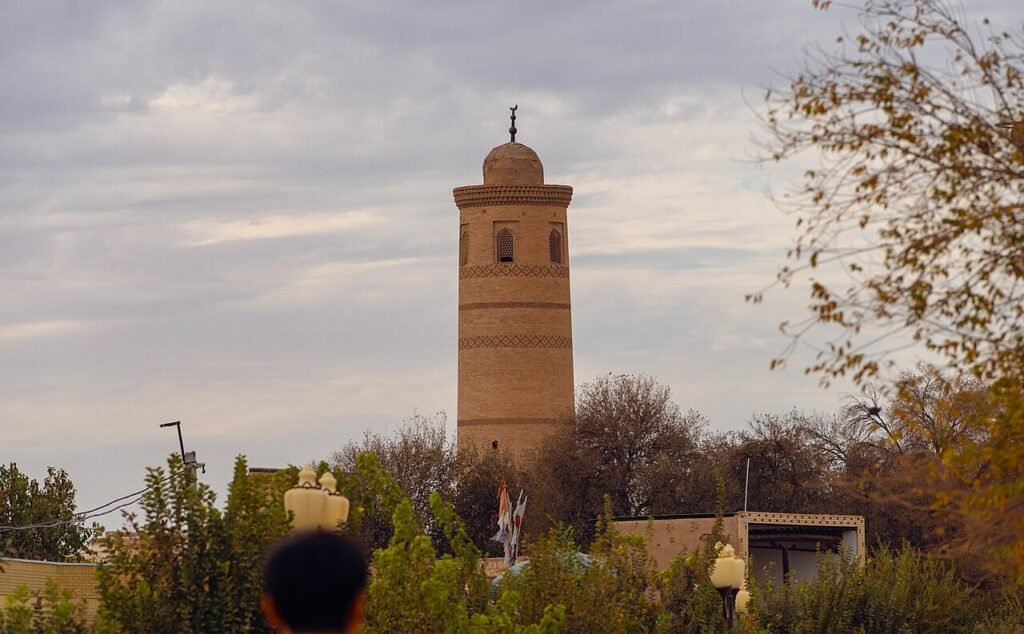
Photo: Medrese Kutlug Murad Inak.jpg by Gregor Rom, Wikimedia Commons, CC BY-SA 4.0.
The Kutlug Murad Inaq Madrasa is one of the most interesting monuments in Khiva’s walled old city, Itchan Kala. Built between 1804 and 1812, it combines the disciplined layout of a traditional Islamic college with unusually prominent decoration on its entrance façade. Its two storeys, compact courtyard, carved wooden doors and former underground water reservoir offer a more intimate experience than Khiva’s largest ceremonial monuments.
History and foundation
The madrasa was associated with Qutlug Murad Inaq, a military commander and regional governor who was related to the Khivan ruling family. Sources place its construction between 1804 and 1812, with 1812 often given as the completion date. This was a period when Khiva was expanding and rebuilding important parts of Itchan Kala under the Qongirat dynasty.
The building was not simply a monument. It was an operating educational and religious institution supported by a charitable endowment, or waqf. Historical records describe students, teachers, an imam, a muezzin, a caretaker and other staff connected with the madrasa. A surviving nineteenth-century account records 95 students studying there in 1858, divided into different levels of instruction.
The madrasa’s endowment also supported the distribution of grain. This detail is useful because it shows how a madrasa functioned within the wider urban economy: it provided education, religious services, accommodation and food support rather than serving only as a classroom.
A local tradition says that Qutlug Murad Inaq wished to be buried beside the madrasa. The story is connected with an opening once made in the nearby city wall so that his body could be brought into the city. The precise burial location remains uncertain, so visitors should treat this as a tradition rather than a firmly established fact.
Architecture and artistic details
The Kutlug Murad Inaq Madrasa is notable for being two storeys high, with 81 student cells arranged around a central courtyard. Its basic organization follows the familiar madrasa pattern: a controlled entrance, an inward-facing courtyard, residential hujras, a teaching room and a mosque.
Architectural historians identify similarities with the Abdulaziz Khan Madrasa in Bukhara, although the Khivan building is a more economical adaptation rather than a direct copy. The builders simplified some elements, omitting large corner rooms and elaborate summer verandas found in more expansive precedents. In their place, they created a compact and practical arrangement of cells.
The entrance façade gives the building its most distinctive character. Its portal uses a deep, five-sided arched recess with niches and decorative framing. Coloured ceramic tile appears around the arches and on the small corner towers, while carved ganch details add texture inside the entrance. The façade has a somewhat fortified appearance, strengthened by narrow openings and the tall domed forms marking its sides.
Inside, the ornament is more restrained. The mosque and teaching room are relatively plain, while the domed passageway and summer mosque retain modest decorative details. This contrast is worth noticing: the madrasa presents a carefully composed public face but relies on simple, functional interiors for everyday study and residence.
What to notice inside
Carved wooden doors
Look closely at the main entrance doors and the doors leading to the mosque and teaching room. Their carved surfaces are among the building’s most valuable artistic features. The workmanship is easy to miss if you move quickly through the courtyard, so allow time to inspect the patterns, proportions and joinery.
Student cells and domes
The hujras are small, vaulted rooms designed for study and residence. Many include wall niches and a raised platform. Some rooms reportedly had a partial wooden upper level, creating a small mezzanine-like space within the cell. These details help visitors imagine the rhythm of student life: lessons, reading, prayer and communal activity organized around the courtyard.
The former water reservoir
One unusual feature was a special well or underground cistern known as a tagi-zamin, described as a sardoba-like water source. It served local residents as well as the madrasa community. Even when it is not accessible to visitors, its presence illustrates the practical infrastructure built into historic Khivan architecture.
The courtyard has also been used for craft activity and exhibitions. Cultural programming can change, so the building’s present use should be confirmed locally rather than assumed from older descriptions.
How to plan your visit
The madrasa stands inside Itchan Kala, so it is best visited as part of a walking circuit rather than as an isolated stop. Start early or later in the afternoon, when the light brings out the relief of the portal and the colour of the tiles. Midday can be harsh, especially in summer, and the courtyard may offer limited shade.
- Allow: about 20–40 minutes for the madrasa itself, depending on access and whether exhibitions or craft workshops are operating.
- Bring: comfortable shoes, water and a camera or phone for architectural details.
- Check locally: opening arrangements, ticketing, restoration work and photography rules, as these can change.
- Dress respectfully: shoulders and knees should generally be covered when entering historic religious spaces.
- Accessibility: the historic building may have uneven thresholds, narrow passages and stairs to upper areas. Step-free access should be confirmed before arrival.
For broader context, place the madrasa within a route through the old city using this complete guide to Itchan Kala. It is also useful to compare its scale and educational role with the grander Allakuli Khan Madrasa and trading quarter.
Nearby places to combine
The madrasa is well positioned for a concentrated heritage walk. Continue toward the Pahlavan Mahmud complex, where the atmosphere shifts from educational architecture to pilgrimage and funerary art; our guide to the Pahlavan Mahmud Mausoleum provides useful background.
From there, you can walk toward Tash Khauli Palace to compare the madrasa’s disciplined courtyard with the palace’s more theatrical sequence of ceremonial spaces. The Tash Khauli Palace guide is a helpful companion for understanding Khiva’s courtly architecture.
If you want a broader view of the city’s defensive setting, combine the visit with the Khiva city walls and watchtowers. The relationship between the madrasa, the street network and the enclosing walls is an important part of understanding Itchan Kala as a complete urban landscape.
Frequently Asked Questions
When was Kutlug Murad Inaq Madrasa built?
It was built between 1804 and 1812, with 1812 commonly identified as the completion year. The dates are associated with inscriptions and historical accounts connected with the building.
How many rooms did the madrasa have?
Historical descriptions record 81 student cells, arranged over two storeys around the central courtyard.
Is the madrasa still a functioning religious school?
No. It is preserved as part of Khiva’s historic architectural heritage. Its current public use, including exhibitions or craft activity, may vary.
Can visitors enter the upper floor?
Access can depend on conservation work, safety arrangements and the day’s visitor policy. Ask locally before climbing, and take care on historic stairs and uneven surfaces.
Sources and further reading
- Meros.uz: Qutlug‘ Murod Inoq Madrasa
- Meros.uz: Ichan Kala heritage overview
- UNESCO World Heritage Centre: Ichan Kala monument list
- UNESCO World Heritage Centre: Periodic Report on Ichan Kala conservation
- Uzbekistan Travel: Khiva cultural heritage overview
- www.meros.uz
Photo: Medrese Kutlug Murad Inak.jpg by Gregor Rom, Wikimedia Commons, CC BY-SA 4.0.




1 Comment
[…] larger madrasas provide useful comparisons. Kutlug Murad Inaq Madrasa illustrates another important Khivan foundation, while the Muhammad Rahim Khan Madrasa offers a […]