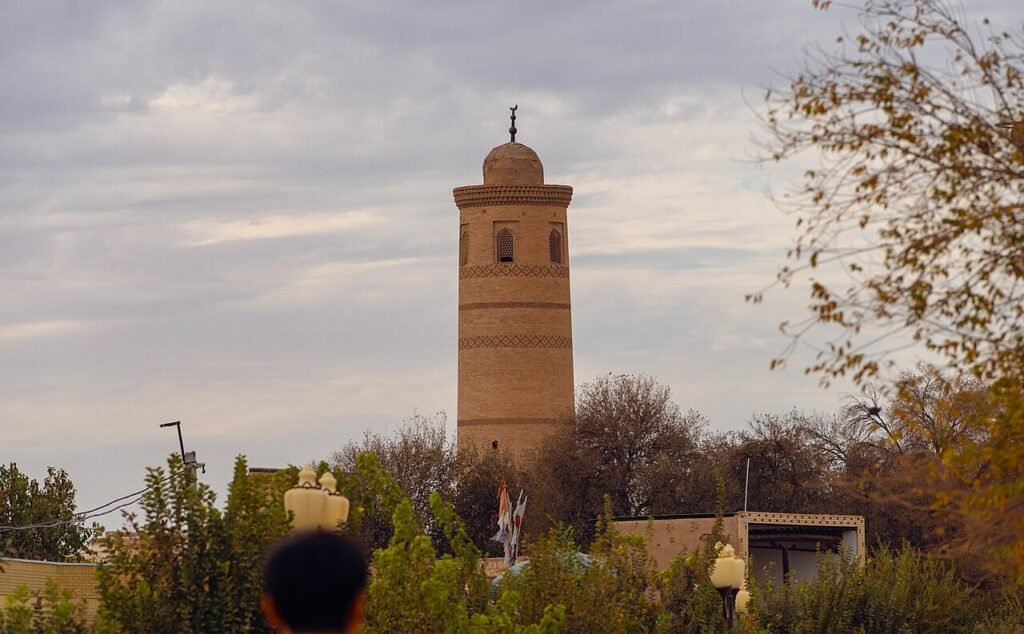

Ming Urik Archaeological Site: Tashkent’s Ancient City

Photo: Archaeological site Ming Urik.jpg by St. Christofor, Wikimedia Commons, CC BY-SA 4.0.
In the centre of modern Tashkent, a low archaeological mound preserves the remains of a city that existed long before the capital acquired its present name. Ming Urik, meaning “Thousand Apricots”, is one of the most important places to visit for understanding Tashkent’s pre-Islamic past. Its excavated remains, small museum and reconstructed spaces offer a glimpse of Chach, an ancient political and commercial centre connected to the wider worlds of Sogdiana, Kangju and the Turkic Khaganate.
Why Ming Urik matters
Ming Urik is not a monumental complex in the same sense as Samarkand’s Registan or Bukhara’s Ark. Much of the ancient city survives as earthworks, foundations and archaeological layers rather than complete buildings. That is precisely its value. The site allows visitors to read Tashkent as a lived urban landscape: a settlement shaped by irrigation, craft production, political power and long-distance exchange.
The mound stands near the Salар canal and close to central Tashkent. Its location is a reminder that the capital’s history did not begin with the Russian imperial period, the Soviet city or the modern republic. Several ancient settlements in and around the Tashkent oasis—including Ming Urik, Kanka and Shashtepa—help document the gradual development of urban life in the region.
For a broader introduction to the city’s historic layers, combine the site with our Tashkent Travel Guide.
History and archaeology
Archaeological research places the origins of the settlement at least as early as the beginning of the first century CE, although the site developed and changed over several centuries. Researchers have associated it with Chach, the historical name of the Tashkent oasis. Later Arabic sources rendered the name as Shash, since Arabic writing did not possess the “ch” sound in the same way.
The historical picture is complex. Chinese accounts connect the wider region with Kangju, while later political changes brought the oasis into the orbit of the Turkic Khaganate. Ming Urik appears to have grown from a fortified settlement into a larger urban centre, with a citadel, residential areas, workshops and elite buildings. Some official descriptions identify the city as a capital or royal residence, but individual phases of the site and the precise political titles of its rulers remain subjects for archaeological interpretation.
Archaeologists first began investigating Ming Urik in the late nineteenth century. Excavations have revealed evidence of walls built from pakhsa—rammed earth—and unfired brick, as well as domestic objects, ceramics, metalwork, terracotta figures and other traces of daily life. The settlement’s scale has been described as substantial, with a fortified core and a more extensive urban area around it.
Palace, temple and city
One of the most intriguing discoveries is an elite architectural complex interpreted as a palace or official residence. The complex included halls, living rooms, storage spaces and ceremonial areas. Archaeologists have also identified features interpreted as a fire sanctuary, including open altars. These findings are important because they reflect the religious diversity of Central Asia before the region’s Islamisation.
Fragments of colourful wall painting have been reported from the site, although the remains are far less complete than the celebrated murals of Afrasiab in Samarkand. Their presence nevertheless points to a sophisticated visual culture and to connections with the wider Sogdian cultural sphere. Ming Urik should therefore be understood not as an isolated fort, but as part of the artistic, commercial and political networks of early Central Asia.
The city also appears to have supported skilled crafts. Pottery production, metalworking and textile manufacture are among the activities associated with the settlement. Coins connected with Chach are another reminder that the oasis participated in organised political and economic life rather than functioning only as an agricultural outpost.
What to see at Ming Urik
- The archaeological mound: Begin with the topography. Look for changes in ground level, raised areas and the outlines of excavated structures. Even modest earthworks can reveal the former hierarchy of the city.
- Excavated architectural remains: The exposed foundations and walls help visitors imagine the relationship between fortified areas, elite buildings and ordinary urban spaces.
- The museum displays: The on-site museum presents archaeological material connected with the settlement, including household objects and craft-related finds. Displays may be modest, but they help translate the site from a landscape of ruins into a human story.
- Reconstructed spaces: Visitor images and official tourism material show reconstructions of domestic rooms, a kitchen, a guest area and a teahouse. These installations are useful for imagining how buildings may have been organised, but they should be treated as interpretive reconstructions rather than surviving ancient interiors.
- The setting within modern Tashkent: Spend a few minutes looking beyond the mound. Roads, colleges, offices and contemporary city life surround a place that once formed part of a very different urban landscape.
Allow time to observe rather than simply photograph. At an archaeological site, the relationship between the mound, watercourse and surrounding city is often as informative as the individual artefacts.
Planning your visit
The site is listed at 31 Moshtabib Street, with a nearby reference point given as the Tashkent Polytechnic Professional College. It is relatively central and can be combined with other central-Tashkent sights. A taxi or ride-hailing service is the simplest option if you are unsure of the exact entrance. Public transport can also be practical, but check the final walking route locally because access arrangements may change.
Published information gives weekday and Saturday visiting hours, with Sunday listed as the regular day off. The online listings are not completely consistent about the morning opening time, so verify the current schedule shortly before travelling. Opening hours, ticketing, conservation work and access to individual areas can change without much notice.
A realistic visit takes around 45 minutes to 1.5 hours. That includes time for the museum, the mound and a careful look at the reconstructed areas. Archaeological ground can be uneven, dusty or exposed to strong sun. Wear comfortable shoes, carry water in warm weather and avoid climbing on walls or entering areas marked as restricted.
Etiquette and photography
Treat the site as a protected archaeological monument. Do not remove pottery fragments, soil or stones, and do not touch exposed surfaces unnecessarily. Ask before photographing museum staff, local visitors or any religiously interpreted displays. Photography rules can vary between the open area and the museum, so follow posted instructions or ask at the entrance.
Accessibility may be limited by uneven paths, steps and the historic nature of the mound. Visitors with mobility concerns should confirm current conditions before arriving and consider visiting with assistance.
Nearby ideas
Ming Urik works especially well as part of a central-city heritage day. Continue to the Amir Temur Square and Museum to explore how later generations represented Central Asian history. The Tashkent Metro offers a contrasting experience of the modern capital, with richly decorated stations and convenient connections across the city.
For a more traditional urban atmosphere, travel onward to Chorsu Bazaar. Its market life provides a useful contrast with Ming Urik: one place preserves the material traces of an ancient city, while the other demonstrates how commerce and social exchange continue to shape Tashkent.
Frequently Asked Questions
What does Ming Urik mean?
Ming Urik is commonly translated as “Thousand Apricots”, referring to the apricot garden traditionally associated with the mound before its archaeological importance was fully recognised.
How old is Ming Urik?
Archaeological summaries place the settlement’s origins at least as early as the beginning of the first century CE. The site was occupied, expanded and transformed over subsequent centuries, so it is better understood as a long-lived urban complex than as a single-period monument.
Is Ming Urik the ancient capital of Tashkent?
Ming Urik is strongly associated with ancient Chach or Shash and is often described as a capital or royal centre. The exact political history is complex, however, and interpretations depend on combining archaeology with limited written evidence.
How long should I spend there?
Plan on 45 minutes to 1.5 hours, depending on how much time you spend in the museum and how carefully you examine the archaeological remains. Check opening arrangements shortly before your visit.
Sources and further reading
- Uzbekistan Travel: Ancient Settlement of Ming Urik
- Uzbekistan Government Heritage Directorate: History of Ming Urik
- Uzbekistan Travel: Tashkent Metro
- uzbekistan.travel
- app.uzbekistan.travel
- uzbekistan.travel
Photo: Archaeological site Ming Urik.jpg by St. Christofor, Wikimedia Commons, CC BY-SA 4.0.