
Amir Temur Square and Museum in Tashkent: Complete Guide
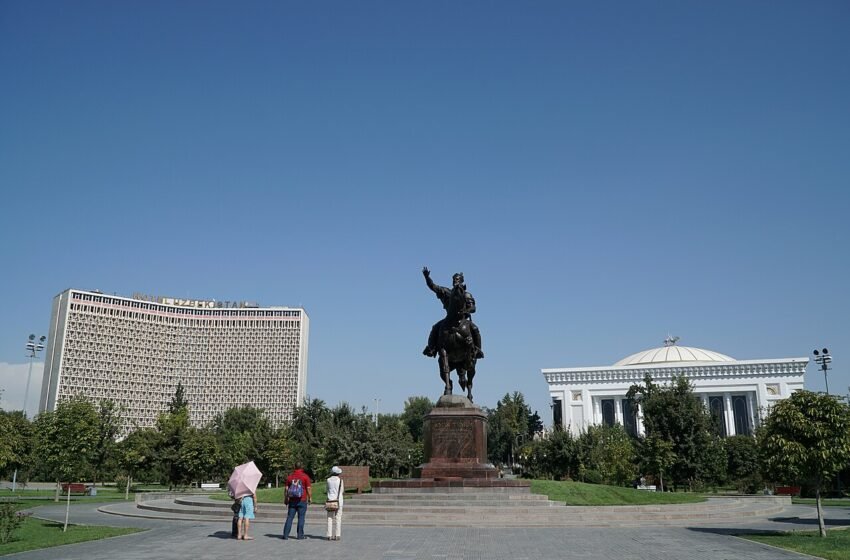
Photo: Adam Harangozó / Wikimedia Commons. CC BY-SA 4.0. Source: https://commons.wikimedia.org/wiki/File:Amir_Temur_Square.jpg License: https://creativecommons.org/licenses/by-sa/4.0
Amir Temur Square is the clearest orientation point in central Tashkent. A leafy circular park surrounds the equestrian monument to Amir Temur, while the Museum of the Temurids, Hotel Uzbekistan, university buildings and historic clock towers frame the adjoining avenues. Together they tell a story that reaches from the Russian imperial city through Soviet modernism to post-independence national identity.
The square is easy to pass through quickly, but it rewards a slower circuit. Each side represents a different architectural period, and the nearby museum helps visitors understand why Amir Temur and the Timurid cultural legacy occupy such a prominent position in modern Uzbekistan.
How the square developed
The park was laid out in the late nineteenth century as part of the planned colonial-era city east of old Tashkent. Its name and central monuments changed several times during the twentieth century, mirroring political transitions. The present dedication emerged after independence, when the space was reorganised around the figure of Amir Temur.
This layered history remains visible in the surrounding streets. Older institutional façades, Soviet-era landmark buildings and newer civic architecture share the same sight lines. Walk the full perimeter before focusing on the central statue; the contrast is the square’s most important urban feature.
The Amir Temur monument
The equestrian statue presents the fourteenth-century ruler as a founder and statesman. Its elevated position controls the centre of the radial park and creates long views along Amir Temur Avenue. The monument is popular with residents as well as visitors, especially in the cooler hours of late afternoon and evening.
Photographs work best from several distances. A wide frame can include the museum dome or Hotel Uzbekistan, while a closer angle records the modelling and inscription. Stay on paths and lawns where access is permitted, and do not climb the pedestal or interrupt formal ceremonies.
Museum of the Temurids
The State Museum of the History of the Temurids opened in 1996. Its blue-domed circular building deliberately recalls forms associated with major monuments of Uzbekistan. Exhibitions introduce Amir Temur, his descendants, diplomacy, warfare, scholarship, manuscript culture and the artistic achievements of the Timurid period.
The museum is most useful when visited before Samarkand or Shakhrisabz, because it supplies names, chronology and maps that help organise later sightseeing. Displays and language provision can change, so ask about an English guide or audio material at the ticket desk and confirm whether every gallery is open.
A central Tashkent walking route
Begin at Amir Temur metro station, circle the park and visit the museum, then walk toward Broadway and Independence Square. The Alisher Navoi Theatre can be added without making the route too long. In hot weather, reverse the order and use the museum during the brightest part of the afternoon.
Allow thirty minutes for the park and ninety minutes for the museum. The wider Tashkent travel guide connects this central district with Hazrati Imam, Chorsu Bazaar and the main collections elsewhere in the capital.
Practical information
Tashkent is spread across a large urban area, so group sights by district instead of crossing the city repeatedly. The metro is usually the simplest way to connect the old city, central squares and museum district. Spring and autumn are comfortable for long walks; in summer, schedule open-air visits for morning or late afternoon. Religious complexes remain active places of worship, so wear modest clothing, speak quietly and follow any local photography instructions.
Before you go: Opening hours, ticket prices, restoration closures and photography rules can change. Confirm current conditions at the official ticket office, museum or your accommodation. Never climb on historic fabric, and ask permission before making close portraits of residents or vendors.
Frequently asked questions
Who was Amir Temur?
Amir Temur was the fourteenth-century founder of the Timurid state and a central figure in the political and cultural history of the region.
Is the museum inside the square?
It stands beside the park, a short walk from the equestrian monument and Amir Temur metro station.
How much time is needed?
Plan around two hours for the square and museum together, excluding nearby streets and cafés.
Sources and editorial note
This independent guide was written in original language and fact-checked against the authoritative references below. It does not reproduce their text. Practical details should be rechecked close to the date of travel.
Featured photo: Amir Temur Square.jpg by Adam Harangozó, Wikimedia Commons. CC BY-SA 4.0. Resized for display.