
Abulkasym Madrasa Tashkent: Crafts, History and Visiting Tips
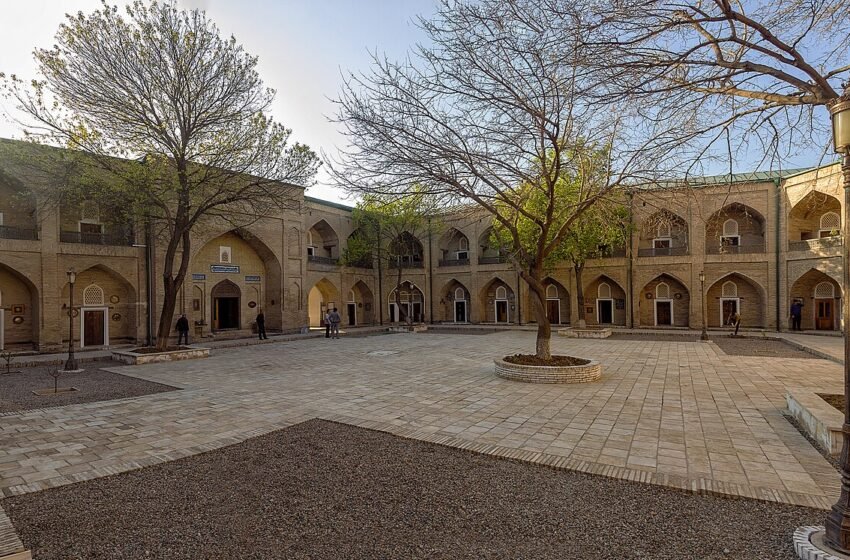
Photo: NatalieChunina / Wikimedia Commons. CC BY-SA 4.0. Source: https://commons.wikimedia.org/wiki/File:Abulqosim_madrasasi.jpg License: https://creativecommons.org/licenses/by-sa/4.0
Abulkasym Madrasa Tashkent is a nineteenth-century monument in the historic Beshyogoch area, south of the old city centre. Although its original religious-school function has ended, the complex remains connected with cultural preservation and traditional craftsmanship. Its brick façade, courtyard plan and layered history offer a quieter alternative to Tashkent’s better-known madrasa landmarks.
Why visit Abulkasym Madrasa?
Abulkasym Madrasa is valuable not only as an architectural monument but also as a place where Tashkent’s religious, educational and artistic traditions overlap. The building is associated with Abulkasym Eshon and is also known by names including Abulkasym Sheikh Madrasa, Madikhon Qazi Madrasa and Yangi Mahalla Madrasa. It stands in the Beshyogoch district, between the Legislative Chamber of the Oliy Majlis and Peoples’ Friendship Square.
For visitors, the appeal is its sense of continuity. This is not simply a preserved façade to photograph from outside: the complex has been adapted over time and is linked with organisations and teaching initiatives concerned with applied arts. Access to individual rooms or workshops may vary, so treat the site as a working cultural place rather than a conventional museum with a fixed visitor route.
History and cultural context
The madrasa dates from the nineteenth century. Available heritage descriptions place its beginnings in the early part of that century, while later construction expanded the complex. Its second storey was added between 1864 and 1867, creating the substantial two-level form visible today.
Abulkasym Eshon is remembered as the founder and patron of the madrasa. Heritage accounts also connect the institution with several important figures in Uzbek intellectual and literary history, including Abdulla Qodiriy, Munavvar Qori Abdurashidkhanov, Ghulam Zafari and Abdurauf Fitrat, who studied there for periods of time. These associations help explain why the building matters beyond its decorative qualities: it formed part of the educational life of old Tashkent.
The madrasa was closed in 1919. During the twentieth century, its spaces were used for different purposes, including residential and storage functions. The building suffered damage in the 1946 earthquake and later deterioration. Restoration work in the 1980s returned much of its architectural character. Since the independence period, the complex has also been associated with heritage-protection work and the “Ustoz-Shogird” approach, in which experienced masters pass practical skills to younger apprentices.
Architecture: what to notice
Abulkasym Madrasa is built mainly of baked brick and follows the courtyard-based traditions of Central Asian Islamic architecture. Its eastern-facing main façade is dominated by a projecting pishtaq, or monumental entrance portal. The portal rises above the surrounding wall and is framed by slender corner towers with upper elements recalling the architectural vocabulary of the sixteenth and seventeenth centuries.
Look closely at the façade rather than expecting the brilliant glazed-tile surfaces associated with Samarkand. Here, the visual effect comes largely from carefully laid brick, geometric proportion, shadow and relief. The upper sections include decorative bands and a parapet-like finish, while the entrance creates a strong transition between the busy modern city and the more enclosed world of the courtyard.
Historical descriptions mention classrooms near the entrance, student cells around the courtyard, a bathhouse, a cistern and a khanaqah connected with the sacred Muyi Muborak tradition. The original complex reportedly contained more than sixty cells for students arriving from outside Tashkent. Not every historic component survives, and some areas may not be open to casual visitors.
Crafts and the ustoz-shogird tradition
The madrasa’s contemporary identity is closely tied to handicrafts. Traditional Uzbek applied arts include ceramics, wood carving, ganch carving, embroidery, textiles, jewellery and other forms of decorative work. In a madrasa setting, craft is especially meaningful because historic educational institutions were not isolated from everyday urban life: they were part of neighbourhoods where religious learning, trade and skilled making developed side by side.
If workshops are operating during your visit, observe quietly and ask before entering a working area or handling an object. A demonstration may be informal rather than scheduled, and a master may be concentrating on a commission or teaching an apprentice. Purchases can support the continuation of these skills, but ask about the maker, materials and care requirements rather than treating every object as a generic souvenir.
For a broader introduction to Uzbek decorative arts, consider pairing the madrasa with the State Museum of Applied Arts in Tashkent. To compare another historic educational complex with an active craft environment, see the guide to Kukeldash Madrasa in Tashkent.
How to plan your visit
Allow time for a short, attentive stop
Plan around thirty to sixty minutes if you are mainly viewing the architecture, or longer if a workshop, conversation or cultural programme is available. The most rewarding approach is slow: first examine the entrance from outside, then look for permission to enter, and finally spend time noticing the relationship between the façade, courtyard and surviving historic spaces.
- Check before travelling: opening arrangements, workshop schedules, restoration activity and photography rules can change. Verify current details locally or through an official tourism contact shortly before visiting.
- Dress respectfully: choose modest clothing suitable for a religiously significant historic setting, especially if prayer or devotional activity is taking place.
- Ask before photographing people: this is particularly important in craft workshops, where portraits and images of unfinished work may not be welcome.
- Expect uneven access: historic courtyards, steps, thresholds and narrow passages may be difficult for wheelchair users or visitors with limited mobility. Ask in advance about the most accessible route.
- Visit in comfortable light: morning or late afternoon is often best for reading the brickwork and avoiding the harshest midday heat.
The madrasa works well as part of a wider heritage day. You can continue towards the old city and the Amir Temur Square and Museum, or build a religious-heritage route around the Hazrati Imam Complex. If you want food, textiles and everyday urban atmosphere afterwards, the guide to Chorsu Bazaar is a useful companion, although it lies in a different part of the historic city.
Nearby ideas
Abulkasym Madrasa is best understood within Tashkent’s wider historic landscape. Pair it with another madrasa if you want to compare architectural periods, or with a museum if you are interested in how Uzbekistan presents its cultural heritage today. The nearby Beshyogoch area also helps visitors see how surviving monuments are woven into a modern capital rather than preserved in an entirely separate archaeological zone.
Frequently Asked Questions
Where is Abulkasym Madrasa?
It is in Tashkent’s Beshyogoch district, on Bunyodkor Street, between the Legislative Chamber of the Oliy Majlis and Peoples’ Friendship Square. Map listings and transport arrangements should be checked shortly before travel.
When was Abulkasym Madrasa built?
The madrasa belongs to the nineteenth century. Heritage descriptions identify an early nineteenth-century foundation, with a second storey added between 1864 and 1867.
Can visitors see craft workshops there?
The complex has been associated with applied-arts education and the ustoz-shogird master-apprentice tradition. Whether a particular workshop is open, staffed or receiving visitors can change, so ask locally and do not assume that every room is accessible.
Is photography allowed?
Rules may vary by room, activity and occasion. Ask before photographing interiors, religious features, craftwork or people, and follow any signs or staff instructions.
Sources and further reading
- Uzbekistan Travel: Tashkent heritage and Abulkasym Madrasa listing
- Uzbekistan Travel: Main pilgrimage sites of Tashkent
- Uzbekistan Travel: Handicraft and shopping traditions
- dkm.gov.uz
- uzbekistan.travel
- uzbekistan.travel
Featured photo: Abulqosim madrasasi.jpg by NatalieChunina, Wikimedia Commons. CC BY-SA 4.0. Resized for display.