Chor Minor in Bukhara: Four Towers, History and Visitor Guide
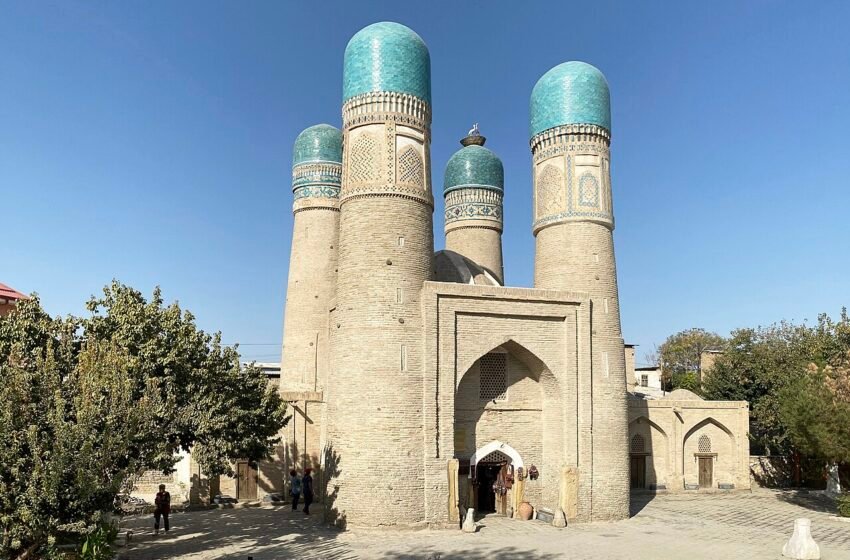
Photo: Bernard Gagnon / Wikimedia Commons. CC0. Source: https://commons.wikimedia.org/wiki/File:Chor_Minor,_Bukhara.jpg License: http://creativecommons.org/publicdomain/zero/1.0/deed.en
Chor Minor is one of Bukhara’s smallest famous monuments and one of its easiest to recognise. Four blue-capped corner towers rise above a compact gatehouse in a residential quarter east of Lyabi-Hauz. The name means “four minarets,” although the towers did not all function as minarets in the conventional sense.
The surviving building was once connected with a larger madrasa complex that has mostly disappeared. That context changes the way it should be seen: Chor Minor was an entrance and symbolic façade, not a miniature freestanding mosque designed only for picturesque effect.
Khalif Niyaz-Kul and the lost madrasa
The monument is generally dated to 1807 and associated with Khalif Niyaz-Kul, a wealthy patron of Turkmen origin. He founded a madrasa whose cells, courtyard and supporting buildings once extended beyond the gatehouse. Most of that educational complex no longer survives.
Bukhara’s better-known monuments often belong to the sixteenth century or earlier, making Chor Minor’s nineteenth-century date important. It represents continued patronage and architectural invention under the Manghit-era city rather than the peak of Shaybanid construction.
Why the four towers are unusual
Each tower has its own decorative arrangement, with glazed tile, brick pattern and a small blue dome. Their compact proportions and close grouping create the impression of a crown around the central chamber. At least one tower contains a stair, while others served practical or symbolic functions rather than calling worshippers to prayer.
Study the building from all four sides. The famous frontal view hides the differences between the towers and the relationship with later surrounding houses. Morning light often suits the main façade; late afternoon can reveal texture on the brick and quieter details in the adjoining lane.
Conservation and the neighbourhood setting
One tower collapsed in the 1990s and was reconstructed, a reminder that the apparent symmetry depends on modern conservation. Groundwater, structural movement and repairs have affected many earthen and brick monuments in the historic city. Visitors should avoid leaning on walls or climbing anywhere not explicitly opened.
The residential approach is part of the experience. Walk quietly, do not block doorways and ask before photographing residents. Small shops may operate near the monument, but the lane remains a lived neighbourhood rather than a purpose-built tourist plaza.
Combining Chor Minor with central Bukhara
Chor Minor is around a fifteen-minute walk from Lyabi-Hauz, depending on the route. The walk passes guesthouses, mahalla lanes and smaller religious buildings, giving useful contrast with the main monument corridor.
Allow thirty minutes at the site and extra time for the neighbourhood. Continue west through Lyabi-Hauz and the trading domes toward Poi Kalyan. Our Bukhara guide combines these stops into a balanced two-day plan.
Practical information
Most landmarks in central Bukhara are close enough to explore on foot. Begin early, rest during the hottest part of the day and return toward sunset, when brick façades gain warmer colour. Comfortable shoes are essential because paving can be uneven. Mosques, madrasas and mausoleums may have separate ticket or access rules, and restoration work occasionally changes routes. Confirm current opening hours locally and treat prayer spaces with appropriate respect.
Before you go: Opening hours, ticket prices, restoration closures and photography rules can change. Confirm current conditions at the official ticket office, museum or your accommodation. Never climb on historic fabric, and ask permission before making close portraits of residents or vendors.
Frequently asked questions
What does Chor Minor mean?
The Persian-derived name means “four minarets,” referring to the four blue-domed corner towers.
Was Chor Minor a complete madrasa?
The visible building was the gatehouse of a larger madrasa complex, most of which has disappeared.
How long does a visit take?
Thirty minutes is sufficient for the monument, but allow longer to walk from Lyabi-Hauz through the surrounding quarter.
Sources and editorial note
This independent guide was written in original language and fact-checked against the authoritative references below. It does not reproduce their text. Practical details should be rechecked close to the date of travel.
Featured photo: Chor Minor, Bukhara.jpg by Bernard Gagnon, Wikimedia Commons. CC0. Resized for display.