Kunya-Ark Fortress in Khiva: Palace History and Visitor Guide

Photo: Faqscl / Wikimedia Commons. CC BY-SA 3.0. Source: https://commons.wikimedia.org/wiki/File:Konya_Ark_access_gate.JPG License: https://creativecommons.org/licenses/by-sa/3.0
Kunya-Ark was the fortified citadel of Khiva’s rulers, a palace-within-a-city positioned against the western wall of Itchan Kala. It contained spaces for government, ceremony, worship, defence and court life. Although only part of the former complex survives, the remaining courtyards and decorated iwans provide an essential introduction to the khanate’s political architecture.
The name means “old fortress,” distinguishing the complex from later royal residences. Its origins are associated with the seventeenth century, while much of what visitors see reflects rebuilding and decoration under nineteenth-century khans. Reading those layers is more useful than searching for a single construction date.
A royal city inside the city
The citadel functioned as a controlled administrative world. Walls and gateways separated the ruler’s domain from surrounding streets, while internal courts organised audiences, official business and private life. Minting, storage, military functions and religious observance all had a place within the broader palace system.
Much of the original area has disappeared, so the visitor route can feel fragmented. Use the western wall and surviving courts as anchors. Together they show how royal authority depended on enclosure, staged access and carefully decorated ceremonial spaces.
The kurinishkhana reception court
The reception court, or kurinishkhana, is one of the most impressive surviving spaces. A tall iwan with blue-and-white tilework faces an open courtyard where audiences and ceremonies could be arranged. The contrast between the shaded platform and bright court emphasised the ruler’s position.
Look closely at the tiled panels, carved wooden columns and ceiling details. Ornament is concentrated where it would frame authority and ritual. The layout also responds to climate: deep shade and airflow made the iwan a practical as well as symbolic architectural form.
Mosque, mint and watchtower
A summer mosque uses an open iwan and richly decorated surfaces, demonstrating the close connection between worship and court life. Museum displays in the complex may address coinage, government or Khiva’s history, though exhibition arrangements can change.
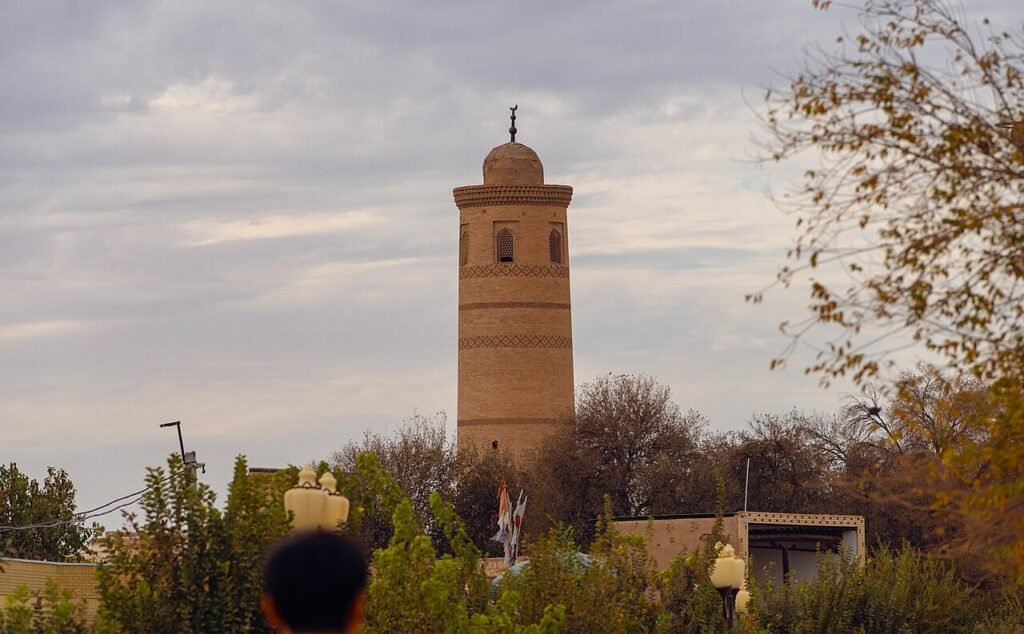
The watchtower area is famous for its elevated view over Itchan Kala, especially toward Kalta Minor and the old-city roofs. Access can involve steep or narrow stairs and may operate under a separate ticket. Travellers with mobility or vertigo concerns should assess conditions before climbing.
How to include Kunya-Ark in your route
Visit soon after entering through Ota Darvoza, before the courtyards become crowded. Allow at least an hour for the main spaces and more if the viewpoint is open. Late-afternoon light is attractive, but capacity around the watchtower may be limited.
Museum labels cannot always convey the original relationship between rooms that no longer survive. Before leaving, pause in the largest court and imagine the missing service buildings, guards, officials and petitioners that once made this a working centre of government rather than an isolated decorative palace.
Kunya-Ark sits beside Kalta Minor and the Muhammad Amin Khan Madrasa, making them a natural group. Continue east through Itchan Kala toward the Juma Mosque and central madrasas.
Practical information
The core of Khiva is compact, but the concentration of monuments rewards an unhurried visit. An early start gives quieter streets and softer light; evening is ideal for seeing the walls and minarets change colour. Surfaces can be uneven and shade is limited in summer. A combined ticket may cover several museum-monuments, although inclusions can change, so verify the current arrangement at the official ticket office. Dress respectfully in mosques and mausoleums.
Before you go: Opening hours, ticket prices, restoration closures and photography rules can change. Confirm current conditions at the official ticket office, museum or your accommodation. Never climb on historic fabric, and ask permission before making close portraits of residents or vendors.
Frequently asked questions
What was Kunya-Ark used for?
It was the khans’ fortified residence and included ceremonial, governmental, defensive and religious spaces.
Is there a viewpoint?
The watchtower area is known for city views, but access, stairs and ticket arrangements should be checked on arrival.
How long should visitors spend?
Allow 60 to 90 minutes, longer if museum displays and the watchtower are open.
Sources and editorial note
This independent guide was written in original language and fact-checked against the authoritative references below. It does not reproduce their text. Practical details should be rechecked close to the date of travel.
Featured photo: Konya Ark access gate.JPG by Faqscl, Wikimedia Commons. CC BY-SA 3.0. Resized for display.