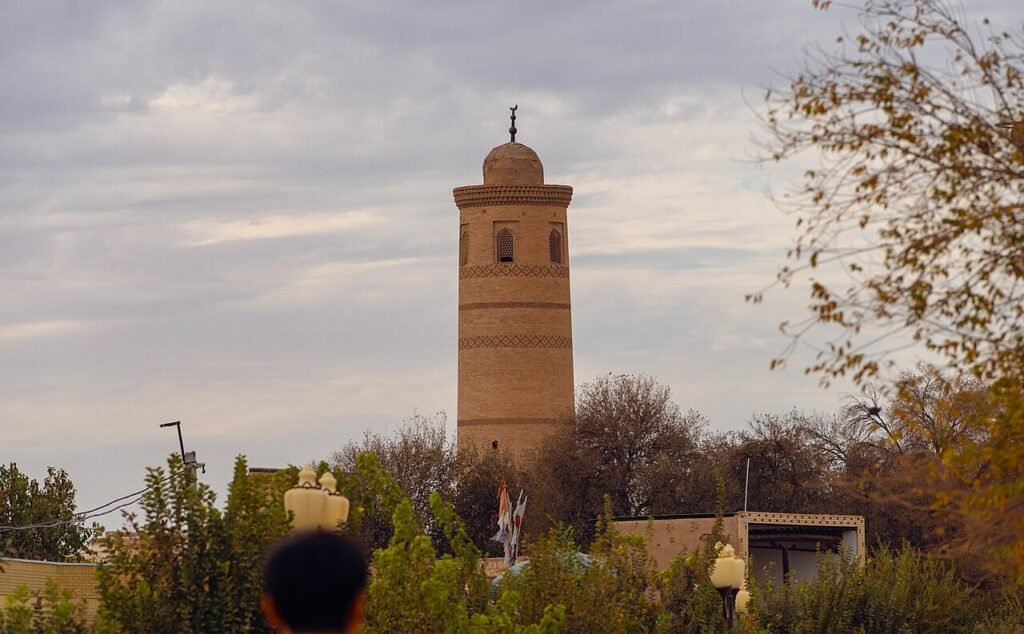
Dorut-Tilovat Ensemble: A Visitor Guide
At a glance
In the historic centre of Shahrisabz, the Dorut-Tilovat Ensemble brings together religious, commemorative and architectural landmarks associated with the city’s Timurid heritage. Its name is commonly translated as “House of Reflection” or “House of Recitation.” The complex is arranged around a courtyard and includes the mausoleum associated with the Sufi scholar Shamsiddin Kulol, the Gumbazi-Seyidon mausoleum and the Kok-Gumbaz, or “Blue Dome,” Friday Mosque.
Dorut-Tilovat is best understood as both a historic monument and a continuing sacred place. Visitors come to study Timurid architecture, but the site also preserves graves, memorial traditions and spaces connected with Islamic learning and devotion. Allow time to look beyond the most prominent dome: inscriptions, geometric brick mosaics, carved or tiled details and the relationship between the buildings are central to the experience.
History and significance
The ensemble began to take shape in 1370–1371 after the death of Shamsiddin Kulol, an important religious figure connected with Kesh, the historic name of Shahrisabz. Kulol was associated with the spiritual education of Amir Temur and was remembered as a respected Sufi teacher. His burial place became a site of reverence, and Amir Temur ordered a distinguished tombstone for the grave.
The complex developed further during the Timurid period. The Kok-Gumbaz Mosque was built in 1435 under Ulugbek, on behalf of his father Shakhrukh, and occupies a prominent position opposite the mausoleum. The mosque is identified as a Friday congregational mosque and became the principal architectural focus of the ensemble.
In 1437–1438, Ulugbek commissioned the Gumbazi-Seyidon mausoleum. Its name means “Dome of the Sayyids,” reflecting the burial traditions and gravestones associated with Sayyid families. Some stones from the fifteenth to seventeenth centuries bear names connected with the Termez Sayyids; other marble elements were brought from places including Termez and Kabul.
The ensemble forms part of the wider historic centre of Shahrisabz, a city strongly associated with Amir Temur and the Timurid period. The historic centre is included on the UNESCO World Heritage List for its monuments and its importance in the cultural and political history of medieval Central Asia.
What to see
Shamsiddin Kulol Mausoleum
Begin with the mausoleum connected with Shamsiddin Kulol. Its importance lies not only in its architecture but also in the person commemorated there. The site’s history links the religious scholar with Amir Temur’s family and with the broader spiritual life of Kesh. Nearby burial remains are also associated, by local and historical interpretation, with Taragay, Amir Temur’s father; treat this attribution as part of the site’s memorial tradition rather than as an invitation to disturb or closely approach the graves.
Kok-Gumbaz Mosque
The Kok-Gumbaz is the ensemble’s most recognizable building. Its blue dome gives the mosque its name, while the portal and façade display geometric ornament made with brick mosaic. Qur’anic inscriptions appear on the drum of the outer dome. The building’s scale and position help explain how the ensemble worked as a place of congregational prayer as well as remembrance.
Look carefully at the entrance composition, the patterned surfaces and the transition from the exterior into the interior. Architectural details can be easy to miss in strong sunlight, so a slower circuit around the courtyard is more rewarding than a quick photograph from the main approach.
Gumbazi-Seyidon
The Gumbazi-Seyidon mausoleum is more closely associated with dynastic and family remembrance. Its dome and compact form contrast with the larger mosque, creating a balanced courtyard composition. Take time to observe the gravestones and their inscriptions from a respectful distance. The stones are part of the historical record and should not be touched, climbed on or used as informal seating.
The courtyard and surrounding historic centre
The courtyard is an important part of the ensemble’s design. The three principal buildings are not isolated monuments; they form a connected setting in which prayer, burial and commemoration were brought together. Dorut-Tilovat also sits within a larger group of Shahrisabz landmarks, including the remains of Ak-Saray and the nearby Dorus-Saodat complex. Combining these sites can give a clearer sense of the city’s Timurid urban landscape.
Access and visitor planning
Dorut-Tilovat is located in the centre of Shahrisabz, within the city’s historic area. The ensemble is commonly visited together with Kok-Gumbaz and other central monuments, so it fits naturally into a walking-focused sightseeing route. Exact walking times, transport arrangements and road conditions can vary according to your starting point and local changes.
Operational details should be checked directly before travelling. Current opening hours, admission arrangements, ticket prices, guide availability, restoration work and photography rules are not fixed here because they may change. Confirm them with the local tourism information service, your accommodation or site staff before setting out.
Plan for uneven historic surfaces and limited shade in open areas. Comfortable shoes, water and sun protection are sensible, particularly during warmer months. If you want to understand the inscriptions and Timurid chronology in greater depth, arrange a qualified local guide or prepare a short reference list in advance.
For a calmer visit, arrive early or later in the day if local access conditions allow. Religious monuments can become busier around prayer times or during local observances. Leave enough time to visit without rushing, especially if you also plan to see Ak-Saray and Dorus-Saodat.
Cultural etiquette
Although Dorut-Tilovat is a historic attraction, it remains a sacred environment. Dress modestly: shoulders and knees should be covered, and loose, comfortable clothing is appropriate for all visitors. Women may wish to carry a lightweight scarf in case one is requested for entry to a religious space.
Speak quietly near graves and prayer areas, follow any instructions from caretakers and avoid blocking entrances. Do not sit on tombs, lean against fragile architectural features or handle carved, tiled or inscribed surfaces. Ask before photographing people, worshippers or staff. Because photography permissions can vary by area and by day, confirm the current rules locally.
During prayer or religious ceremonies, wait discreetly and give worshippers priority. If a building is temporarily closed for religious use, restoration or another local reason, accept the restriction rather than attempting to enter. A respectful visit is part of preserving the ensemble for both the community and future travellers.
Frequently asked questions
What does Dorut-Tilovat mean?
The name is translated in different ways, including “House of Reflection,” “House of Meditation” and “House of Recitation.” The variations reflect the religious and commemorative character of the complex.
Which buildings are included in the ensemble?
The principal buildings are the mausoleum associated with Shamsiddin Kulol, the Gumbazi-Seyidon mausoleum and the Kok-Gumbaz Friday Mosque, all arranged around a shared courtyard.
Is Dorut-Tilovat part of the UNESCO-listed historic centre?
Yes. The ensemble lies within the historic centre of Shahrisabz, which is included on the UNESCO World Heritage List. UNESCO documentation identifies Dorut-Tilovat as a group of Timurid-period burial and religious structures.
What should I confirm before visiting?
Check current opening hours, ticket prices, entrance arrangements, restoration activity, guide availability and photography rules directly with local authorities, tourism services or site staff. These details may change and are not stated here as fixed facts.
Sources
- Uzbekistan Travel: Ensemble Dorut-Tilovat
- Uzbekistan Travel: Kok Gumbaz
- Meros: Dor-ut Tilovat Ensemble
- UNESCO World Heritage Centre: Historic Centre of Shakhrisyabz nomination
Automatically prepared reference guide, checked by automated source and translation checks; not an on-site review.