

← All historic cities of Uzbekistan
Uzbekistan • City chronicles
The History of Shafirkan
Shafirkan is a useful place to look beyond Bukhara’s monumental centre. Its surrounding district brings together the archaeology of Vardonze, traditions of irrigation, religious memory and embroidery. The history is dispersed through an oasis landscape rather than concentrated in one celebrated square.
The modern town and the ancient settlement of Vardonze must be kept distinct. They belong to a connected regional story, but Vardonze’s ruins are not simply the old centre of present-day Shafirkan.
At a glance: Shafirkan and its historical landscape
- Ancient and early medieval periods: settlement develops in the northern Bukhara oasis, including Vardana, now commonly called Vardonze.
- Tenth century: Narshakhi’s history of Bukhara preserves accounts of settlements and traditions in this wider area.
- Medieval Islamic period: religious networks give the district a continuing spiritual significance.
- Later centuries: agriculture and crafts sustain communities around the oasis.
- Twentieth century: modern district administration and economic change reshape the settlement pattern.
- Today: Shafirkan’s history is encountered through pilgrimage, archaeology and living craft traditions.
1. Shafirkan in the geography of the Bukhara oasis
To understand Shafirkan, begin with the cultivated country around Bukhara. A great city required more than impressive buildings: it needed grain, animals, cloth, fuel and people able to bring these goods to market. The surrounding settlements helped sustain urban life while maintaining histories of their own. Shafirkan belongs to this wider geography of production, exchange and community.
The boundary between oasis and desert was not simply a line separating civilisation from empty space. Pastoral communities also participated in regional exchange. Livestock, agricultural produce and manufactured goods connected people who used land differently. A settlement near that boundary could become important through its position between these economic worlds.
For a traveller arriving from central Bukhara, the change in scenery is therefore part of the historical experience. Fields, channels and villages help explain the foundations beneath the capital's prosperity. The district offers an opportunity to follow history outward, from the monument to the landscape that supported it, rather than treating everything beyond the city walls as background.
2. Water and the making of a settled landscape
In an oasis, the availability of land does not guarantee the possibility of cultivation. Water must reach it at useful times and in sufficient quantities. Channels require attention, sediment must be managed and neighbouring users must coordinate their demands. Irrigated agriculture is consequently a social arrangement as well as an engineering achievement.
This perspective gives ordinary features around Shafirkan historical significance. A branching watercourse suggests relationships between upstream and downstream communities. A field boundary may reflect successive divisions of land rather than a single ancient plan. The visible landscape combines inherited routes with later modifications; its present appearance cannot automatically be projected back a thousand years.
Water also helps explain why settlements can change position or importance. When reliable supplies shift, households face decisions about cultivation, work and residence. Such changes need not happen everywhere at once. Looking at the whole oasis makes these gradual adjustments easier to understand than a history written only as a sequence of rulers and battles.
3. Shapur, the canal and a remembered beginning
Local tradition connects the name Shafirkan with a prince called Shapur and a watercourse associated with him. The story belongs to the historical memory preserved around Vardana and Bukhara. It should be introduced as a foundation tradition, rather than used to assign the modern town an exact birthday or an independently verified royal founder.
Its lasting appeal is understandable. Bringing water to land is a powerful image of good government, prosperity and the creation of a community. A founder who makes cultivation possible gives a place both a name and an explanation for its existence. The narrative joins political authority to the practical conditions of everyday survival.
Names, however, can change through pronunciation, translation and copying. An attractive modern explanation does not settle their origin on its own. Visitors can appreciate the story while keeping a separate question open: what do written records, archaeology and the study of watercourses establish independently? That distinction allows local memory and historical investigation to enrich one another.
4. Vardonze: a neighbouring settlement with its own history
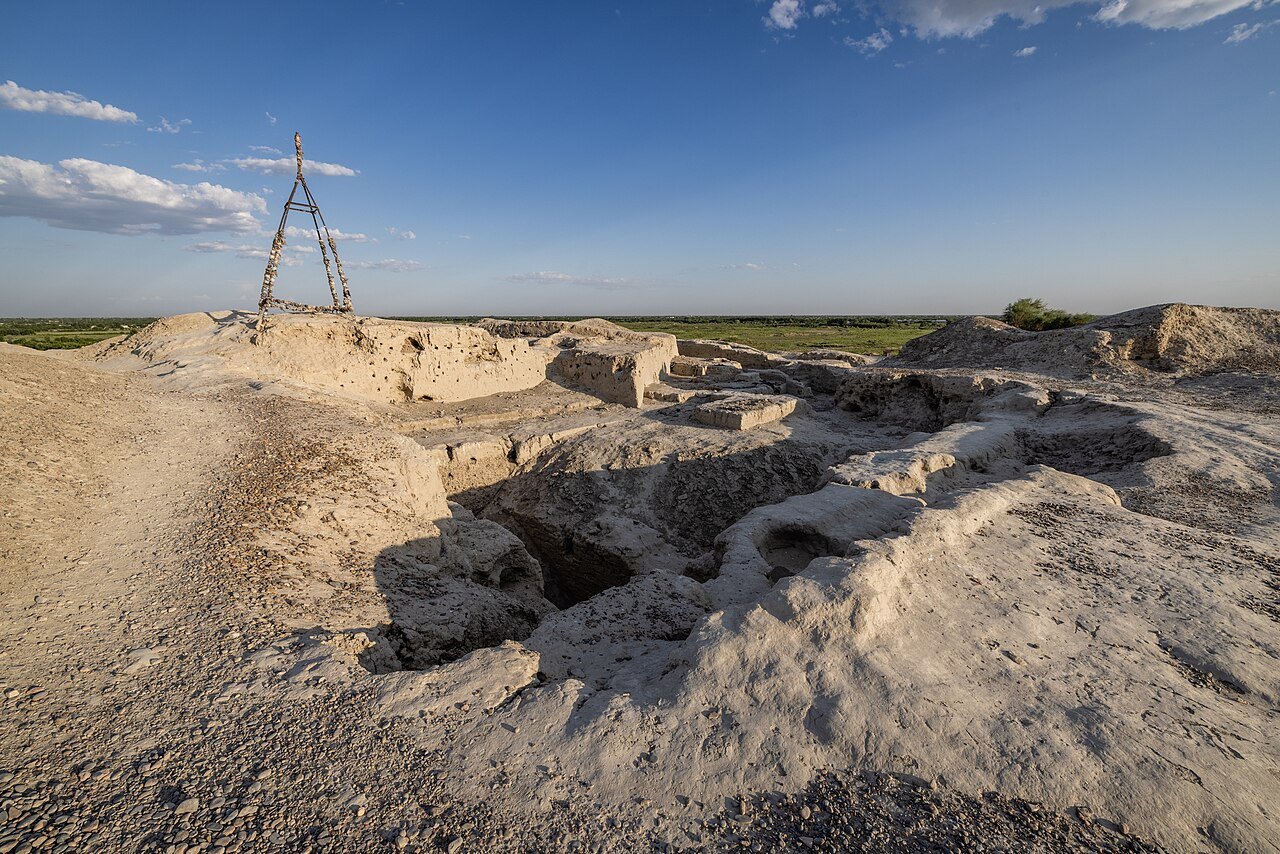
Vardonze, also written Vardanzi or Vardanze, preserves the remains of historical Vardana in Shafirkan District. It must be treated as a separate archaeological destination. Calling it the old town of modern Shafirkan obscures the different locations and development of the two settlements. Their connection is regional, not a claim that every modern street lies above ancient Vardana.
The site is especially valuable because an earthen ruin invites different questions from a restored religious complex. Instead of beginning with tile patterns or inscriptions above an entrance, the visitor looks at ground levels, the relationship between higher and lower areas, and the organisation of defended space. A site plan is often more useful than a panoramic photograph.
This is also a place where absence needs interpretation. Buildings made largely from earth rarely survive as complete rooms with intact roofs. Erosion and rebuilding alter their outlines. What looks like an undistinguished mound may contain the accumulated evidence of walls, floors and occupation. The modest appearance of the remains should not determine the importance assigned to them.
5. Local rulers before Bukhara's later dominance
Early medieval Vardana had rulers known as Vardan-khudats and was an important centre within the oasis. Its history challenges the assumption that Bukhara always exercised the same degree of dominance over every neighbouring settlement. Regional power could be divided among competing centres rather than organised around a single unchanging capital.
For visitors, this changes the way a citadel should be imagined. It was more than a defensive building: fortified elevated space could express authority, organise access and distinguish the ruling household from other inhabitants. The relationship between the stronghold and the surrounding settlement is therefore a political question as well as an architectural one.
Later fame can hide this earlier complexity. Bukhara's surviving ensembles naturally receive most attention, while places whose monuments are less visible can seem secondary in every period. Vardana is a useful correction. A historical journey becomes richer when the importance of a place is assessed for its own time, instead of measured only by what tourists can photograph today.
6. Narshakhi and the written memory of the oasis
Narshakhi's tenth-century history is an essential point of reference for the Bukhara region. His account brings settlements, rulers and remembered origins into a connected narrative. It also demonstrates why a history of Bukhara cannot be confined to the monuments within the modern city: neighbouring communities are part of the story from the beginning.
A medieval chronicle is not equivalent to a modern archaeological report. Its author selected material for particular readers and purposes, drawing on inherited accounts as well as knowledge closer to his own period. The surviving textual tradition also passed through translation and adaptation. These features make it valuable, while requiring care about the certainty assigned to individual episodes.
When a guide introduces a story with the words 'Narshakhi relates', that attribution is useful information. It tells the listener what kind of evidence is being presented. The next step is to ask whether excavations support a date, clarify a building phase or suggest a different interpretation. Written memory and material remains answer related, but not identical, questions.
7. Archaeology as a sequence of everyday lives
Research at Vardonze has investigated fortifications, buildings and occupation layers. Such work can reveal changes that are invisible in a short foundation story. A wall may have been repaired, a room divided, a doorway blocked or an older surface buried beneath a new floor. Each alteration records a decision made by people living at the site.
Pottery is particularly useful in this kind of investigation. A broken vessel can help specialists compare deposits and study production or consumption. Its meaning depends on where it was found and what surrounded it. A fragment removed from the ground without a record loses much of its value, even if it looks attractive or appears to be an ordinary discarded object.
Visitors should therefore experience the remains as an archive under investigation. Ask which areas have been excavated, what is securely dated and which interpretations remain provisional. These questions offer a more engaging encounter than expecting every feature to have a completed explanation. An archaeological site is a place where knowledge is still being built.
8. Vardonze and the Silk Roads World Heritage property
In 2023, Vardonze became a component of the UNESCO World Heritage property Silk Roads: Zarafshan-Karakum Corridor. This is a transnational, serial property connecting multiple places in Central Asia. The recognition applies to the identified component within that larger property; it does not mean that the whole modern town of Shafirkan has been inscribed as a historic city.
The corridor approach is particularly appropriate here. Long-distance movement depended on a chain of settlements, resources and stopping places. Studying one monument alone can conceal those connections, while a group of sites helps reveal how different landscapes contributed to exchange. Shafirkan's surroundings make sense within that network of oasis life and regional routes.
World Heritage recognition does not turn an archaeological mound into a fully reconstructed visitor attraction. Access arrangements, conservation work and interpretation can vary. The rewarding way to visit is to arrive with an understanding of why the site matters, then use the surviving evidence to explore its place in a much larger historical geography.
9. Environmental change and the movement of communities
The relationship between settlement and its environment remained important long after the early medieval period. Archaeological discussion of Vardonze connects its decline with changing conditions on the oasis margin. Rather than imagining a timeless city suddenly disappearing in a single dramatic moment, it is useful to consider processes that could affect different parts of a community at different speeds.
Households facing reduced opportunities might move closer to water, relatives or a more active market. Buildings could continue to be used after political importance had diminished. A name could survive even when the focus of settlement moved. These possibilities explain why abandonment dates and settlement histories require careful definition: they may describe different stages rather than one universal event.
The landscape around Shafirkan invites this longer view. Present villages, older ruins and cultivated areas form a changing relationship. A historical map should therefore be read alongside the current one. Understanding how people responded to their surroundings brings human choices into a story that can otherwise be reduced too easily to the advance of sand.
10. Khoja Arif Rivgari and spiritual geography
Khoja Arif Rivgari is one of the Sufi teachers honoured in the Bukhara region's Seven Pirs pilgrimage tradition. He is associated with the spiritual succession following Abdalkhaliq Gijduwani. His memorial in Shafirkan District connects this quieter part of the oasis with a network of religious learning and remembrance extending beyond Bukhara's central monuments.
Such connections did not require a place to become a political capital. A teacher's reputation, disciples and remembered example could give a community significance across a much wider area. This is a different form of historical influence from military power or court patronage, and it helps explain why small settlements can remain important pilgrimage destinations.
Accounts of revered teachers sometimes include exceptional ages or miraculous episodes. These belong to devotional tradition and should be identified accordingly. A visitor does not need to turn every such account into a literal biographical fact to understand its meaning for worshippers. The history of reverence is itself a subject worthy of attention and respect.
11. Reading a living pilgrimage complex
A religious memorial has several histories at once: the lifetime of the person commemorated, the development of the place of remembrance, and the construction or restoration of the buildings now visible. These layers should remain distinct. A newly finished courtyard does not imply a recent religious tradition, while an old association does not make every visible surface medieval.
Observe how the space is used. Paths, shaded areas, places for prayer and the movement of visitors can show the practical organisation of pilgrimage. Architecture helps people gather, pause and approach the memorial. The living activity of the complex explains aspects of its design that a description of dates and decorative motifs alone cannot convey.
Ask locally about appropriate access, photography and dress. Give worshippers room to use the site without becoming the subject of a photograph. A visit made with this awareness can still be curious and informative: questions about restoration, local memory and the relationship with other pilgrimage places are usually more productive than treating the complex as an empty historical exhibit.
12. Embroidery as a record of household culture
Shafirkan is associated with the embroidery traditions of the Bukhara region. This brings a different set of historical participants into view. Rulers and scholars often dominate written histories, but textiles direct attention towards makers, households and the work involved in preparing objects for use, presentation and important occasions.
An embroidered textile contains many decisions. Someone selected its ground fabric, planned the arrangement of motifs, chose threads and invested time in stitching. Its eventual use affected its dimensions and composition. A large furnishing and a smaller personal object may share techniques while answering different needs. Looking at function gives the pattern a social setting.
The word suzani is useful, but it should not flatten the variety of embroidered work into a single standard product. Nor should every piece sold in the region be assumed to have been made in Shafirkan. Asking who made an object, where it was produced and what materials were used creates a more meaningful connection with the craft than relying on a broad regional label.
13. What to notice in a textile workshop
A workshop visit becomes more informative when it follows the process. Begin with the fabric and the drawing or arrangement of the design. Then look closely at how the thread sits on the surface, how curves are formed and how colours are distributed. The reverse can sometimes help explain construction, but ask permission before handling or turning a piece.
Discuss the maker's own experience rather than expecting a rehearsed account of an unchanged ancient tradition. How was the skill learned? Which parts take the longest? Do different people contribute to one piece? Answers can reveal both the discipline of the work and the social relationships through which knowledge continues.
Contemporary changes are part of the history. Available materials, customer preferences and the time a household can devote to making all affect production. Adaptation does not automatically make a craft inauthentic. A useful distinction is between an honestly described modern object and one given an unsupported antique provenance. The maker's explanation is often more interesting than an exaggerated claim of age.
14. From the emirate to twentieth-century administration
The wider Bukhara region experienced major political change in the nineteenth and twentieth centuries. Russian predominance over the emirate developed in the nineteenth century; the emirate itself ended in 1920. Soviet institutions subsequently reorganised government, agriculture, education and religious life. Shafirkan's modern development belongs within this changing regional framework.
These changes reached households through practical arrangements: how land was managed, where people studied, which institutions provided employment and how communities interacted with officials. Political history therefore helps explain the everyday environment as well as changes in state symbols. A school or administrative building can represent a different chapter from the nearby shrine without being less relevant to the town's story.
It is useful to distinguish the history of the settlement from the history of the administrative district. Boundaries and official categories can change while a community continues. Conversely, the territory administered from a town can include sites much older than the town's present role. Keeping those scales separate avoids assigning the whole district a single foundation date.
15. Shafirkan after independence
Since Uzbekistan became independent in 1991, local histories, religious heritage and craft traditions have received renewed public attention. In Shafirkan, these interests connect the present town to both the archaeological landscape and the skills maintained within communities. The area's identity is made from several kinds of inheritance rather than one universally recognised architectural landmark.
Modern development also deserves a place in the account. Residents need housing, education, employment and transport. A historic district is a living environment in which these needs coexist with the protection of older places. Understanding that balance helps visitors see contemporary buildings and activities as part of the town, rather than as distractions from an imagined completely preserved past.
The strongest visit combines those perspectives. Walk through the present settlement with attention to its daily life, then travel to the separate sites that reveal earlier periods. The difference between them is instructive. Shafirkan's story emerges from their relationship: ancient occupation, religious memory, household workmanship and the continuing adaptation of an oasis community.
16. Connecting Shafirkan with Bukhara and Gijduvan
Shafirkan adds depth to a journey through the Bukhara oasis because it changes the questions a traveller asks. Bukhara's ensembles show concentrated patronage and urban institutions. Gijduvan introduces its own religious history and ceramic tradition. Shafirkan brings archaeological settlement, embroidery and another part of the pilgrimage landscape into the same regional picture.
These places should be connected without treating them as interchangeable. A craft associated with one centre is not automatically a product of another, and a religious teacher's relationship with a predecessor does not merge their memorials into a single location. Careful naming makes an itinerary clearer and gives each community its own historical identity.
Allow time for explanation rather than trying to collect the greatest number of stops. A thoughtful conversation with a maker or a guided reading of an archaeological plan can reveal more than a rushed photograph. Shafirkan rewards this approach because much of its interest lies in relationships that are not immediately visible: between water and settlement, teachers and disciples, objects and the households that made them.
Reading the history on a visit
Plan Vardonze as a separate archaeological stop and use a knowledgeable local guide where possible. Pair it with a visit to a craft workshop or religious memorial. Check local access conditions before travelling to outlying sites.
Avoid climbing fragile earthen remains, and ask before photographing people in workshops or at pilgrimage places. The most rewarding questions concern water, settlement and the transmission of skills.
Sources and further reading
- Historical study discussing Shafirkan, Vardonze and regional embroidery
- Bukhara administration: regional craft heritage
- Uzbekistan Tourism: the seven Sufi pilgrimage sites of Bukhara Region
Shafirkan, Shofirkon and Shofirkon tumani may refer to the town or its district. This chronicle identifies the broader landscape explicitly rather than assigning every regional site to the town centre.