

← All historic cities of Uzbekistan
Uzbekistan • City chronicles
The History of Shahrihan
Shahrihan, usually written Shahrixon in Uzbek, belongs to the history of the Kokand Khanate’s transformation of the Fergana Valley. Its rise in the early nineteenth century was closely connected with irrigation, settlement and craft production. It is a historical town whose importance does not depend on claiming an ancient royal foundation.
The story offers a different view of state-building from Kokand’s palace. Here the crucial questions are how water reached new land, how people were settled and how a town acquired the skills needed to grow.
At a glance: Shahrihan through time
- Early nineteenth century: Umar Khan’s government develops irrigation and settlement in this part of the valley.
- 1815: the district administration’s historical account dates Shahrihan’s recognition as a city to Umar Khan’s decree.
- Nineteenth century: artisans and agricultural communities contribute to urban growth.
- 1876: Russian annexation of the Kokand Khanate changes the town’s political setting.
- Twentieth century: district administration, Soviet economic policies and new infrastructure reshape local life.
- Since 1991: Shahrihan continues as a town and district centre in independent Uzbekistan’s Andijan Region.
1. A younger town in an ancient valley
The Fergana Valley has a long history of settlement, but not every town within it began in antiquity. Shahrihan's importance comes from a later chapter: the expansion of cultivation and urban life under the Kokand Khanate. Its early nineteenth-century foundation gives it a different historical character from Andijan, with its much older urban past.
This distinction makes Shahrihan especially useful for understanding how cities were made. A ruler's decision could establish a settlement, but a functioning town required water, residents, buildings and economic relationships. A foundation was the beginning of a process, not the instant appearance of a complete urban community. Shahrihan makes those practical requirements central to the story.
The town is now part of Uzbekistan's Andijan Region. Its historical connections extend across the valley towards Kokand, Namangan, Chust and Margilan. These links matter more than an attempt to isolate its past within current administrative boundaries. The creation of Shahrihan was part of a regional transformation in which people, resources and skills moved between established centres and new settlements.
2. Umar Khan's project of settlement and cultivation
Umar Khan's government associated the foundation of Shahrihan with irrigation development in the eastern valley. The scholarly history of the Kokand Khanate places such projects within a broader effort to increase cultivated land and establish a productive population. Water engineering and state-building were closely connected: fields could sustain households, and households could contribute to the khanate's economic base.
This helps explain why a town could be founded away from the royal capital. A government did not strengthen itself only by enlarging its palace or winning territory. It could also seek to make land more productive and link new inhabitants to markets and administration. Shahrihan represents this less spectacular, but fundamental, dimension of political power.
The benefits and demands of settlement should be considered together. Cultivation created opportunities, while construction and maintenance required labour and resources. A chronicle celebrating a ruler's achievement may tell us less about the experience of the people who carried it out. Remembering them makes the story of the foundation broader than the biography of its patron.
3. Why the foundation appears as 1815 or 1815–1816
The district administration identifies 1815 as the year of Shahrihan's recognition as a city under Umar Khan. Its account also discusses a chronogram transmitted through Ibrat's history of Fergana. Encyclopaedia Iranica gives 1231 AH, corresponding to 1815–1816, for the foundation. These references place the event in the same short period without providing a single universally identical date.
A chronogram expresses a date through the numerical values assigned to letters. Reading one therefore involves more than translating a phrase. The text, its transmission and the calendar used all matter. A Hijri year also overlaps portions of two Gregorian years, which can make modern summaries look inconsistent when they are describing closely related evidence.
For a visitor, the useful conclusion is straightforward: Shahrihan grew as a planned settlement in the early nineteenth century during Umar Khan's rule. The local date of 1815 can be given with its attribution. It should not be confused with the separate dates of a canal's construction, later urban classification or the formation of the modern administrative district.
4. Shahrixonsoy and the work behind the water
The Shahrixonsoy canal is central to the town's foundation narrative. Its historical significance lies in what a water supply made possible: cultivated fields, settled households and the demand for an urban market. A channel that appears ordinary today can therefore be as important to the town's origins as a surviving public building.
Canals are working systems rather than one-time achievements. Sediment accumulates, banks require attention and users must coordinate access. Their history includes maintenance as well as initial construction. This is why the landscape should not be imagined as a finished royal project that then remained unchanged for two centuries. Successive generations continued to adapt and manage it.
On a visit, consider the relationship between water, roads and settlement. Where can people cross? How do branches reach cultivation? Which areas appear to have developed around existing routes? These observations do not establish exact historical dates, but they make the logic of the town easier to understand. Shahrihan's urban history begins with the possibility of sustaining daily life.
5. Settlers and the transfer of skills
Local historical accounts describe people arriving from other valley centres, including Kokand, Namangan, Chust and Margilan. Craftspeople, traders and other workers helped the new settlement acquire an urban economy. Migration brought knowledge as well as population: methods of making, commercial contacts and experience in organising work travelled with households.
This is an essential part of how a town becomes more than a collection of houses. Cultivators require tools and repairs; residents need clothing, household objects and construction work; makers need customers and supplies. The activities support one another. A diverse group of settlers can create these relationships more quickly than a community dependent on a single occupation.
The movement of people also complicates the idea of a completely isolated local style. A craft can become strongly associated with Shahrihan while retaining connections with techniques practised elsewhere. Local identity develops through selection and adaptation, not only through separation. Asking a maker about family origins or teachers can reveal these connections more effectively than searching for a single founding master.
6. The bazaar as an urban institution
A market gave the growing town a place where the products of farms and workshops could meet. Its importance was not confined to distant commerce. Everyday exchanges provided the most regular connection between Shahrihan and the surrounding countryside: food, utensils, clothing and services brought residents and visitors into repeated contact.
The bazaar can be read as a system of relationships. A craftsperson needs raw materials, a place to work and someone willing to buy the finished object. Traders make those connections possible, while repair and small services keep useful things in circulation. Behind a display of goods lies an organisation of labour that rarely receives much space in accounts of kings.
Visitors should avoid assuming that everything in a present market is locally made or historically distinctive. Ask where objects come from and which stalls are connected to workshops. A modern market contains both regional production and goods arriving through wider supply chains. That mixture is itself evidence of a living economy, rather than a reason to expect the bazaar to resemble a preserved nineteenth-century scene.
7. Shahrihan's knife-making tradition
Knife-making is one of Shahrihan's best-known crafts. Uzbekistan's tourism publications identify the town alongside Chust as an important centre and describe a specialised knife market, often called Pichak Bazar. The regional guide also distinguishes products by intended use, including kitchen work and presentation, rather than treating every knife as an identical decorative souvenir.
For the visitor interested in workmanship, the object can be understood through its parts. The blade, handle and joining elements need to work together. Shape and weight relate to use; decoration gives the maker additional possibilities for expression. Two pieces with similar silhouettes can therefore differ considerably in materials, finish and the time invested in them.
The most informative encounter is a conversation about the maker's own work. Ask what tasks the object is designed for, which materials have been used and how the artisan learned the trade. These questions keep attention on practical knowledge and individual skill. They also avoid repeating promotional claims that every item sold locally follows an entirely unchanged ancient method.
8. Learning to look beyond decoration
Craft tourism can easily become a search for the most elaborate surface. Shahrihan offers a chance to look more carefully at the relationship between appearance and use. A highly decorated handle may be intended for a gift, while a plainer object can express considerable skill through proportion and a clean finish. Complexity and quality are not always the same thing.
Ask permission before handling products or photographing work in progress. A workshop is a place of employment, with tools, heat or unfinished materials that require the maker's attention. Watching from a position chosen by the artisan usually produces a better experience than trying to arrange a performance around the camera. Not every stage can be demonstrated on demand.
It is also useful to ask how production has changed during the maker's lifetime. New tools, different supplies and changing customer preferences can become part of a local tradition. Honest accounts of adaptation reveal the craft as skilled contemporary work with a history, rather than as a spectacle supposedly untouched by the wider world.
9. Cradles, skullcaps and copper work
Shahrihan's craft identity extends beyond knives. The district's historical account also identifies cradle-making, skullcap embroidery and copper work. These objects point towards the needs of households and the importance of skilled making in everyday life. They widen the story from a single recognisable product to the range of work that supports a community.
A cradle, for example, directs attention to family life and the preparation of household furnishings. A skullcap combines construction, fit and surface design. Copper objects invite questions about shaping, joining and intended use. Each category offers a different way to discuss the connection between an artisan's choices and the people who used the result.
These crafts should not be assigned a shared founding date simply because they are listed together in a modern description. Their histories may differ, and present workshops may have their own lines of apprenticeship. Local testimony, dated objects and documentary evidence are more useful than a general claim that all production has continued unchanged since the town's establishment.
10. Gumbaz and the history of religious education
Gumbaz is among the historic religious monuments associated with Shahrihan. Published local descriptions are not consistent about its chronology: the district history lists a madrasah dated 1825, while a regional tourism inventory describes a Gumbaz complex connected with 1872 and Khudoyar Khan. Without a monument-specific building study, these should not be merged into one confidently dated structure.
The difference may involve construction phases, naming or the identification of related institutions; the available summaries do not establish which explanation is correct. For this reason, the broader nineteenth-century setting is more secure than assigning all visible fabric to one ruler. On site, ask for an inscription, conservation record or a clear explanation of the different parts of the complex.
The educational function is nevertheless important to the town's history. A madrasah represents investment in learning and the institutions of an established community. Its place in the settlement helps illustrate a stage beyond initial irrigation and housing: a growing town also needed spaces through which knowledge, religious practice and public authority could be maintained.
11. Ponsod Mosque and a changing political setting
The district administration dates Ponsod Mosque to 1888. This places its foundation after the Russian annexation of the Kokand Khanate in 1876, an important distinction when reading Shahrihan's monuments. A nineteenth-century religious building should not automatically be described as a commission from the independent khanate simply because its appearance belongs to a regional architectural tradition.
The date illustrates how political change and cultural practice can move at different speeds. The end of a dynasty did not immediately erase the skills of builders or the needs of worshipping communities. Construction could continue within a new administrative framework, drawing on familiar forms while responding to contemporary patrons and circumstances.
For visitors, this makes Ponsod a useful companion to the story of the town's foundation. One chapter concerns Umar Khan's early nineteenth-century settlement project; another concerns the community several generations later. Ask which features are original and which reflect repair or expansion. A building's foundation date is the start of its architectural history, not the date of every surface now visible.
12. The end of the Kokand Khanate
Shahrihan's first decades unfolded within a khanate whose rulers faced rivalry, internal political struggles and expanding Russian power. The state that had encouraged new cultivation did not remain stable throughout the nineteenth century. Its final crisis culminated in Russian annexation in 1876, after which the valley became part of an imperial administrative system.
For a town such as Shahrihan, the significance extends beyond a change in the name of the ruler. Authority, taxation and commercial relationships were placed within a different framework. Residents continued to work and maintain households while adapting to decisions made beyond the town. The persistence of a market or craft does not mean that political change had no effect.
This period is best explored alongside the history of Kokand itself. The capital explains the court and the collapse of the khanate, while Shahrihan shows a settlement created through that state's domestic ambitions. Reading the two together connects royal policy with the longer life of the communities it helped establish.
13. Soviet administration and changing names
The twentieth century brought a new sequence of political and administrative changes. The district history dates the formation of Shahrihan District to 1926 and records subsequent Stalin-related and Moskovsky names. It also identifies 1970 as the year when Shahrihan's name and city status were established in their later Soviet form. These are administrative milestones, separate from the early nineteenth-century foundation.
Older maps or family documents may therefore use names unfamiliar to a visitor today. A place can remain physically recognisable while its official designation changes. When comparing records, the date and the administrative unit matter: a name used for a district may not describe exactly the same territory as a name used for the town.
Renaming also shows how political authority enters daily life. It appears in addresses, school records, public signs and the way residents describe where they live. The recovery of an older name does not remove those intervening decades from the historical account. Instead, the succession of names provides evidence of the different systems through which the community was governed.
14. Agriculture, work and education in the twentieth century
Across the Fergana Valley, Soviet policies reshaped agriculture, ownership and employment. Shahrihan's relationship with its surrounding fields continued, but the institutions organising production changed. Its history as an irrigation settlement makes this especially relevant: the connection between town and cultivated land remained important under a very different political and economic system.
Education and new occupations also widened the possibilities available to residents. A household might combine knowledge inherited through craft with work or study in institutions that did not exist during the khanate. The town's development should therefore include more than the survival of old practices. New skills and aspirations became part of local life alongside older forms of knowledge.
This perspective helps explain the present built environment. Streets, schools, public buildings and residential expansion belong to successive periods of growth. They should not all be measured against an imagined original town plan. Shahrihan is a community shaped over time, and the modern layers can reveal as much about its residents' changing circumstances as the better-known historic monuments.
15. Shahrihan in independent Uzbekistan
Since 1991, Shahrihan has developed within independent Uzbekistan's Andijan Region. Public descriptions emphasise its craft heritage alongside education, employment and improvements to the urban environment. The historical identity of the town therefore combines pride in skilled workmanship with the concerns of a contemporary district centre.
This balance is useful for visitors to recognise. Residents are not living inside a display arranged around the foundation story. Workshops have customers to serve, markets supply daily needs and neighbourhoods adapt to changing households. The opportunity is to encounter history within those activities, with enough preparation to understand why a craft or watercourse matters.
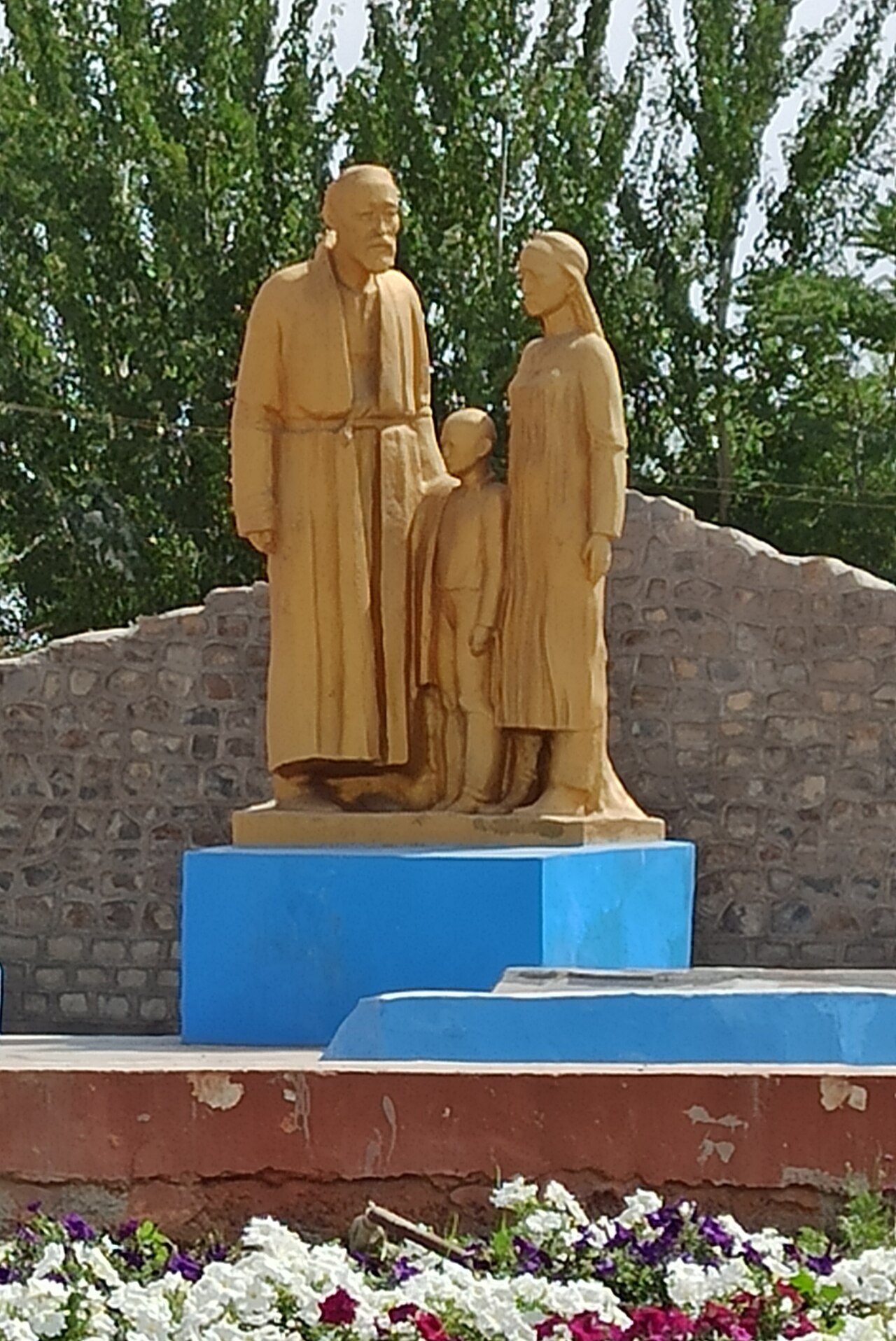
Modern commemorations should likewise be read on their own terms. A memorial can demonstrate how the community honours its past without being an original structure from that past. Ask whom or what it commemorates, when it was created and why that subject was chosen. Those questions turn a recent addition into historical evidence about memory and identity.
16. Following the town's story through the valley
Shahrihan is especially rewarding when visited in connection with Andijan and Kokand. Andijan provides an older eastern-valley urban history, while Kokand explains the state responsible for Shahrihan's foundation. A craft-focused journey can also compare the town's workshops with other valley centres, paying attention to differences rather than assuming every regional product has the same origin.
Within Shahrihan, combine several kinds of evidence. A canal explains the practical basis of settlement, a market shows exchange, a workshop reveals transmitted knowledge and a religious building records community investment. Together, they give a fuller picture than a route concerned only with the age or size of monuments.
The strongest theme is the making of a town through coordinated work. Water had to be managed, people had to settle, skills had to find customers and institutions had to develop. Two centuries later, Shahrihan still invites attention to those relationships. Its significance lies in showing how the Fergana Valley's urban world continued to grow long after the foundation of its most ancient cities.
Reading the history on a visit
Explore Shahrihan as a complement to Andijan and Kokand. Kokand provides the court and state context; Andijan explains an older eastern-valley centre; Shahrihan reveals the creation of a new town through irrigation and the movement of skilled people.
Ask guides to distinguish the town’s foundation, later district administration and modern commemorative sites. These are separate chapters, all worth understanding on their own terms.
Sources and further reading
- Shahrihan district administration: local history
- Shahrihan district administration: Uzbek historical account
- Encyclopaedia Iranica: Kokand Khanate — irrigation and settlement
Shahrihan, Shahrixon and Shakhrikhan are transliterations of the same name. The early nineteenth-century foundation is distinct from the much older history of the Fergana Valley as a whole.