

← All historic cities of Uzbekistan
Uzbekistan • City chronicles
The History of Margilan
Margilan’s history is inseparable from skilled hands. Silk threads, dyes, looms and trading relationships connect the city’s past with its present. Yet reducing Margilan to a factory stop misses the larger story of an old Fergana Valley town whose markets, religious institutions and households supported a specialised urban culture.
Its strongest historical experience is often a process rather than a monument: watching patterned cloth emerge from carefully prepared threads. That encounter makes sense when placed within the city’s longer relationship with agriculture, commerce and political change.
At a glance: Margilan through time
- Medieval period: Margilan develops as a town within the commercial and agricultural landscape of the Fergana Valley.
- Eighteenth–nineteenth centuries: it becomes an important city of the Kokand Khanate.
- 1876: Russian annexation of the khanate changes the region’s administration; nearby New Margilan is founded separately.
- Twentieth century: industrial organisation and Soviet cultural policies reshape textile production.
- 1972: the Yodgorlik silk factory is established.
- 2007: the Margilan Crafts Development Centre is created.
- 2017: its work safeguarding atlas and adras techniques enters UNESCO’s Register of Good Safeguarding Practices.
The southern Fergana landscape
Margilan belongs to the older towns of the southern Fergana Valley. The valley is a region, not simply the present-day city of Fergana, and its history extends across several modern national borders. Mountains frame a basin of agricultural settlements, towns and routes. Margilan developed within this productive landscape, where urban activity depended on an intimate relationship with the surrounding countryside. A craft centre could not support itself through craft alone; it needed food, water, fuel and materials delivered through wider local networks.
Irrigation made the relationship between land and settlement especially important. Channels required construction and maintenance, and water had to be distributed among users. Agricultural production involved organised labour as well as favourable soil. The abundance associated with a fertile valley was not simply a gift of nature. It was also the outcome of repeated work, decisions about land and the continued functioning of infrastructure that could be damaged by conflict or neglect.
Antiquity, names and the Alexander tradition
Margilan is an old settlement, but its beginnings are not represented by a single securely documented foundation ceremony. Archaeological history, medieval geographical references and later traditions provide different kinds of evidence. They should not be combined indiscriminately. The presence of ancient settlement in the Fergana Valley does not establish the exact age of every modern street, nor does the age of a city mean that a particular surviving building is equally ancient.
Stories connect Margilan with Alexander the Great and sometimes explain its name through an episode of hospitality. Such narratives are valuable as local traditions. They show how communities place their city within a celebrated past and attach meaning to its name. They do not, by themselves, prove that Alexander founded the settlement. A responsible historical account can preserve the story while clearly identifying its status as legend rather than turning it into a dated event.
Medieval town life beyond the Silk Road slogan
The expression Silk Road often makes readers imagine a single route carrying luxury goods directly between China and Europe. Margilan's history is better served by a network model. Goods could pass between several markets, and most participants did not travel across the entire continent. Regional demand, local production and short journeys were fundamental to the system. A merchant exchanging cloth within the valley was part of that history even without ever seeing a distant imperial capital.
Medieval towns supported a range of activities that made exchange possible. Producers needed tools and materials, traders needed places to meet and store goods, and travellers required provisions. Religious and educational institutions connected residents with wider intellectual networks. These activities reinforced one another, creating a town whose importance was not reducible to one commodity. Silk later became Margilan's best-known symbol, but an urban population required much more than a specialised export trade.
Margilan within the Kokand Khanate
The rise of the Kokand Khanate in the eighteenth century placed Margilan within a state centred on the western part of the valley. Kokand supplied the royal court, but its authority depended on the resources and activities of other towns. Margilan's commercial and productive life formed part of that wider economy. The relationship between capital and provincial centre was therefore reciprocal, even if political power was unequally distributed.
Royal demand could create opportunities for skilled producers. A court required clothing, furnishings, gifts and ceremonial objects, while wealthy households outside the court also purchased fine goods. Yet the history of craft should not be limited to elite consumption. More ordinary customers sustained a broad market for cloth, and differences in fibre, workmanship and finish allowed products to serve different needs. A city famous for luxury textiles also contained the everyday economics of making a living.
Uvaysi and the literary life of the valley
Jahon-Otin Uvaysi, born in Margilan in the late eighteenth century, is a central figure in the city's literary heritage. She wrote in the Chaghatay tradition and is associated with the cultural environment of both Margilan and Kokand. Her career expands the city's history beyond textiles and trade. It also provides a connection with Nodira and the wider visibility of women in the literary life of the Kokand period.
The title otin points towards a world of women's teaching and religious or literary knowledge. Such education could take place in settings less visible than a monumental madrasa. Domestic space, personal instruction and gatherings of women were part of the transmission of culture. Their historical record is often less extensive than the record of royal patronage, but that imbalance should not be mistaken for evidence that they were unimportant.
Uvaysi's work belongs to an established poetic culture, with conventions of imagery, form and allusion. A poem should not be read only as a transparent report of the author's life. Literary voices can explore love, grief, spiritual longing and social observation through inherited forms that allow several meanings at once. Appreciating those choices gives the writer an artistic identity beyond the biographical facts preserved in a short museum label.
From mulberry leaves to raw silk
Silk begins with a living creature rather than with a loom. Domesticated silkworms feed on mulberry leaves and produce cocoons containing long filaments. Raising them requires attention to food, conditions and timing. The quality of the eventual fibre is therefore connected to knowledge and labour that precede the visible textile workshop. The agricultural stage is not a picturesque prelude; it is part of the production system on which every later specialist depends.
The cocoon must be processed before its filament can become usable thread. Reeling brings filaments together, while subsequent preparation adjusts the material for weaving and dyeing. The exact arrangement of these stages varies by enterprise and product. It is better to ask which operations a particular workshop performs than to assume that every place showing a loom also raises its own silkworms and prepares all its raw material on site.
What atlas and adras mean
Atlas and adras are names visitors will encounter repeatedly in Margilan. Broadly, atlas is associated with silk and a satin structure, while adras commonly combines a silk warp with a cotton weft. The terms identify material and weaving traditions, not merely a colourful printed design. Local commercial usage can vary, so the most reliable explanation of a specific piece comes from asking about its fibre content, weave and method of patterning.
Warp and weft describe the two main directions of thread in woven cloth. The warp is arranged lengthwise on the loom; the weft passes across it. The way they interlace affects texture, strength, flexibility and the visibility of each thread system. These structural choices help explain why two fabrics with similar colours can feel and behave differently. A satin surface reflects light differently from a plain weave, even before pattern is considered.
Planning a pattern before cloth exists
One of the most striking features of ikat is that the design must be anticipated before the fabric is woven. In the warp-patterned textiles associated with Margilan, prepared threads are arranged so that their dyed sections will form an image when brought together on the loom. The maker works across two stages of appearance: the organised bundle of threads and the eventual surface of cloth. The relationship between them requires experience, measurement and a trained eye.
Imagine drawing a design on many parallel lines, then allowing those lines to move slightly before they become a continuous surface. That thought experiment helps explain both the challenge and the visual character of the method. Small shifts produce the softened boundaries associated with ikat. They are not simply evidence of carelessness. The technique creates a particular kind of edge, quite different from the sharply repeated outline that a modern printing process can produce.
Binding and dyeing: controlling where colour goes
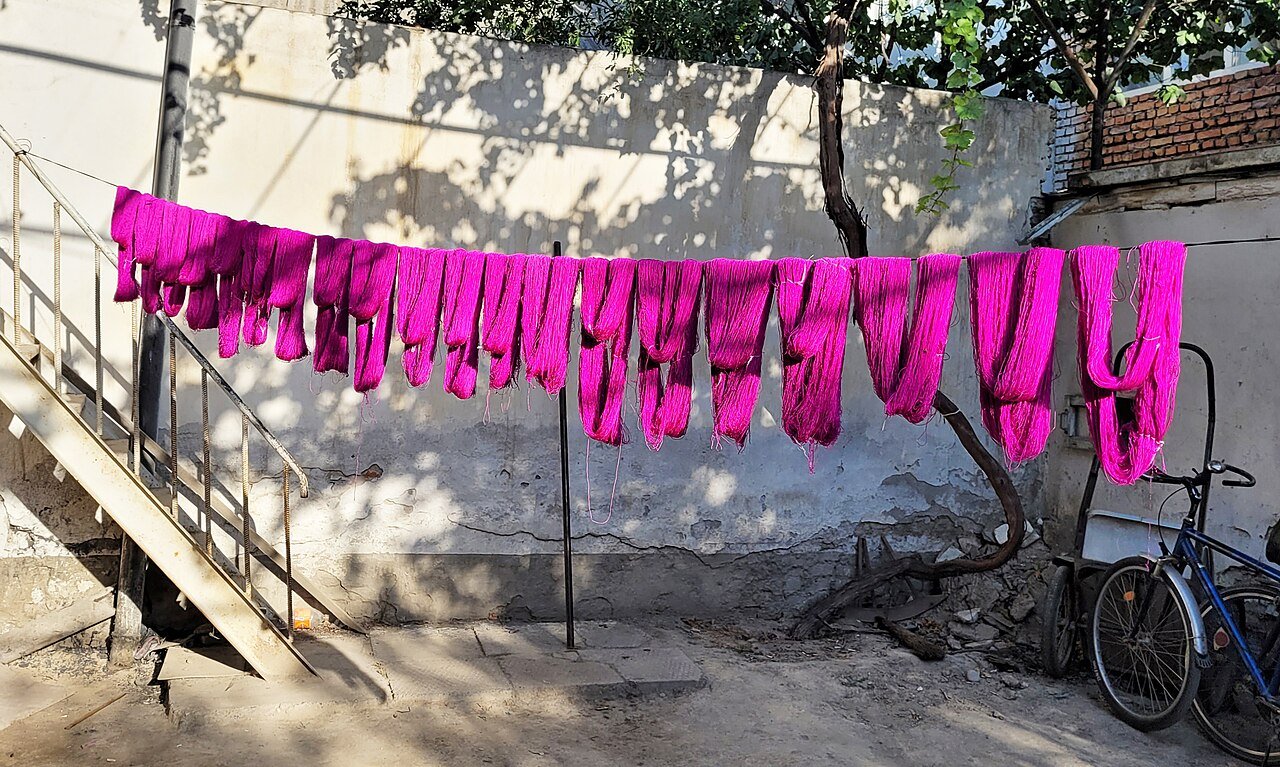
Resist dyeing works by preventing colour from reaching selected parts of the thread. Bundles are bound in planned areas, exposed sections take the dye, and later stages can involve re-binding and additional colours. The order matters because each operation affects what remains possible. The maker must understand how materials, bindings and dyes interact. A vivid result is not produced by simply dipping an undifferentiated bundle into several attractive colours.
Colour preparation is a field of knowledge in its own right. Different fibres respond differently to treatment, and a desired shade depends on more than the name of a dye. Conditions during preparation and processing influence the result. This is one reason historical craft production involved specialisation. A skilled dyer contributed something that could not be replaced merely by giving a weaver a pot of pigment and a general instruction to make the cloth bright.
The loom and the work of alignment
By the time a patterned warp reaches the loom, much of the design has already been established. Weaving brings it into a stable cloth through repeated interlacing. The operator manages tension, alignment and rhythm while attending to the emerging surface. Small adjustments can influence the appearance of the pattern, so the process combines repetition with continuous judgment. It is skilled work even when its movements look familiar or effortless.
The loom is a tool with its own spatial demands. Threads must be arranged, equipment maintained and the worker positioned to carry out repeated actions. A workshop's layout reflects those needs. Several looms operating together create a different environment from a single demonstration station, and the sound of work can make the sequence of movements easier to understand. Observing the tool in use often explains more than a static display of its component parts.
The bazaar as an institution of knowledge
A market is not simply the place where production ends. It is also where information circulates. Sellers learn what customers want, buyers compare materials and makers discover which designs attract attention. Prices reflect judgments about quality, labour, scarcity and demand. In a city with a strong textile identity, these exchanges influence what workshops produce next. The bazaar is therefore part of the history of design as well as commerce.
Trade also depends on trust. A buyer needs information about fibre content, method and workmanship; a seller needs reliable suppliers and customers. Long relationships can reduce uncertainty, while an unfamiliar visitor may need more explicit explanation. This is why useful questions are concrete: where was the fabric woven, which fibres does it contain, and is the pattern dyed into the threads or printed on the cloth? Such questions respect the work more than a vague request for something authentic.
Pir Siddiq and the sacred landscape
The Pir Siddiq complex offers a different kind of historical encounter. Associated with an eighteenth-century mausoleum and later elements, it is known for the traditions surrounding its pigeons. A local story tells of birds protecting a holy man by making his hiding place appear undisturbed. The narrative explains the special regard for pigeons at the site. It should be presented as a devotional legend, not as independently documented evidence for the life of a companion of the Prophet.
The complex combines several elements, including a mausoleum, mosque, minaret and structures associated with the birds. These components need not all belong to one construction campaign. Religious ensembles often grow over time as patrons add, repair or replace buildings. A single date attached to the oldest element cannot safely be applied to the whole visible site. Looking for differences in material, scale and use can make the layered history easier to recognise.
The pigeons contribute to the site's present identity, but they should not distract entirely from its religious meaning. For some visitors the complex is a place of devotion and remembrance. The tourist's interest in an unusual story exists alongside those uses. Quiet observation and respect for the behaviour of other visitors allow the place to be encountered as a living setting rather than reduced to a picturesque photo opportunity.
Said Ahmad Khoja Madrasa: a building with successive purposes
The Said Ahmad Khoja Madrasa is central to the relationship between Margilan's architectural and living heritage. Its association with the Crafts Development Centre places historical space in the service of contemporary teaching and production. The building is not merely a backdrop for textiles. Its rooms and courtyard provide a setting in which knowledge is transmitted, giving the site an active role within the city's cultural economy.
The original purpose of a madrasa involved education within a religious institution. Its organisation can still help visitors imagine the relationship between communal space and smaller rooms, even when present activities differ. The transition to craft training is therefore both a continuity of teaching and a change in institutional function. Recognising both aspects avoids the claim that the building has always served precisely the same purpose.
1876 and the creation of New Margilan
The Russian annexation of the Kokand Khanate in 1876 transformed the administration of the Fergana Valley. A new settlement was founded near historic Margilan and named New Margilan. It later became Skobelev and then Fergana. This was a separate urban centre, not simply a new name for the old city. The distinction is fundamental to understanding the geography visitors encounter today.
The choice to establish a new administrative city expressed colonial priorities. A planned centre could accommodate offices, military functions and residential districts within a layout designed for the new authorities. Existing Margilan retained its older commercial and social networks. The proximity of the two cities created a relationship between an established town and a newly organised seat of regional government, rather than a complete replacement of one by the other.
Comparing them makes political change visible in urban form. The planned streets and administrative history of Fergana belong to a different process from the accumulated neighbourhood and market life of Margilan. Neither city tells the whole story alone. The newer centre reveals how imperial government arranged space; the older one reveals how communities and economic activities continued under altered conditions.
Imperial markets and pressure on established crafts
Russian rule connected the valley more closely with imperial trade and industrial production. New transport links and commercial relationships changed the conditions in which textiles were made and sold. Manufactured fabrics could reach customers through expanding distribution networks, while local producers had to respond to competition and changing demand. The effect was not a single abrupt disappearance of handwork, but a reorganisation of opportunities and pressures.
Competition can alter a craft in several ways. Makers may simplify a process, change materials, adjust the scale of patterns or seek a different market. Some decisions preserve a livelihood at the cost of an older technique; others create a new product with its own appeal. A history of decline alone can miss this adaptation, while a history of uninterrupted tradition can conceal the losses. Margilan's textile story requires attention to both.
Soviet industry and the changing organisation of silk
During the Soviet period, textile production was reorganised within a planned economy. Larger enterprises, state priorities and new systems of training changed the relationship between household knowledge and industrial output. Mechanisation and standardisation offered different possibilities from small workshops. The history cannot be reduced to a choice between all handwork and all machinery; particular processes could survive within arrangements very different from those of the nineteenth century.
Industrial organisation affects more than the speed of production. It influences how work is divided, who controls materials, which designs are approved and how products reach customers. A skilled worker may retain considerable expertise while having less control over the finished product than an independent maker. Conversely, an institution can provide training and employment that a small household operation could not sustain. These tensions are part of Margilan's modern social history.
Yodgorlik and the meaning of a modern heritage enterprise
Yodgorlik, established in 1972, is one of the best-known places associated with Margilan's silk production. Its founding date is significant. The enterprise is modern, even when it demonstrates techniques with much older histories. Calling it an ancient factory confuses the age of an institution with the age of a method. The more accurate and interesting story is that a twentieth-century organisation became a setting for the continuation of traditional processes.
Workshop visits can make the production sequence visible through thread preparation, dyeing and weaving. The details on display may vary with the working day and the activities currently taking place. A visitor should distinguish a staged explanation from regular production without assuming that one is worthless. Demonstrations can teach effectively, but they offer a selected view. Asking what usually happens before and after the observed stage helps restore the larger sequence.
The Crafts Development Centre and the 2017 UNESCO recognition
The Margilan Crafts Development Centre was created in 2007 through cooperation involving the local community, authorities and UNESCO support. Its work focuses on sustaining knowledge and practice associated with atlas and adras. Training, exhibitions and opportunities for makers to share and develop skills address a central problem of living heritage: techniques survive through people, and those people need practical settings in which to learn and work.
In 2017, the safeguarding programme was selected for UNESCO's Register of Good Safeguarding Practices. This is not a World Heritage inscription for the entire city of Margilan, nor a guarantee that every fabric sold there meets a particular standard. The recognition concerns an approach to maintaining living cultural knowledge. Keeping that distinction clear makes the achievement more understandable and avoids using the UNESCO name as a general marketing label.
The centre's association with the Said Ahmad Khoja Madrasa gives the programme a visible architectural home. It also demonstrates that safeguarding can involve institutions created in the present. Tradition is not maintained only by repeating inherited routines in unchanged surroundings. Communities may need new partnerships, teaching methods and opportunities to respond to contemporary conditions. The important question is whether these arrangements help knowledge continue meaningfully.
Apprenticeship and the future of skilled work
Craft knowledge is partly verbal, but much of it is learned through observation and practice. A teacher can explain a sequence, yet the learner must develop judgment about tension, alignment, colour and material behaviour. Repetition turns instruction into competence. The process takes time, and mistakes can be necessary to understanding why a particular adjustment matters. A short demonstration cannot substitute for that sustained experience.
Transmission also depends on social and economic conditions. Young people need reasons to invest in learning a demanding technique, and experienced makers need time to teach. Access to materials, equipment and customers affects whether a skill can become a livelihood. This is why safeguarding cannot be measured only by the number of objects produced for an exhibition. It must also concern the continuity of work and the ability of a new generation to practise independently.
Reading the history on a visit
Combine a textile workshop with time in the town’s markets and religious surroundings. Ask permission before photographing workers and allow them to continue their tasks. A demonstration becomes more rewarding when the visitor understands the skill and time behind it.
Read Margilan alongside Kokand for the history of the khanate, and alongside Fergana for the transformation after 1876. Each city explains a different part of the same valley.
Sources and further reading
- UNESCO: safeguarding atlas and adras techniques in Margilan
- UNESCO: Crafts Development Centre in Margilan
- Uzbekistan Tourism: Margilan craft centres
- Uzbekistan Tourism: the separate history of modern Fergana
Margilan, Marg‘ilon and Marghilan are alternative spellings of the same city.