

← All historic cities of Uzbekistan
Uzbekistan • City chronicles
The History of Gijduvan
Gijduvan is known for ceramics, but its history also includes medieval commerce, Sufi teaching, Timurid educational patronage and a decisive early sixteenth-century battle. It is one of the places that make the Bukhara oasis intelligible as a network of towns rather than a single famous city.
Its heritage is both built and practised. A madrasa preserves the ambitions of a patron; a potter’s workshop preserves knowledge through repeated work. Visiting both provides a richer historical experience than concentrating on only one.
At a glance: Gijduvan through time
- Tenth century: Gijduvan appears in written accounts of the Bukhara oasis.
- Twelfth century: Abd al-Khaliq Ghijduwani becomes associated with the town’s spiritual history.
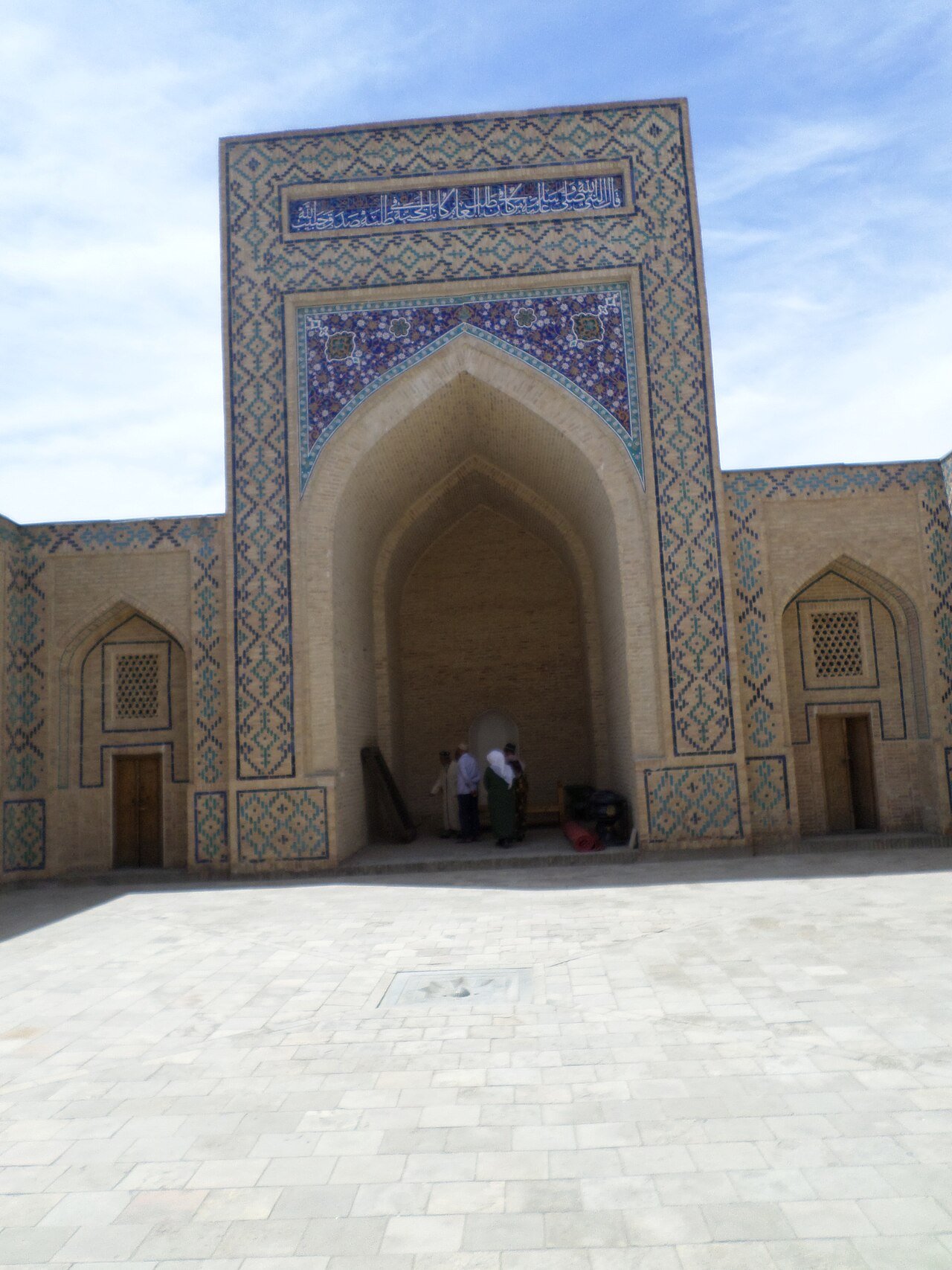
- 1433: Ulugh Beg’s madrasa is built at the sacred site.
- 1512: the Battle of Gijduvan strengthens Shaybanid control in Transoxiana.
- Emirate period: trade and craft production continue within the Bukhara state.
- Twentieth century onward: local pottery families sustain and adapt the town’s distinctive ceramic tradition.
More than a stop before Bukhara
Gijduvan belongs to the historic network of the Bukhara oasis. Its position connected agricultural communities, markets and routes, giving it an identity that was not dependent solely on the nearby capital. Travellers often encounter it briefly on the way to Bukhara, but its religious, architectural and craft history rewards a more deliberate visit. It explains how the oasis functioned beyond the walls of its best-known city.
The surrounding landscape supported settlement through cultivation and water management. A market town needed produce and materials, while villages needed access to tools, services and buyers. These exchanges sustained local life even when long-distance trade fluctuated. The town's history therefore includes ordinary regional movement as well as the more celebrated connections of the Silk Roads.
Gijduvan, G‘ijduvon and Ghijduwan are different forms of the same place-name. The designation Ghijduwani identifies an association with the town, most famously in the name of its revered Sufi teacher. Recognising the variations helps connect modern signs with historical books. It also prevents unfamiliar spellings from making one place appear to be several separate destinations.
Medieval markets and the changing oasis
Gijduvan appears in medieval accounts of the Bukhara region. Its history is connected with other settlements, including Tavavis, whose importance changed over time. The oasis did not possess one fixed hierarchy of towns throughout the centuries. Routes, water, patronage and the movement of population could favour one centre while another declined.
An intermediate town could serve several purposes at once. It offered a market for surrounding communities, a place for skilled production and a setting for religious institutions. Those functions reinforced one another. A growing market attracted people, while an established community supported teachers, patrons and craftspeople. Urban development resulted from the accumulation of these relationships rather than from a single famous construction project.
The surviving monuments represent only part of that history. Many houses and workshops were built with materials requiring regular repair and replacement. Their disappearance does not mean that the town lacked activity between major dates in a chronology. Written references and the continuity of local institutions help restore the wider setting in which the surviving madrasa and shrine acquired significance.
Abd al-Khaliq Ghijduwani and the Khwajagan tradition
Abd al-Khaliq Ghijduwani is central to Gijduvan's spiritual identity. Associated with the twelfth-century world of Central Asian Sufism, he is remembered as an important teacher in the Khwajagan tradition. His legacy later formed part of the spiritual genealogy of the Naqshbandi order. The distinction between an earlier chain of teachers and a later named order matters: institutions and terminology developed over generations.
His teachings are associated with disciplined attention and the cultivation of an inward spiritual life amid ordinary activity. Their significance extends beyond a single building. Religious knowledge passed through instruction, practice and relationships between teachers and followers. A town could therefore acquire a wide reputation through the influence of a person whose teaching circulated far beyond its boundaries.
Historical biographies and devotional accounts do not always give identical dates or details. The most useful visitor introduction identifies the teacher's place in the tradition without pretending that every episode is equally documented. The memorial remains important because communities have continued to honour that legacy, not because every current structure dates from his lifetime.
A shrine that developed across generations
The Ghijduwani memorial complex is a living place of devotion. Its present appearance reflects successive acts of patronage, repair and commemoration. A tomb's religious significance can be much older than the surrounding architecture, while a renewed courtyard may belong to a recent phase of visitor provision. These layers should be distinguished rather than assigned one convenient date.
Sacred places attract different kinds of visitors. Some come to pray, others to learn about history or architecture, and some combine these purposes. The site should therefore be approached with attention to its current use. A tourist route is only one way of experiencing the place; it does not replace the devotional relationships that have helped sustain it.
The relationship between the memorial and Ulugh Beg's madrasa is especially revealing. A later educational foundation was placed within an already meaningful religious landscape. The new building did not invent the site's importance. It added another institution and another patron's presence to a place whose reputation had developed through earlier generations.
Ulugh Beg's madrasa, 1433
The madrasa associated with Ulugh Beg is dated to 1433 and belongs to the Timurid ruler's wider educational patronage. Its scale is smaller than the famous madrasa at Samarkand's Registan, but that does not make it historically secondary. It shows how a major patron supported an institution in a regional town and connected learning with an established sacred site.
A madrasa was a working organisation with teachers, students, rooms and financial needs. Its courtyard and repeated cells reflect those requirements. The façade presented the institution to the outside world, while the internal arrangement supported daily use. Reading both aspects helps explain the building beyond its decorative appearance.
Comparison with Ulugh Beg's madrasas in Bukhara and Samarkand should focus on adaptation as well as resemblance. A patron could use a shared architectural vocabulary while responding to different sites, resources and purposes. Gijduvan demonstrates that educational patronage was not confined to the largest city. It formed part of a regional network in which smaller towns retained their own importance.
Looking closely at the madrasa
Begin with the relationship between entrance, courtyard and rooms. The building organises a transition from public approach to an interior setting for study and communal life. Its proportions make sense when considered at that human scale. A smaller courtyard can create a different experience from the vast public spaces associated with a capital, without being less carefully designed.
Decoration also needs to be read alongside restoration. A renewed surface may preserve an older pattern while replacing damaged material. The date of a foundation does not automatically date every tile currently visible. Information about repair campaigns helps distinguish the original design from the present material state, giving a more accurate understanding of what has survived.
The setting is as significant as the individual façade. The madrasa's relationship with the memorial across the space joins Timurid patronage to an earlier spiritual reputation. Looking at the two together explains why the building stands here. Architecture is not simply an object placed on a map; its location can express a relationship with history and authority.
The Battle of Gijduvan in 1512
In 1512, Gijduvan became the site of a major battle in the struggle for Transoxiana. Shaybanid forces defeated a Safavid army led by Najm-e Thani. The outcome helped consolidate Uzbek rule after the disruption caused by the death of Muhammad Shaybani and the renewed ambitions of Babur. The town's name consequently entered a political history extending far beyond the Bukhara oasis.
The conflict belongs to the transition from Timurid to Shaybanid power and to Safavid involvement in the region. It should not be presented simply as a local quarrel or as an uninterrupted continuation of the earlier Timurid world. Alliances and military fortunes changed rapidly, while control of important cities could be lost and regained. The battle marked a significant limit to one attempt to reshape that balance.
For residents, military events affected a lived landscape of fields, markets and households. Chronicles tend to record commanders and victories more clearly than the consequences for ordinary people. A city history can acknowledge those consequences without inventing unsupported casualty figures or individual stories. Gijduvan's later peaceful craft identity should not conceal the fact that it also stood within a region repeatedly shaped by conflict.
The town under the Bukhara state
In the centuries after the battle, Gijduvan remained part of the political and commercial world centred on Bukhara. Its markets and crafts served local communities as well as visitors from farther away. Religious reputation continued to attract attention, while the practical economy sustained the people who maintained the town. These functions developed together rather than belonging to separate histories.
Provincial towns were important to a state's everyday operation. Revenue, agricultural supply and the movement of goods depended on them. Local patrons and respected families also supported institutions that the capital could not manage in every detail. Gijduvan's history therefore illustrates the distributed nature of an oasis society, in which influence and activity extended beyond the most famous monuments of Bukhara itself.
The nineteenth-century expansion of Russian influence changed the wider political and economic framework. Craftspeople and traders faced new conditions, but the town did not lose all of its established relationships at once. Continuity and adaptation are both necessary to understanding the period. A market can survive while its customers, materials and methods of exchange change.
A ceramic tradition with a distinctive identity
Gijduvan's ceramics are known for a characteristic approach to colour and pattern, often including warm yellow, green and brown tones with floral and geometric organisation. These associations help distinguish the local tradition from other Uzbek ceramic centres. They should be treated as tendencies within a varied body of work, not as a rule that every potter must use exactly the same palette.
A ceramic style develops through materials, technical knowledge and choices made by generations of makers. Clay, pigments, glaze and firing conditions influence what can be produced, while customers and patrons influence what is wanted. The result is neither purely environmental nor purely decorative. It is a working tradition in which skill and judgment connect material possibilities with aesthetic preference.
Comparing Gijduvan with Rishtan can be especially rewarding. Both have strong ceramic identities, but they are not interchangeable. Rather than deciding which is more authentic, look at the handling of surface, colour, shape and pattern. The differences reveal the variety within Uzbekistan's craft heritage and the importance of local schools and individual makers.
From clay to a usable vessel
The process begins before a vessel takes shape. Clay must be prepared so that it can be worked consistently, and shaping requires control of thickness, proportion and moisture. A pot that looks complete at the wheel still has several stages ahead of it. Drying, surface preparation, decoration, glazing and firing each introduce decisions that affect the final result.
The sequence matters because later stages cannot always correct an earlier problem. Uneven drying can cause cracking, while a poorly prepared surface can affect decoration or glaze. The maker must anticipate how the material will behave as it changes. This makes pottery a form of practical knowledge rather than simply the ability to draw an attractive pattern on a plate.
During a workshop visit, following one object through the stages is more informative than watching only a brief wheel demonstration. Ask which processes take place on site and which materials come from elsewhere. A clear explanation respects the craft by identifying the work actually performed, instead of relying on a general claim that everything is made exactly as it was centuries ago.
Pattern, glaze and the uncertainty of firing
Decoration is planned in relation to a vessel's shape. A central motif, border and repeated elements must work across a curved or circular surface. The design may appear different when the object is held, placed on a table or displayed on a wall. Skilled painters understand that relationship between pattern and form rather than treating the surface as a flat sheet of paper.
Glaze and firing transform the appearance again. The kiln brings together temperature, time and the behaviour of materials. A finished surface is therefore the result of several coordinated stages, not the direct appearance of wet pigment as it was first applied. The process contains uncertainty, and experience helps a maker judge how a particular combination is likely to behave.
This is one reason small variations can be meaningful. They may reveal handwork and the conditions of firing, although variation alone does not prove quality. The useful questions concern structural soundness, intended use and the maker's explanation of the process. A functional bowl and a decorative exhibition piece can have different requirements, and their value should be understood accordingly.
The Narzullaev family and twentieth-century continuity
The Narzullaev family is especially associated with the public presentation of Gijduvan ceramics. Usto Ibodulla Narzullaev played an important role in the twentieth-century tradition, and later generations continued the work. Their achievement belongs within a longer local ceramic culture. It would be misleading to call one modern master the inventor of all pottery in the town.
Family transmission can preserve techniques through repeated observation and practice. A learner sees not only a successful demonstration but also the judgments made when clay behaves unexpectedly or a firing produces an unusual result. Such knowledge is difficult to capture fully in a written instruction. It develops through time spent working with materials and receiving correction from experienced makers.
Public workshops and exhibitions add another role. They allow visitors to encounter the process and provide markets beyond the immediate town. This can support continuity, but it also shapes production through contemporary demand. A living tradition changes as its makers find new audiences. That adaptation should be described openly rather than concealed beneath a claim that nothing has changed.
Craft, household life and other local skills
Ceramics are only one part of Gijduvan's material culture. Embroidery and other forms of skilled work also contribute to the town's identity. These activities connect households with markets and create objects used in everyday life, hospitality and celebration. A history focused exclusively on the most famous workshop would overlook that broader environment of production and use.
Objects acquire meaning through the people who keep, display and exchange them. A bowl may be valued for serving food, a textile for its workmanship or family association. The social life of an object continues after it leaves the maker. Repairs, wear and continued use can therefore be historical evidence, not merely imperfections that reduce its appeal to a collector.
Visitors can explore this dimension through designated workshops, museums and conversations with willing makers. Private homes and working spaces should not be assumed to be public attractions. Respect for present use makes the encounter more accurate: Gijduvan is an inhabited town whose crafts serve residents and wider markets, not a performance created only for travellers.
Soviet change, independence and safeguarding
Soviet economic and cultural policies changed the institutions through which crafts were produced, taught and sold. Family knowledge and organised enterprises existed in shifting relationships. Some techniques were maintained, others adapted or placed under pressure. A balanced history should recognise both the disruptions and the work of people who kept skills active through changing circumstances.
After independence in 1991, tourism, exhibitions and renewed interest in national heritage created further opportunities. Ceramics could reach new customers, while makers developed products suited to different uses. The challenge of continuity remained practical: materials, training and a sustainable livelihood are necessary if a demanding technique is to remain part of regular work.
Uzbekistan's ceramic arts were inscribed on UNESCO's Representative List of the Intangible Cultural Heritage of Humanity in 2023. This national recognition concerns living craft knowledge and practice. It is not a World Heritage designation for every shop or building in Gijduvan, nor a certification of every item offered for sale. Understanding the distinction gives the recognition its proper meaning.
How to connect the sacred site and the workshop
A strong visit pairs the Ghijduwani memorial and Ulugh Beg Madrasa with a ceramic studio. The first encounter explains spiritual memory and educational patronage; the second makes the transmission of material knowledge visible. Both depend on people maintaining and teaching something valued across generations, although their purposes and histories are different.
At the memorial, ask about the chronology of the teacher, the madrasa and later restoration. At the workshop, ask about the maker, clay, glaze and firing process. These focused questions produce more useful answers than broad claims of antiquity or authenticity. They also help distinguish a documented fact from a local story or a commercial description.
Gijduvan's particular strength is the combination. It brings together a medieval market town, an influential spiritual tradition, Timurid architecture, a decisive battle and continuing craft. Seen in that way, it becomes an important chapter in the history of the Bukhara oasis rather than a brief shopping stop before the regional capital.
Reading the history on a visit
Pair the Ulugh Beg Madrasa and Ghijduwani memorial with a working ceramic studio. Ask about the maker, materials and process rather than judging only by colour. If photographing artisans, obtain permission and avoid interrupting delicate work.
Read the town alongside Bukhara’s monument guides to understand the relationship between the regional capital and its surrounding centres.
Sources and further reading
- Uzbekistan Tourism: Gijduvan’s historic places
- Gijduvan Craft Centre: the Narzullaev family tradition
- Cultural Legacy: Gijduvan ceramics
- Ulugh Beg Madrasa: chronology and references
Gijduvan, Gijduvon and G‘ijduvon are common transliterations. The historical name Ghijduwani identifies association with the town.