

← All historic cities of Uzbekistan
Uzbekistan • City chronicles
The History of Nurata
Nurata lies where mountain foothills meet a drier landscape. Its history is organised around water: a spring, systems of irrigation and the communities that depended on them. The fortress above the town and the Chashma religious complex below it make that relationship visible.
It is also a place where history and sacred tradition overlap. Stories about Alexander the Great and the origins of the spring are part of local memory. They deserve to be heard as traditions, while the surviving structures and archaeological evidence are considered separately.
At a glance: Nurata through time
- Ancient and early medieval periods: settlement develops around water sources and routes at the edge of the oasis world.
- Medieval period: the place known as Nur appears in the history of the Bukhara region.
- Later centuries: the spring becomes the focus of an important sacred landscape.
- Early modern period: the town participates in the political and commercial world of Bukhara.
- Twentieth century: administrative and economic changes reshape the town and surrounding countryside.
- Today: Nurata combines active pilgrimage, local life and visits to its fortress and water heritage.
The meeting of foothills and dry country
Nurata's setting is the first key to its history. The town lies near the Nuratau foothills, where the availability of water creates possibilities for settlement at the edge of a much drier landscape. The contrast between hillside, inhabited ground and open country is visible from the fortress. It explains why a place of relatively modest size could remain important through changing political periods.
A settlement here served more than one environment. Agricultural communities, pastoral groups and travellers could exchange goods and information. The boundary between cultivated land and steppe was not an absolute divide between unrelated societies. It was also a zone of contact, negotiation and movement. Nurata's history belongs to those relationships as much as to any one dynasty ruling a distant capital.
The modern administrative map places Nurata in Navoi Region, but the town's history long predates the twentieth-century city of Navoi. Regional labels used in travel planning should not be projected unchanged into the past. Nurata, Karmana and Navoi have different chronologies, even when they appear within one itinerary. Their connection is geographical and administrative today, while their earlier roles developed in different settings.
Water before walls
The spring at Chashma supplied an enduring focus for settlement. In a dry environment, dependable water influences where people live, how they cultivate land and where travellers stop. A fortress can be rebuilt or abandoned, but the practical value of a water source may persist. Nurata's continuity is therefore easier to understand by beginning with the spring rather than with a list of conquerors.
Water also requires organisation. Channels must carry it to users, and their maintenance affects more than the person nearest the source. Households, gardens and cultivated plots are linked by the same system. Decisions about distribution can encourage cooperation or create disagreement. The history of a spring-fed town is consequently social as well as environmental: people must establish ways to share and care for a resource on which they depend.
This connection changes how the historic centre is read. The spring, religious buildings, paths and nearby settlement are parts of a larger arrangement. Treating Chashma as only a picturesque pool leaves out the practical life that helped make the place significant. Its sacred reputation and its material usefulness developed together, even though they answer different kinds of human need.
Nur in medieval accounts
The name Nur appears in the medieval history of the Bukhara region, including the tradition preserved through Narshakhi's History of Bukhara. The place was known for religious visitation and belonged to a network extending beyond the main oasis city. Written evidence of this kind shows that Nurata's significance was recognised long before the modern tourism industry selected it as a destination.
A medieval account should still be read in context. It can describe a place's reputation, institutions and stories without providing a complete archaeological chronology. Later copies, translations and additions may also shape how a text reaches modern readers. The historical value lies in careful interpretation, not in turning every sentence into a precise reconstruction of buildings that survive today.
Nur's relationship with Bukhara was more than subordination to a larger city. It offered a different setting at the edge of cultivated and pastoral landscapes, with its own water source and sacred associations. A regional network needed such places as well as great capitals. The scale of the town does not diminish the breadth of the connections that brought people to it.
The fortress above the spring
The earthen remains of Nur fortress occupy a commanding position above the town. Their setting makes the relationship between defence, settlement and water especially clear. Height offers visibility, while control of approaches and resources can matter as much as the thickness of a wall. The stronghold should be considered within this landscape rather than viewed only as an isolated shape on the hill.
Local tradition associates the fortress with Alexander the Great. The attribution is widely repeated, including in official visitor descriptions, but the visible remains have passed through a long history of construction, erosion and repair. A traditional foundation story does not establish that every wall now seen was built during Alexander's campaigns. The distinction between the age of a strategic site and the date of its surviving fabric is essential.
The monument's earth construction also affects the visitor experience. Weathering can soften once-sharp forms, while foot traffic can damage fragile remains. A site plan and a distant view may explain the structure better than climbing over its walls. The most useful questions concern how the defences related to one another, what areas they protected and how the settlement below supported the people who occupied them.
Alexander, light and the language of tradition
Alexander-related stories occur at many Central Asian sites. They connect local places with a famous figure whose memory acquired meanings far beyond his documented campaigns. In Nurata, the tradition gives the fortress a place within a prestigious ancient past. It is worth preserving as part of cultural memory while keeping it separate from securely dated archaeological evidence.
The name Nur, associated with light, also appears in stories explaining the spring's origin. One well-known narrative describes a luminous object falling from the sky and water emerging at the place of impact. This is a sacred-origin story, not a scientific account demonstrating a meteorite event. Its importance lies in the way it joins landscape, naming and belief.
Legends need not be either accepted literally or dismissed as worthless. They can explain why people care for a place, how they understand its special qualities and what stories they pass to visitors. A good historical account identifies the genre of evidence being used. Architecture, written records and oral tradition can all contribute, provided that one is not silently substituted for another.
Chashma as a living religious ensemble
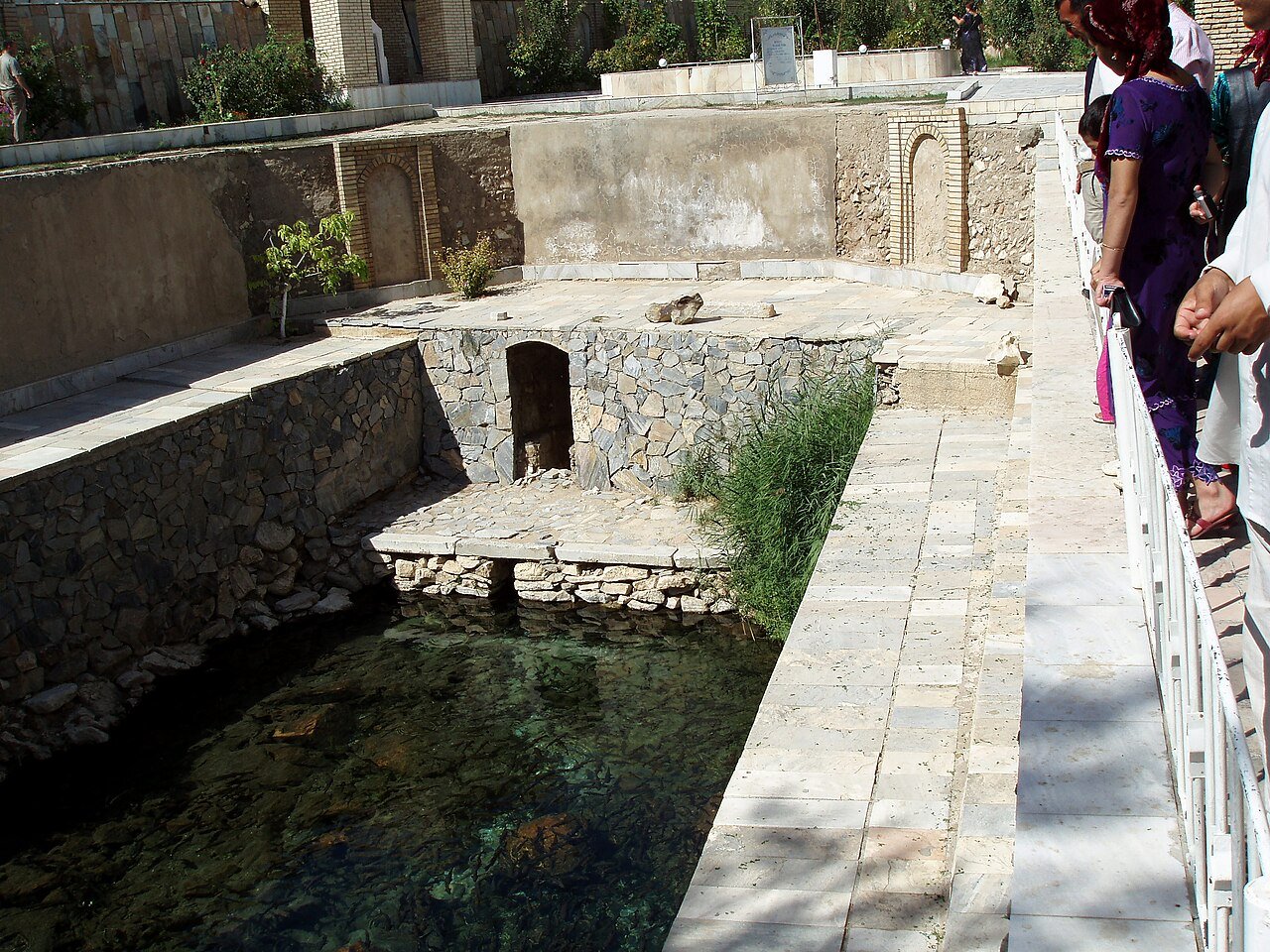
Chashma means spring, and the water source gives the religious complex its organising centre. Mosques, memorial traditions and the pool form a place still used for devotion. The visitor encounters an active sacred landscape rather than a building preserved solely for historical display. That continuing use is part of the site's importance and should shape how it is approached.
The ensemble developed over time. Religious significance may precede the present buildings, while repairs and additions may be much later than their original foundations. Applying one date to the entire complex conceals that sequence. A mosque, bath, memorial and renewed walkway can stand close together while belonging to different phases in the life of the site.
Observe the relationship between movement and gathering. Some visitors pause at the water, others enter a prayer space or approach a memorial. The routes connect practical access with devotional behaviour. A tourist's interest in architecture exists alongside those purposes. Quiet observation and attention to local guidance make it possible to understand the site without interrupting the people for whom it has a different significance.
The fish and the spring's special status
The fish in the clear water are among Chashma's most recognisable features. Their protection belongs to local religious and cultural practice. Stories about their sacred character help explain how people behave around the pool and why the fish are treated differently from an ordinary food resource. This is part of the history of the place's relationship with its environment.
Claims about the spring's healing qualities should be understood as expressions of belief, not presented as established medical effects. A cultural history can describe reverence for water without promising that drinking it treats illness. The same distinction applies to stories about supernatural consequences of harming the fish. Their significance is devotional and social rather than a substitute for scientific evidence.
For visitors, the most meaningful response is to respect the established use of the site. The pool is not simply a backdrop for photographs or a place to test local stories. Its character depends on shared restraint and care. The continued presence of fish and water in the religious centre makes visible a relationship between community practice and landscape that has helped sustain Nurata's identity.
Mosques and the layered architecture of worship
The Chashma ensemble includes the Juma and Panjvakta mosques, associated with different functions and stages of construction. The names direct attention to prayer and gathering, while their present form reflects later maintenance as well as older work. It is safer to understand the ensemble as layered than to assign every surface to one early foundation date.
A mosque's architecture is organised around use. Entrances, shaded spaces, the prayer hall and orientation work together to accommodate worshippers. Decoration contributes to the experience, but the building is not only a decorative object. Looking at how people enter and occupy the space helps explain choices that may be less obvious in a photograph of the dome or façade.
Materials also reveal different kinds of craft. Brick construction, timber elements and plaster or painted decoration require separate skills and age in different ways. A renewed surface can sit on an older structure, while a replacement timber may preserve the form of an earlier element. Understanding those combinations allows restoration to be recognised as part of the building's history rather than mistaken for untouched antiquity.
Karez: bringing water through the ground
Nurata is associated with traditional underground water channels commonly called karez or kariz. These systems belong to a wider family of technologies used in dry regions. A gently sloping subterranean channel can bring groundwater towards the surface by gravity, while shafts provide access during construction and maintenance. The principle differs from pumping water vertically from an ordinary well.
Building such a system requires knowledge of terrain, water and gradient. Too little slope limits flow; an unsuitable route can make excavation ineffective or unstable. The line visible at the surface through access points represents work carried out beneath it. This makes karez heritage easy to overlook: its most important feature is largely hidden, and its value lies in function rather than monumental display.
The system also requires continuing care. Channels can become blocked or damaged, and access arrangements affect the people who rely on them. Technical knowledge is therefore inseparable from organisation and labour. An account that attributes every channel to a famous conqueror misses the generations of local expertise needed to keep water moving after an initial construction campaign.
Agriculture and the work behind an oasis town
Water connects Nurata's sacred centre with its productive surroundings. Cultivation requires land preparation, distribution and seasonal labour, while the town supplies markets and services. These relationships sustained people whose daily lives were not recorded in chronicles of rulers. A history of Nurata must therefore include the ordinary work through which a settlement remained viable.
The town's position near different environments encouraged exchange between agricultural and pastoral activities. Products and skills could move between communities, and the market provided a meeting place. Such connections complicate a simple division between nomadic and settled worlds. People interacted through trade, family relationships and political arrangements as well as occasional conflict.
For a traveller, asking about local water and agriculture can produce a more grounded understanding than collecting additional legends about the fortress. The practical landscape explains endurance. It shows why the site remained useful and how people adapted to conditions that placed limits on settlement. The town's history is a continuing negotiation with those conditions, not merely a sequence of changes in government.
Nurata and the political world of Bukhara
In the early modern period, Nurata belonged to the political and economic world centred on Bukhara. Its foothill position, settlement and religious reputation gave it a role distinct from the capital. Administration relied on local officials and communities, while trade and pilgrimage connected the town with a wider area. These relationships could continue even as dynasties and rulers changed.
Political authority was expressed through more than military occupation. Revenue, patronage, appointments and the maintenance of routes affected the town's place within the state. Local religious figures and established families could also mediate relationships between residents and government. The resulting order involved negotiation as well as command, particularly in places at the edges of major agricultural centres.
The nineteenth-century expansion of Russian influence over Bukhara altered the wider framework. Nurata's experience should be understood through that relationship rather than equated automatically with cities annexed directly into Russian Turkestan. The distinction is useful when comparing it with Fergana or Tashkent, where colonial administration took a different institutional form.
Embroidery and the history carried by households
Nurata is also associated with a distinctive embroidery tradition, including suzani textiles. Museum collections preserve examples attributed to the area, while contemporary local craft activity continues the association. Embroidery offers a different kind of evidence from the fortress or mosque: it reveals design, household work and the social value of objects used or displayed in domestic settings.
A large embroidered textile may involve planning, several stages of work and more than one participant. Materials, stitches and the placement of motifs reflect both practical knowledge and aesthetic choices. The finished object should not be reduced to a universal dictionary of symbols. Similar forms can be interpreted differently, and a pattern's meaning may depend on the maker, user and occasion.
Historic and contemporary examples answer different questions. An older textile can preserve evidence of past materials and use; a newly made piece shows how skills and tastes continue to change. Neither needs to be misrepresented as the other. A workshop conversation about technique and provenance is more useful than a claim that every item follows an unchanged method from remote antiquity.
Soviet change and renewed public heritage
The twentieth century brought new administrative and economic arrangements to Nurata. Soviet policies affected agriculture, work, education and religious institutions. Sacred sites could lose some of their earlier public functions, while everyday relationships and local knowledge continued in altered settings. The period should not be described as either complete disappearance of tradition or uninterrupted continuity.
After Uzbekistan became independent in 1991, religious heritage became more visible in public life and tourism. Chashma and the fortress gained renewed attention as places through which the town could present its identity. Restoration and visitor facilities added contemporary layers to the historic landscape. These changes can support access, but they also influence how the past is seen.
The most informative presentation distinguishes original fabric, later repair and new construction. A recently paved path may help people visit an old site without itself being historical evidence for the site's earlier form. Recognising such distinctions allows practical improvements to be appreciated while preserving an honest understanding of the monument's age and survival.
The wider Nuratau region without geographical confusion
Nurata often appears in journeys that also include mountain villages, Aydarkul and desert camps. These places broaden a trip, but they should not be treated as parts of one ancient urban settlement. A mountain village has its own community history, and a contemporary yurt camp is a tourism institution rather than proof that a particular historical tribe occupied the same spot.
The distinction also applies to natural landscapes. A lake, protected mountain area or desert route may have a very different formation and management history from the town. Combining them in one itinerary is convenient; combining their chronologies without explanation is misleading. Nurata works best as a point of connection between different experiences whose identities remain clear.
For historical purposes, the strongest comparison is between the town's water-centred settlement and the surrounding range of environments. The spring, karez, cultivated areas and routes show how people lived at this boundary. The landscape is not an empty space around a monument. It is the setting of the relationships that made the town possible.
A visit organised around water, memory and evidence
Begin at Chashma and take time to understand its present use before moving to the fortress viewpoint. The two places explain different aspects of the same settlement: the water source and sacred centre below, the defensive position above. The relationship is more valuable than treating them as unrelated attractions. A local explanation of channels and cultivation can connect both with the life of the town.
Ask a guide to distinguish documented dates from traditional attributions. The Alexander story, the spring's sacred origins and the chronology of a repaired mosque are not the same kind of historical statement. A clear explanation can preserve the interest of all three without confusing them. This approach also makes it easier to appreciate the site when the visible remains are fragmentary or heavily restored.
Nurata's enduring significance lies in the combination of water, strategic position and religious memory. Its history is neither only ancient nor only sacred. It includes the labour of maintaining a settlement, the knowledge of managing water and the choices through which communities preserve meaningful places. Those connections give the town a distinctive place in a journey through Uzbekistan.
Reading the history on a visit
Visit Chashma respectfully, then view the fortress and the wider landscape. The contrast between an active religious setting and weathered earthen remains offers two different ways of encountering the past.
Ask specifically about the water system and local agriculture. Those topics often explain more about the town’s endurance than a list of conquerors. Avoid climbing fragile archaeological structures and follow local guidance around the spring.
Sources and further reading
Nurata, Nurota and the historical name Nur occur in different sources. Alexander-related and sacred-origin stories are presented here as traditions rather than securely dated events.